Sunday, November 27, 2011

Links to recent Peru Posts

I'm doing so me slight catching up on my travels in Peru. For a better look, here are some links:

http://nodhimmitude.blogspot.com/2011/11/blue-zone-lima.html

http://nodhimmitude.blogspot.com/2011/11/cuzco-from-afar.html

http://nodhimmitude.blogspot.com/2011/11/cuzco-parade.html

http://nodhimmitude.blogspot.com/2011/11/cuzco-market.html

http://nodhimmitude.blogspot.com/2011/11/urubamba-onward-to-machu-piccu.html

http://nodhimmitude.blogspot.com/2011/11/ollantaytambo-toward-macchu-piccu.html

Ollantaytambo, toward Macchu Piccu.


I got my final ride to by normal transport to Ollantaytambo, a ride in a jam-packed little bus, and then, upon arrival, I got out and had lunch and coffee and spent some time chatting about travel with a Russian. That story will come some other time. For now, here are a few sights of the village, almost to Macchu Piccu.

Not for any practical reason anymore, but I do like to look at schools to see what I, not to mention students, are missing. For those camped out in city parks and other public places in America, people complaining that their $35,000.00 student loans for graduate studies in Puppetering are hurting them, I look at people in a nowhere village in Peru who are happy to take some night school training to maybe improve their lives and the lives of their community members in a more practical and possibly finer fashion. But that's just me.
****
When I'm not complaining about spoiled American hippies, I go go lunch. I found this lovely place close to the bus stop, as it were, a big open area by the market where I spent some time chatting up the locals. They seem pretty happy with things, as was I while I was at Ollantay. Lunch wasn't free like it is for hippies sleeping in the park in America, but I didn't pay as high a price as this fellow.
The lady swinging the axe who served my lunch was quite nice. Thanks to her and the cow here, I had some good soup.
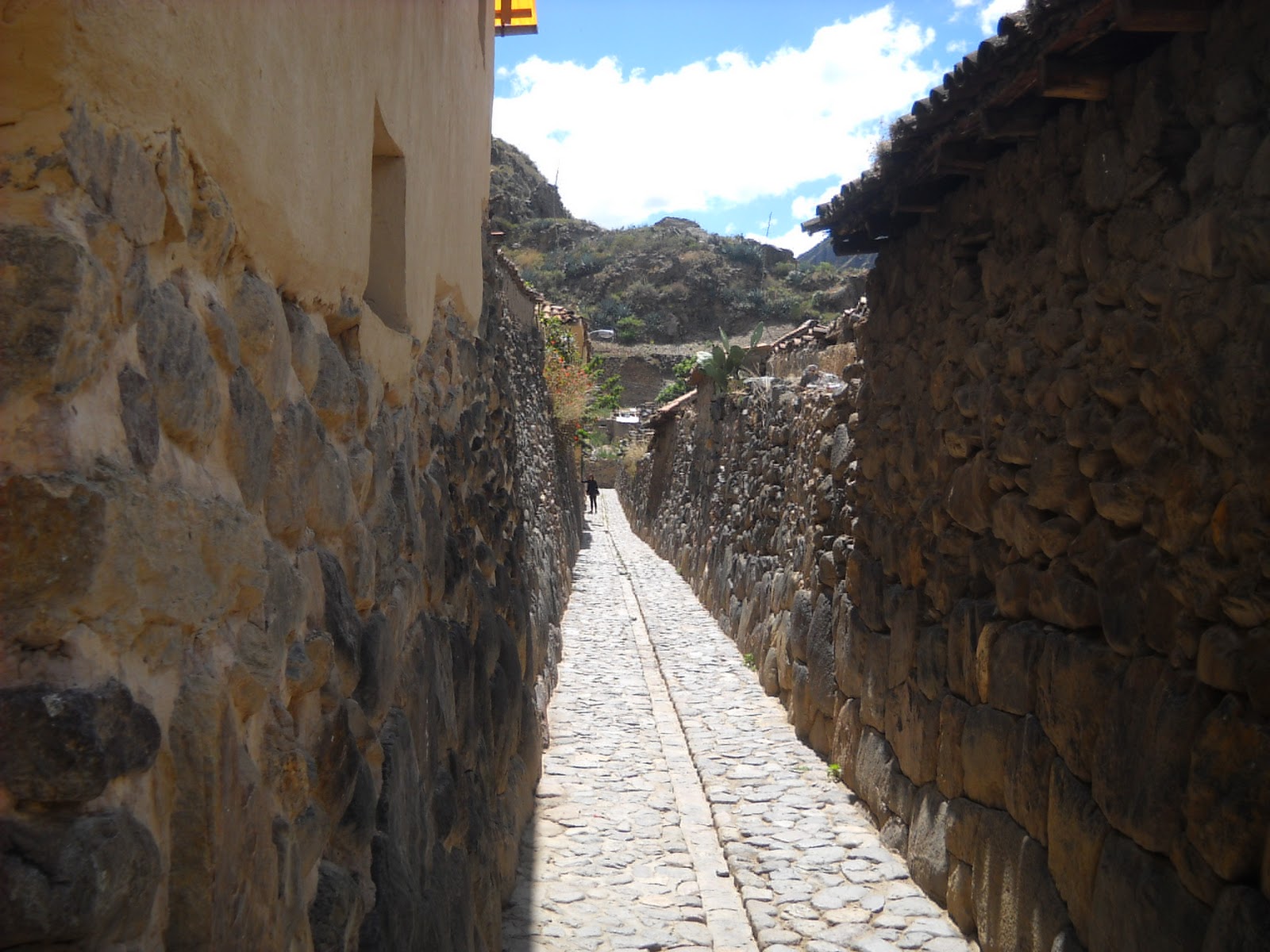
But I didn't go all the way to Ollantaytambo to have lunch. I went there to catch a train to Macchu Piccu, the only way to get there without walking. In town, this is pretty close to Main Street. It looks far nicer on the outside that what one encounters inside.


Another view of Main Street.

I looked up at the hillsides when I arrived, and there I saw what I think amounts to the Inca version of a retirement settlement for guys with bad knees.
If you click on the image you should see a settlement on the mountain side. This is but one of many seen from the town plaza. Here's a closer view.

I was still suffering from cramps due to elevation sickness, but my knee is so badly damaged now that I probably couldn't have made the hike anyway, so let us for now be happy with a picture.

I'll return in the next post with a bit more about Ollantaytambo and my train ride to Aguas Calientes, onward to Macchu Piccu. Till then, here's a Liderman, Manuel, a fellow who wandered around the riverside with me, pointing out ruins across the way, telling me a bit about his life, and looking pretty pleased with life, which he and I are happy to share here.


Hello, Manuel!

Urubamba: Onward to Machu Piccu

I took a train to Aguas Calientes, the hell-hole entrance to Macchu Piccu one cannot escape except by hiking the Inca Trail, which I am no longer capable of.Lots of younger people do it, and many my age as well, but not me. :(

I was stuck with taking the train to this nasty little place and by good fortune just happened to share a seat with a young couple and the boy's mother. What a lovely time that was. But before arriving at Aguas Caliente, and out of sequence here, I stopped at Urubamba, a little village where I had coffee at this lovely spot just like home.
If one goes downtown Cuzco and finds the local bus terminal, one finds a combi or a collectivo to Urubamba for about $0.50 U.S. I did that. I transfered later to Ollataytambo, another $0.85 or so to get to Aguas Caliente and on the train for Machu Piccu. At Urambamba I had coffee. I was going to have lunch but the place filled up with a family of over a dozen and I was forgotten. Though the coffee kept coming, my lunch never did. Such is life in the Los Angeles fast lane.


Monday, November 21, 2011

Delayed in posting on Machu Picchu

I´m on the move for a few days, and I don´t have a chance as yet to post my greetings to those people I met on the train trips to Machu Picchu and back. Please wait  a few more days, and I hope by then to have photos and text.

Tuesday, November 15, 2011

Cuzco Market

I come from a village in the mountains, a similar life to those in Cuzco than the life of those in a city the size of pretty much anything; and my little town depended in large part on tourism bringing in some new money. I like to think that I have some appreciation of tourists, they being not only money-bringers but those who have some curiosity that they act on for their own benefit, broadening the world of others upon return, perhaps. I have also seen towns and cities made mad in the mind because of Western tourists and their free-floating money, their tourist dollars seemingly there for the asking, for the demanding, for the grabbing and hollering and shouting and screaming and outpourings of hatred for those who are not buying, not paying, not spending. If tourists don't come to fling away their money like drunks in Las Vegas, why do they come at all? Tourists come to be seen as garbage people who are objects of deep hatred, as I have seen in some places to an extent I want to wipe out whole cities from the face of the earth. Greed is a terrible sickness. It makes me want to kill those who have it. It makes me a bad person to be among the greedy.


Greed can take hold of a community, a city, a whole nation and turn nasty people into vendor-Berserkers who lose all sight of humanness and who obsess about money at all costs. They aren't necessarily poor people trying to better themselves by taking from the undeserving rich. They are sick people who would terrorise anyone for the sake of gain. I have one particular nation and one people in mind as I write this, and I truly hate them. Against them I judge the people of Cuzco, Peru. I do not like this place. It does have some nice places to look at though. Here's one site on the way to the market I came to enjoy.
I had stupidly expected a small colonial town such as I have experienced in many places over the world, and I had thought this too would be a lovely place of culture and calm. My mistake.

Viva el Peru, as it says on the mountain side. This could be a lovely place.

There are, according to unofficial statistics, a million taxis taking two million tourists daily to ten million hotels, hospedajes, and hostels wedged between so many clip joints that my eyes blur as I walk down the streets. If you have limited time and nearly unlimited money, this is your place for organised ... I don't know what to call a tour bus full of people moving from place to place at the direction of others telling them trivia about the people and culture and place they are at this day. I miss a lot being an independent traveller, but I don't miss the hustle of professionals offering package deals. For those who don't have time to adjust, this is a good place. For me, no, it's no good at all. I have the time to be lost and sick and hungry and nervous. I have time to look at potatoes.
If you've seen one potato, you've seen them all. Except that there are a hundred varieties of potatoes here in Peru, from where they originated. Potatoes changed the course of history and made our Modern world possible. I love potatoes. I don't eat them often, but they are a wonder of our world, and that is what I love. I leave you to wait for one volume of my up-coming five volume book in which I write about potatoes. For now, a picture of beauty.
There is a market where (and I don't know where) I go for a bit of time away from all the things I hate about this place. It's a place to buy native potatoes; a place where I go to buy a sack of coca leaves from a squatting girl selling foul looking paste in a plastic bucket on the side walk out the side door, the girl who puts the coins inside her hat and runs down the street to get my tea leaves and brings it back to me; this being close to the ten by ten room with a squishy wet floor where for men it's 20 centavos to stand at a trough to use the urinario, a mirror running along side that the girl watches to make sure... well, who knows what she's watching for, and for 30 centavos-- because women take longer and thus have to pay more-- women can sit across from the men and do their thing. Paper is extra. 

I like the market. In the mornings I go for baked custard in a fountain glass, costing me about $0.50 or less. When I finish eating and flirting with the old lady behind the stand I go flirt with another old lady where I get two big mugs of coffee syrup and hot water (which I call coffee) for under a buck. Sometimes I get hot milk and chocolate syrup that I have to add a lot of sugar to, the chocolate being pretty bitter. Almost as good as the best,  I sit with my coffee and look across the aisle at stalls #740-726, all of them selling exotic potatoes in bulk.
In between the coffee lady and the potato people sits a lady in an aisle unto itself, she selling brown eggs, rolls of toilet paper, and red onions. She is, shall we say, stout. She might have three little girls, or one of them, or maybe she just hugs them and smiles and laughs and talks to them as equals because she is that kind of person. The lady who brings my morning coffee in this awful tourist hole is not what I would call pretty, but she has one very fine palm leaf stove-pipe hat that goes nicely with the two or three skirts she wears under a shawl. When she smiles, which is often, some of the wrinkles on her rather wide face disappear, and pretty or not, I want to lean over and kiss this lady. She is beautiful.


I thought about going to the Hilton Hotel for coffee, but I can't recall enjoying coffee in Cuzco in a place with windows. I like to sit and smell herbs cooking in hot oil and watch chickens turn waxy in the heat, and I like to look at the lady with the coffee when she smiles at me, her smile a broad expanse of nifty-looking gold teeth that sparkle like her eyes.

Once in a while I see an unhappy looking tourist wandering through, lost and hoping to buy some trinkets to take home as a keep-sake of being in Cuzco. They mill around gazing at so much gaudy stuff it would make most people nauseous, and they smile at vendors and speak to them like kindergarten teachers interviewed for their first job. You don't want a verbatim dialogue here. They are trying to be nice and to buy something memorable. I have bought stuff in Peru. I bought a sweater, a flag patch of the great nation-state of Georgia, a pair of scissors, an electric plug adaptor, and enough fabric to make a bag to replace the one I have that's ripping out at the bottom. I  bought shoe laces and a spare pair of eyeglasses. I've probably bought other stuff that I can't remember. I ain't no purist. I buy lots of stuff, but I have to carry it with me wherever I go, and the less the better. I have a couple of years on the road this time. I can't carry much for that time. I have to get to Africa, after all. So I sit and have coffee and chat up the vendors and wander around a bit and hate the hustle. I go outside the market and chat up people sitting in the sun. I look at things.
I sat chatting with a girl who is probably older than 12 and I had a conversation of a good sort with her boy, she holding him up and him blowing bubbles at me, which I returned in grand style. We bubbled as a woman of 20 and her five year old left the two year old girl by a sack at the market wall and then pretended to run off. It took a couple of tries because the little girl didn't notice mom and sis abandoning her the first time round. Then it was all laughter and wonder as they came back to claim her. It's simple and it's childish and I like it, like sitting down to have ice cream from a cart.

Murmurs from the heart to the mind whisper gently that this will be my last journey, no need now to worry about returning to the homeless life I could have back in my own village in my own mountains. I could have been like these folks if I had stayed home to do something in the tourist business or something. Instead I wander around. I go to the market and chat up folks.
I don't know what this place is called. [Actually, I do know.] If you come to Cuzco, you'll have to ask around. To me, this market's sort of called home. And then I leave.

Monday, November 14, 2011

Cuzco Parade

Everybody loves a parade, and especially if on is in it. I ran into this one as I moved from Party Central hostel in Cuzco to a quiet little place across the Plaza. Here I was taken with the ladies wearing hats. I like hats, believing as well that they make a statement to others about how one feels about others. A lovely hat says to me that the person wearing is has some respect for me and has gone to the trouble and expense of showing off in a pleasant way to make me and others glad to be around such a person. But there are numerous reasons for wearing a hat, many of them simply practical, one practicality being to show which group one belongs to. 


  1. Hats become part of a uniform, as does the carry-all blanket. Often times one will find a baby inside a blanket so slung. What's under the hat? Well, that's not really my business.


Sometimes a hat is the work of a year. If one looks closely one will see an inordinate amount of effort went into making such a hat. I must be misspelling the word, but I try it as "Boradoro." or fancy and weird hat making. Twice now I have met crazy people who who sew beads and such onto hats and capes and dresses and banners. Both eople, a man and a women, were probably insane. Neither could speak to me beyond a confused babble, and the last, a young woman, was frantically obsessed with her beads. But one has hats for it all.

The scene played out below, with hats, is a demonisation of Post-Columbians.  All in fun, of course.


And what could be more fun than to belong to a group, to wear a fancy hat, and to show that one is not one of 'them' whoever they might be. Cuzco. Lots of fun for tourists. I didn't like it much for some days, and then, suddenly, I didn't dislike it nearly so much, which is to say, I almost came to like it.

That's a whole nother picture, though.


Cuzco from afar


I got to Cuzco after a 26 hour bus trip from Lima. I didn't realise at the time, but I had a bad case of siroche, or altitude sickness. That's a first for me. This is what Cuzco looks like as one approaches from a very fine highway, a miracle of Modern engineering and human accomplishment.

I didn't like being in Cuzco. I'm not a glizty tourist kind of guy, and the hustlers on the sidewalks drove me mental. I was looking for a place where people live. This is some indication of that as we rode in on the bus, a few of my fellow passengers vomiting and others sick and in pain.
***
This is more or less how the locals live, which isn't bad if one considers that needs are more or less simple, and much of our Modern world is a perversion of such. Still, it is good to be 'rich' in the sense I am, and I expect that Peruvians await the day when they have everything moreso and nicer. Till then, this is the tourist haunt of Cuzco far from the tourists.

***

Thursday, November 10, 2011

The Blue Zone, Lima

Lima has a number of areas easily spotted because of the predominant colour scheme of the buildings. One of the rougher areas of town, the Cerro San Christobal, is seemingly pink. The area we see below is a little brighter. It has a multitude of music and musical instrument shops. Nice area. I bang the drum for the place.


This is in the centre of Lima, though that covers a lot of ground. I couldn't say that asking for the Blue Zone will get you any help, but it's how I know things. I live closer to the Yellow Zone.
 

This is not Hollywood or Las Vegas or New York or Miami but it does have its own version of CSI, Lima. 


****
For those who want a quiet place to sit and contemplate, there is a church inside the area, around some corners from the main round-about where one finds the buildings above. Note that the church, like so many places in Lima and Peru generally, is only partly painted. Still, it's a nice place to visit on a sunny late November day in the warmth of summer here. 


Mostly blue suits me fine. Lima is lovely this time of year.


Wednesday, November 09, 2011

An ordinary strange looking bird flew away

At the top of the stairs of my hotel there's a sliding metal gate that I tap a coin on to get the girl's attention at the desk so she will come round and let me in when I return from the day's doing and need to go home with my stuff, groceries and so on weighing me down and adding to the desire for a sit down and gaze at the misty sky, often, as I discovered, flecked with a fine dust from the desert that this city sits on. I see mist everywhere, the sky speckled with pigeons and over-sized crows that look like small vultures. As the girl opens the gate I climb in and go to the rooftop to catch the setting sun, not a sunset but a darkness descending on the city. From the rooftop the sliding door sounds rolling in its metal track like a distant roar of a crowd of football fans cheering. Another homecoming.

I pass by the stadium sometimes in the course of my day, but I don't involve myself with local affairs very often. It's not important to me whether the hometown team performs well or otherwise. I'm just passing through, and the team is not my concern.

Today I sat sipping coffee on the rooftop in the milky sunshine at my usual dust covered table and a grey pigeon landed nearby on the wall at the street side, his black wings sporting red polka-dots. That is new to me. A strange looking bird. Ordinary like all pigeons, but odd. The sun set and he flew away. Two cheers as the door opened and closed, and I was left sitting briefly in the coming chill.

Tuesday, November 08, 2011

No Cranes in Lima

I walked yesterday from central Lima to the sea, and having walked the length and breadth of the city, and having seen it from a hilltop at the far edge of the city, I think I can say I have seen it pretty well over-all, I have not see a single construction crane. There seems to be no building going on in the city at this time.

There is no building boom, and no building at all that I can see. Some people do private construction on houses, of course, but there are no office towers, no commercial centres, no massive industrial parks or high-tech centres that I can find a'coming.

Yet, the city is filled with people shopping, buying small things as a rule, but buying nonetheless, having at least enough money for food and shoes and taxi rides from the shops everywhere. Is it all cocaine money settling into the working class wallet?

The Peruvian economy grew by more than 4% per year during the period 2002-06, with a stable exchange rate and low inflation. Growth jumped to 9% per year in 2007 and 2008, driven by higher world prices for minerals and metals and the government's aggressive trade liberalization strategies, but then fell to less than 1% in 2009 in the face of the world recession and lower commodity export prices. Growth resumed in 2010 at nearly 8%, due partly to increased exports. Peru's rapid expansion has helped to reduce the national poverty rate by about 15% since 2002, though underemployment remains high; inflation has trended downward in 2009, to below the Central Bank's 1-3% target. Despite Peru's strong macroeconomic performance, overdependence on minerals and metals subjects the economy to fluctuations in world prices, and poor infrastructure precludes the spread of growth to Peru's non-coastal areas. Not all Peruvians therefore have shared in the benefits of growth and despite President GARCIA's pursuit of sound trade and macroeconomic policies, persistent inequality has cost him political support. Nevertheless, he remains committed to Peru's free-trade path. Since 2006, Peru has signed trade deals with the United States, Canada, Singapore, and China, concluded negotiations with the European Union, and begun trade talks with Korea, Japan, and others.

[....]

http://www.theodora.com/wfbcurrent/peru/peru_economy.html

I've been in places where people were starving to death. This is not one of them.

The economy of Peru is classified as upper middle income by the World Bank[10][11] Peru is, as of 2011, one of the world's fastest-growing economies owing to the economic boom experienced during the 2000s... and is the 42nd largest in the world.
http://en.wikipedia.org/wiki/Economy_of_Peru

This country is not booming economically at the moment, but it is a lovely place to be. On a scale of 1-10, this is a 7 to my mind, below Israel at 9 and above Greece at 6, Mexico at 3, and almost any park in a large city in the United States today at 1.

Yesterday was the first time in a month and a half that I had a guy try to sell me cocaine. He was a Bolivian, and a toothless grifter no matter where from. Compare that to Canada where life is nearly unbearable from all the petty crime, the social interference from leftards, and the miserable climate and Peru beats it by a scale of magnitude.