Wednesday, January 04, 2006

Yoots Attack 600 French on Train.

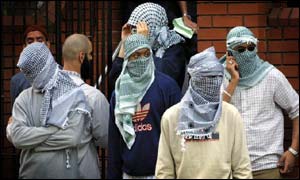
Happy New Year from France, where a gang of 20 to 30 "yoots" swarmed a commuter train and robbed, beat, and raped civilians in what is comparable to a major terrorist attack in Spain, England, or America. There are two accounts in French below, and one in English that happens to mention at the end that three of those involved were Moroccan. The rest? Well, likely Quakers. Said one Muslim to a French girl:

"We will kill you. You will croak."

Where is the media coverage of 600 people terrorized by Muslims? On blogs. We'll update this as we can.
****

Chirac vows to hunt down train gang

From correspondents in Paris

January 04, 2006 FRENCH President Jacques Chirac has vowed to bring to justice a gang that terrorised hundreds of train passengers in a long rampage of violence, robbery and sexual assault on New Year's Day.

The two hour criminal frenzy by between 20 and 30 youths was "totally unacceptable," he saidr.

"Those guilty will be found and punished as they deserve."

The gang boarded the train, bound from Nice on the French Riviera to Lyon, in eastern France, early on January 1, as it carried 600 passengers home from New Year's Eve partying overnight.

Once inside, they went wild, forcing passengers to hand over mobile telephones and wallets, and slashing seats and breaking windows.

A 20-year-old woman cornered by several of the marauders was sexually molested.

Train staff alerted police, and the train pulled into a station to wait.

The three officers who initially turned up had to wait for reinforcements before boarding, during which time the youths continued to cause trouble.

The train then resumed its journey with a heavy police presence aboard but, just before Marseille, the youths pulled the emergency stop and escaped by running along the tracks.

Only three - two 19-year-old Moroccans and a minor, all living in France - were arrested.
Both men were being held for robbery and one was also facing charges of sexual assault.

http://www.theaustralian.news.com.au/common/story_page/0,5744,17733327%255E1702,00.html
****

L'effroyable voyage des passagers du Nice-Lyon

Une bande de délinquants a terrorisé et dépouillé les passagers du train Nice-Lyon en gare des Arcs dans le Var le 1er janvier. Deux suspects ont été placés en détention provisoire à l'issue de leur comparution immédiate devant le tribunal correctionnel de Draguignan. La justice tentera de faire la lumière sur ces accusations le 6 mars prochain.

Créé le 03 janvier 2006
Mis à jour le 03 janvier 2006 à 22h08

Une vingtaine de jeunes gens au moins, dont trois seulement ont pu être interpellés, ont écumé un train Nice-Lyon en gare des Arcs (Var) le jour du Nouvel An, semant la terreur parmi les 600 passagers, dont certains ont été violentés et rançonnés.

Deux jeunes gens de 19 ans, soupçonnés d'avoir participé à cette équipée sauvage, ont été placés en détention provisoire à l'issue de leur comparution immédiate lundi devant le tribunal correctionnel de Draguignan, dans l'attente de leur procès, renvoyé au 6 mars. Les deux prévenus de nationalité marocaine devront répondre de vols en réunion et, en plus pour l'un des deux, d'atteinte sexuelle en réunion. L'un des deux serait en situation irrégulière sur le territoire, selon le parquet qui procédait à des vérifications. Un mineur, également arrêté, sera jugé séparément.

Billets à 1,20 euro

Il est 07H00 le 1er janvier: l'arrêt en gare des Arcs du train Nice-Lyon, prévu pour ne durer que quelques minutes, se transforme en scène de Far-West. A bord du train bondé, plusieurs bandes de jeunes, entre 20 et 30 personnes en tout, selon les témoins, sèment la terreur.

Selon les gendarmes, ils font partie d'un groupe d'une centaine de jeunes des Bouches-du-Rhône et du Vaucluse, descendus la veille réveillonner et faire la fête à Nice, Cannes et Fréjus, grâce au tarif spécial Nouvel An à 1,20 euro mis en place par la SNCF sur les lignes régionales.

Le lendemain, ils reprennent le premier Corail Nice-Lyon. Dès le départ de Nice, des incidents sont signalés. Des passagers sont dépouillés de leur téléphone portable. Des bousculades surviennent. Un couple de Parisiens de 25 ans est méthodiquement dépouillé de ses portefeuilles, cartes bancaires, téléphones portables. Prise à partie par tout un groupe, une jeune fille de 20 ans, domiciliée à Besançon, subit des violences sexuelles. "T'es mort. Tu vas crever!", lancent certains des agresseurs à l'encontre de passagers qui ont osé alerter des contrôleurs.

Apeurés, des voyageurs s'enferment dans les compartiments. "C'était une véritable scène de pillage du train", a raconté lundi à l'audience le procureur de Draguignan, Dominique Luiggi. Le chef contrôleur fait alors usage de son "droit de retrait", appelle les gendarmes, et prend la décision de stopper le train en gare des Arcs, estimant que la sécurité des passagers n'est plus assurée.

"Mouvements de panique"

Des gendarmes arrivent. Il ne sont que trois et doivent, de plus, attendre un dépôt de plainte formelle de la SNCF avant de monter à bord, d'où le délai de blocage en gare d'une heure et demie, explique Alain Wiart, directeur de la communication de la SNCF de la région PACA.

Pendant ce temps, les jeunes continuent leurs saccages: poubelles renversées, sièges et rideaux lacérés, vitres fendues. Des "mouvements de panique" sont observés parmi les 600 passagers du train, rapporte le procureur.

Trois jeunes, dont un mineur, sont alors interpellés en gare des Arcs. Il faudra l'intervention massive de renforts de diverses brigades de gendarmerie ainsi que de pelotons de surveillance et d'intervention de Draguignan et de Fréjus, qui montent à bord, pour que le train puisse repartir.

Peu avant l'arrivée en gare à Marseille, dans la confusion générale la plupart des jeunes toujours à bord, parviennent à s'échapper. Ils tirent le signal d'alarme et s'enfuient sur les voies, au péril de leur vie. Selon la SNCF, ce train avait bien fait l'objet d'un accompagnement par la police ferroviaire et un chien, mais seulement entre Nice et Saint-Raphaël. La SNCF a porté plainte pour vandalisme.

D'après AFP

http://news.tf1.fr/news/france/0,,3276662,00.html

****

PARIS (Reuters) - L'affaire du train Nice-Lyon, où quelque 600 passagers ont été terrorisés par des jeunes le 1er janvier, a tourné à la polémique politique mercredi, le Parti socialiste interpellant Jacques Chirac et Nicolas Sarkozy.

Le ministre de l'Intérieur, qui devait intervenir au 20h00 de TF1, a reçu en fin d'après-midi le P-DG de la SNCF, Louis Gallois, "pour tirer les leçons de ces incidents", a indiqué la place Beauvau dans un communiqué.

Signe d'une effervescence certaine, un second communiqué du ministère de l'Intérieur a rappelé qu'après celui de Paris, trois services régionaux de sécurisation des transports en commun avaient été créés à Marseille, Lyon et Lille depuis septembre 2005.

La SNCF a de son côté fait savoir que seules deux des dix voitures du train n°17430 avaient été dégradées, avec des portes cassées et des sièges lacérés et souillés.

Deux personnes ont été dépouillées de leurs portefeuilles et téléphones portables, "menacées verbalement mais sans violence physique", et une jeune femme majeure a été victime "d'attouchements à caractère sexuel", a précisé la SNCF.

Les incidents se sont produits en moins d'une demi-heure entre les gares de Saint-Raphaël et des Arcs, où les gendarmes sont intervenus et ont procédé à trois interpellations, dont celle d'une personne mineure.

Les deux jeunes majeurs ont été écroués en attendant leur comparution, le 6 mars prochain, devant le tribunal correctionnel de Draguignan.

D'autres incidents sont survenus peu avant l'entrée du train en gare de Marseille. "Se doutant qu'ils étaient attendus par la police, des jeunes ont tiré le signal d'alarme pour faire stopper le train et descendre sur le ballast. Certains ont jeté des pierres sur les voitures", a indiqué la SNCF, qui a déposé dimanche une plainte pour les agressions et une seconde pour vandalisme.

Des responsables des forces de l'ordre ont reconnu avoir escorté dimanche matin en gare de Nice et laissé partir une centaine de jeunes Marseillais venus fêter le réveillon sur la Côte d'Azur grâce au billet à 1,20 euro offert par la SNCF et la région PACA à l'occasion du Nouvel An.

LA GAUCHE ATTAQUE SUR LA SÉCURITÉ

A seize mois de la présidentielle, se souvenant sans doute de la campagne de la droite sur l'insécurité, qui avait fortement déstabilisé le socialiste Lionel Jospin, contribuant à son élimination dès le premier tour en 2002, l'opposition s'est emparée de cette affaire.

Le Parti socialiste a dénoncé "le silence assourdissant" de Nicolas Sarkozy. "Pourquoi ces faits d'une extrême gravité datant de dimanche ne sont révélés que trois jours après?", a-t-il demandé dans un communiqué.

Le premier secrétaire du PS, François Hollande, a interpellé Jacques Chirac et Nicolas Sarkozy sur ces agressions "d'une exceptionnelle gravité". Il a reproché au chef de l'Etat de se contenter de "dresser des constats d'impuissance" face au "durcissement" de la délinquance depuis quatre ans en France.

"Faut-il lui rappeler que son rôle n'est pas celui d'une autorité morale faite de compassion, de dénonciation ou de regrets, mais qu'il a fait campagne en 2002 sur l'insécurité et qu'il en est aujourd'hui à dresser des constats d'impuissance", a dit le numéro un du PS.

François Hollande a dénoncé "la défaillance du gouvernement" et raillé "les déclarations d'autosatisfaction des plus hautes autorités de l'Etat" en matière de délinquance.

Il a interpellé "directement" le ministre de l'Intérieur, à qui il a reproché d'avoir "tardé à donner l'information sur les faits eux-mêmes" et de vouloir faire "reposer sur la SNCF une responsabilité qui n'est pas la sienne".

Nicolas Sarkozy a déploré le manque de communication de la SNCF avec les forces de l'ordre et affirmé qu'il n'avait cherché ni à dissimulé ni à minimiser les agressions.

"Pour des raisons que j'ignore, la sécurité propre à la SNCF s'est arrêtée à un moment donné sans que les services de gendarmerie ou de police aient été prévenus", a-t-il dit.

"Le problème c'est que les services de sécurité ne savaient pas qu'il y avait une opération de promotion tarifaire de la SNCF" sur ce train, a dit le numéro deux du gouvernement.

Jacques Chirac, qui présentait ses voeux à la presse, a jugé "totalement inacceptables" les agressions qui ont été perpétrées dans le train et affirmé que les coupables seraient "recherchés et punis comme il se doit".

"Les forces de l'ordre et la SNCF doivent évidemment assurer la sécurité des voyageurs", a-t-il souligné.

http://www.boursier.com/vals/all/feed.asp?id=8405

Much Bull, Some Dozer

Presbyterians go choking bonkers when they see they're making money from investments in Caterpillar Corporation, the same company that Israelis get bulldozers from in their efforts to build a wall to keep terrorists from murdering civilians. The Presbyterians pull out of Caterpillar rather than taint their souls by profiting from dealing with those who deal with Israel. They're so fucking moral.

Rachel Corrie, air-head extraordinaire, also extra flattened, died when she tossed her idiot self in the path of an oncoming wall. Corrie's idiot parents, not smart enough to raise a child with the sense to survive, have now come close to being kidnapped by same victims of Israeli aggression, like the idiot Burton dhimmis. No doubt the Presbyterians, finding the Muslims easier to deal with than the Israelis will find some new and disgusting way to send more kids to their deaths to make themselves even more righteous in their own mirrors.

Below we have some bulldozer stories. One can only long for the day when Presbyterian churches are set alight in Gaza and all the dhimmi scum inside are cooked.
****

In other chaos,
Palestinian gunmen burst into a Rafah house early Wednesday and tried to kidnap the parents of Rachel Corrie, who was killed in 2003 as she protested the impending demolition of a house in the southern Gaza town, according to a witness.

The five gunmen appeared to be affiliated with the ruling Fatah movement, according to Samir Nasrallah, the Corries' host, though it was not clear if they were from the same group that blockaded the border. The gunmen eventually relented after being told who their targets were, he said.

Corrie was crushed to death by an Israeli bulldozer in 2003 as she tried to stop it from demolishing Nasrallah's house. Her parents, Craig and Cindy, have repeatedly visited Nasrallah since their daughter's death. They left Gaza safely after the attempted kidnapping, Nasrallah said.

By IBRAHIM BARZAK | Associated Press
January 4, 2006

RAFAH, Gaza Strip - Palestinian militants, angry at the jailing of their leader by the Palestinian police, stole two bulldozers Wednesday and rammed through a wall near the border with Egypt, hours after they blocked the official border crossing and took over government buildings.

The gunmen, who belong to the Al Aqsa Martyrs' Brigades, a violent offshoot of Palestinian leader Mahmoud Abbas' Fatah Party, rammed through massive wall as a show of force against the Palestinian Authority. They had not yet breached a second wall that is directly on the border with Egypt, according to an Associated Press photographer there.

The militants' rampage through the southern Gaza town of Rafah underscored the growing lawlessness in Palestinian towns, especially in Gaza. Abbas, who has condemned the chaos, has been unable to impose order, and his failure to keep the gunmen in check is expected to harm Fatah's prospects in Jan. 25 parliament elections.

Fatah-affiliated vigilantes demanding government jobs or the release of imprisoned friends have been responsible for much of the anarchy, particularly since Israel's pullout from Gaza in September.

The tightly run Islamic militant Hamas, whose followers have rarely been involved in vigilante violence, is expected to do well in the vote against the corruption-tainted Fatah.

The rampage began late Tuesday, when Palestinian intelligence arrested Alaa al-Hams, an Al Aqsa militant, on suspicion he and his followers kidnapped human rights activist Kate Burton and her parents for two days last week. The Burtons were among 19 foreigners abducted by Fatah gunmen in Gaza in recent months. All have been freed unharmed.

Al-Hams followers then fired at the Palestinian security headquarters in the southern town of Rafah where he was held. Police and gunmen fired in the air, but there were no injuries.

On Wednesday morning, some 40 masked gunmen took over the central election office in Rafah, the local branch of the Palestinian parliament, a court and another government building. Gunmen were seen on rooftops, inside the buildings and posted at the main doors. Most workers fled the buildings.

A truckload of gunmen then drove to the nearby Rafah border crossing with Egypt, Gaza's main gate to the world.

Firing in the air, they closed the entrance gate to the crossing compound and told waiting passengers to leave the area. They also set up an impromptu checkpoint at the access road to the crossing, turning away travelers.

They left the buildings and the crossing after three hours.

But hours later, with al-Hams still in jail, the militants stole two bulldozers in Rafah and led an impromptu parade of hundreds of jubilant residents toward a massive wall a few hundred meters from the border. Five militants rode in the shovel of one bulldozer, while children held onto the back of the vehicle.

"We are going to do everything we can to pressure the Authority to release our leader," said an Al Aqsa leader who gave his name as Abu Hassan.

The bulldozers smashed two holes in the large wall at the same spot where Hamas militants had blasted through the towering concrete barrier during the border chaos that followed Israel's Gaza pullout. Palestinian security officials had closed the earlier hole with a patch of heavy concrete blocks, but those quickly gave way before the bulldozer's shovel Wednesday.

Hundreds of Palestinians swarmed into the Philadelphi border corridor as militants shot in the air.

"Many people walked through. The Palestinian police can't stop them," said Fawzi Shaheen, a 26-year old Rafah resident who ran toward the border.

Egyptian tanks and dozens of soldiers _ some of whom fired in the air themselves _ prevented the Palestinians from jumping the small wall, which marks the official border, on the other side of the corridor, according to journalists there. Palestinian youth retaliated by throwing stones.

The Rafah crossing was handed to Palestinian control, under European supervision, as part of a U.S.-brokered deal with Israel last month. Since then, the crossing was forced to shut down several times during attacks by gunmen.

Salima Abu Maghaseeb, 42, said she was angry over the disruption of her plans to travel to Egypt with her daughter for her daughter's wedding later in the week.

"I don't know why the Palestinian Authority is allowing them to do this," said Abu Maghaseeb, who had her documents checked at the impromptu roadblock. "Those people should use their guns ... to protect people and not to come and terrify us. They can go to the border and clash with the Israelis. God only knows what the future holds for Gaza."

A spokesman for the European observers, Julio de la Guardia, said the disruptions outside the crossing was an internal Palestinian matter. "Our functioning at the border crossing has not been disturbed," he said.
http://www.freenewmexican.com/news/37270.html

****

Palestinians are garbage people. They are the trash of the Human race. They should all be locked up in lunatic asylums till they die. And they should have Presbyterians for company. The lot of these scums should all commit suicide and leave the rest of us to enjoy our lives in peace. If they won't, then one can only hope someone will help them along.
****

Thousands of Egyptian Interior Ministry troops swarmed the border, firing tear gas and shooting into the air. An Egyptian armored vehicle was set ablaze and a witness said three Palestinians were injured - one seriously, when a troop carrier crushed him against a wall. http://www.forbes.com/work/feeds/ap/2006/01/04/ap2427708.html
****

Christmas Solidarity: Activists, Media and Churches Unite with Palestinian People and Boycott Apartheid Israel

Worldwide Activism, Palestinian Anti-Apartheid Wall Campaign, December 28th, 2005

Christmas celebrations around the world were this year used by solidarity activists to remind the public of the dramatic and ongoing ghettoization of Bethlehem and the rest of Palestine. Journalists wrote countless features describing the imprisonment of Palestinians in Bethlehem, and Church leaders used their Christmas sermons and services to call for justice for the Palestinian people and to urge international solidarity with those under Occupation and imprisoned behind the Apartheid Wall.

In Oslo, the Norwegian Boycott Campaign distributed Spanish and Moroccan clementines and oranges as "Christmas presents" to festive shoppers in order to highlight just how easy it is to find alternatives and boycott Apartheid Israel. 50 kilos of clementines were handed out, together with boycott leaflets to an overwhelmingly supportive Norwegian public.

As Palestinians in the city of Bethlehem prepared for the annual Christmas services at the Church of the Nativity, Christian leaders drew particular attention to the current suffering of the city that is the traditional focus of global Christmas celebrations.

The international catholic grassroots movement Pax Christi organised visits to Bethlehem for the sixth successive Christmas. Representatives of Pax Christi presented Palestinian groups in Bethlehem with Christmas messages of support from hundreds of Christians and churches worldwide condemning the Wall, land theft and the brutal Occupation.

Catholic leaders in Jerusalem itself denounced the Occupation and described Bethlehem and the rest of the West Bank as an "immense prison".

In London, the Archbishop of Westminster – the leader of the Catholic Church in England and Wales – urged people to visit Bethlehem to resist what he described as the Occupation's "blockade". Describing the inhabitants of the city as "terribly alone" and "trapped in" behind the Wall and Occupation checkpoints, Cardinal Cormac Murphy-O'Connor used his Midnight Mass sermon – one of the biggest of the year – to demand, "Let Bethlehem be what it is meant to be: a free and open city."

A movement called Churches Together In Britain and Ireland (CTBI) – incorporating churches across the full spectrum of denominations including Catholic, Orthodox, Anglican, Pentecostal and more – denounced the Occupation and the Wall in a specially issued Christmas statement. Describing Bethlehem as a virtual prison for 160,000 people, and condemning the closure of the historic Bethlehem-Jerusalem road to the great majority of Palestinians, CTBI described the Wall there as "a grave injustice to its people, a serious threat to its economic life and social fabric, and an affront to all Christians."

The spirit of solidarity and resistance was also present in other traditional Christmas events. In Oxford, Cardiff, London and many more cities across the UK, activists held "Alternative Christmas Carol Services" accompanying traditional carol singing with songs of resistance to the Occupation. The carol singers also handed out leaflets and posters drawing attention to the injustices of the Occupation.

Bethlehem is increasingly becoming one of the areas of the West Bank worst hit by the continued expansion of the Apartheid Wall. More than 20,000 Palestinians in the Bethlehem district will be isolated behind the Wall and villages such as Nahhalin, Battir, Hussan and Wadi Fukin will find themselves imprisoned. The Wall slices right through the heart of the city of Bethlehem itself, passing just streets away from the Church of the Nativity and Manger Square and completely sealing off and annexing Rachel's Tomb to the Occupation.
stopthewall.org/latestnews/948.shtml

Tuesday, January 03, 2006

Sarko en Blog


Bloggers might be lying incompetents with no credibility but that puts them right up there with the MSM if it's true. The weasels in the mainstream media are so full of their supposed self-importance, which even they can't believe in anymore unless they're held hostage by Presbyterian dhimmis and get their pretty faces on TV to see themselves in all their idiot glory, that fewer people every day are even pretending to take them seriously. Politicians lie for a living. We all know that. And more and more people are coming to realise that the MSM lies for a living too. More people all the time now choose to compare the varied works of bloggers to make some sense out of what the world is about. Yes, even politicians are understanding how irrelevant the MSM is becoming. The conformity weasels can find work as department store mannequins when the whole commercial media edifice crashes.
****

Mon Dieu
, A Media Breakthrough
Presidential hopeful Nicolas Sarkozy is the first to make his pitch in a podcast

Nicolas Sarkozy, the law-and-order Interior Minister who wants to be France's next President, rarely passes up a chance to speak before an audience. So when Loïc Le Meur, one of the country's most widely read bloggers, approached him about doing a podcast interview, the answer was mais oui.

The Dec. 22 interview has created a sensation in the French blogosophere. It has attracted more than 50,000 views on Le Meur's blog, www.loiclemeur.com, and has been picked up by scores of other French blogs. True, that's a small audience compared with the millions that tune in to the nightly TV newscasts. But in France, the Sarkozy podcast -- the first ever by a French political leader -- qualified as a watershed event. Equally startling to the French, Sarkozy and Le Meur broke with customary etiquette by addressing each other with the familiar "tu" rather than "vous" during their meeting. Hundreds of viewers have posted messages on Le Meur's site in recent days, showing that French politicians can no longer ignore the growing importance of nontraditional media (BW -- July 11).

Still, the interview in the Interior Ministry's elegantly appointed drawing room didn't generate any headline news. Le Meur and Sarkozy chatted amiably about the Internet and podcasting, and Sarkozy described how, as head of the ruling Union for a Popular Majority, he has used e-mail appeals to boost party membership. On a more controversial subject, Sarkozy defended his handling of the recent rioting in the suburbs of Paris and other cities. Critics have said that Sarkozy's tough policing methods stirred unrest among minorities and that he spurred more violence when he referred to rioters as "rabble."

Le Meur says some journalists have criticized him for going too easy on Sarkozy. But, he says: "I didn't want to be confrontational. I did this mainly for my own enjoyment and to learn more myself." .... Although he admits he has little expertise in either journalism or politics, Le Meur says many French journalists have lost objectivity in their coverage of Sarkozy. A recent interview with him in the left-wing newspaper Libération, for example, included the question: "Weren't you ashamed of the way you responded to the riots?"
http://www.businessweek.com/magazine/content/06_02/b3966059.htm
****

In time more and more bloggers will find themselves subject to politicians begging for interviews because no one bothers with television and newspapers. In fact, if George's secretary calls my secretary I think I can find a few minutes for him next week. Jacques, sorry, mon ami, you're out of luck.

Metaphor, Authority, and the Moral (2)

Dead, every one of them, and for what? Hundreds of years of criminal lunacy carried out for the sake of personal vanity, for the sake of lust, for greed and glory, and today the world stands aghast, disgusted permanently, sickened by the exploits of the few who corrupted an institution to the core, an infection that rotted the idea beyond redemption in the eyes of the many. So few, and yet the lasting destruction they caused is seen as nearly universal in the eyes of man. These criminals were the Popes of the Catholic Church. They are dead, and they have destroyed the church in the course of their lives.

What do sickening Catholic popes and Protestant reformers in the Middle ages and their push for universal literacy have to do with 21st century jihad? We argue that the lot of them are responsible of the destruction of the concept of universal morality. We argue that the popes are the cause of our current malaise, that the concept of morality is now so vitiated by the evils of the Catholic Church that most people turn in disgust from the very thought of organized religion, from the concept of God, and from the thought of universal morality itself, leaving only ethical behaviour based on contingency and prudence, on opportunism and personality in its place. The collapse of the moral, the destruction of the general view of morality and of the moral of our story as living creatures with a purpose, that is all but destroyed in the minds of men, annihilated by the evils of the few.

Of the Protestant reformers, of Luther and Calvin, we have nothing good to report of them. Religion is disgraced in the eyes of men because of the likes of them. Below we'll look at a brief and simple outline of some Catholic history. It's a mere sketch of part of the history that leads us to today's amoral cultural and emotional nihilism. Why do we live with multiculturalism? Why do we prise philobarbarism? Why do we consider Islam to be the religion of peace? Why do we tolerate evil in its obvious manifestations and find ourselves incapable of discussing it as such? Worse, how do we come to terms with the evil when we have no moral ground to stand on ourselves? How can we condemn evil in others if we are evil ourselves? What makes the life of a man worth more than that of a chicken? And how do we prove anything? What is our authority to do so? What is our moral? Why do we even bother living at all? How can we condemn Islam if we ourselves have nothing better to offer and no authority to object to its evils in the world? Why shouldn't we just give up and die?

We have lost the immediacy of our past moral authority. We can thank the likes of Boniface VIII and Cotton Mather for that. The evils they committed shame the universe of man. No right person can associate with them, and therefore, our morality is shamed and dishonoured beyond redemption. The revulsion we feel is so deep in our minds that we needn't even know the details of these creatures to know we are ashamed. Christianity is seen-- is felt in the soul-- to be evil. And what is left for us?

The Middle Ages in the West, a time known to the general public in the West today as the worst of times, were indeed bad in many respects compared to our lives in our days; but let's get some perspective before we condemn the period as simply a thousand years without a bath. There has to be more, a strain of thought and feeling that is better than what we assume is the total evil of the times.

Looking at our past can show us where we are today. Today, according to me, we are in a mire of secular gnosticism. We cannot fight the evils of Islam if we hate ourselves and our Modernity. We cannot win a fight we feel is worthless. We cannot know the good if we believe there is none. Below we'll see why we have come to our age of moral cynicism and gnostic hatred of morality itself.

In our next post we'll look again more closely at the gnostic fascism of our time. For now, we see Catholicism at its worst.
****

The Church in Moral Crisis: Prelude to the Reformation

Though most students would have some knowledge of the great schism between East and West, few are aware of the historical rifts that occurred within the Roman church between the 13th and 15th centuries. Religious life suffered as a consequence of the schism, for "Christendom looked upon the scandal helpless and depressed, and yet impotent to remove it. With two sections of Christendom each declaring the other lost, each cursing and denouncing the other, men soberly asked who was saved" (Flick, 1930: 293). Doubt and confusion caused many to question the legitimacy and true holiness of the church as an institution. In the West, the excesses that affected the church ultimately called for radical reform through that movement which we now identify with the Protestant Reformation.

This period of moral decline was instrumental in leading to a Western Schism within Christendom, in which three Popes and anti-Popes concurrently contested control over the See of Peter. The popes refused to convene councils to effect reform, and they failed to bring about reform themselves, rather busying themselves with Italian politics and being patrons of the arts. "Thus the papacy emerged as something between an Italian city-state and a European power, without forgetting at the same time the claim to be the vice-regent of Christ. The pope often could not make up his own mind whether he was the successor of Peter or of Caesar. Such vacillation had much to do with the rise and success... of the Reformation" (Bainton, 1952: 15). By the mid-fifteenth century the Church was in urgent need of drastic reform which, when effected, would have lasting impact on the religious and secular history of Europe.

At the death of Nicholas IV in 1292 there was a deadlock in the sacred college of Cardinals which was to last for twenty-seven months before his successor could be elected. The two ruling factions in Italian politics were represented by the powerful Orsini and Colonna families who vied for control of the Papacy. At this time there were only nine cardinals left in that college, three giving their allegiance to the Orsinis, three to the Colonna family, and three were seemingly independent. Pope Nicholas had been an Orsini and they would not accept the loss of papal control. The Colonnas were determined to take it away from them, and they put pressure on the three remaining independent cardinals who were unwilling to offend either family, both of whom had a history of murder and assassination throughout the streets of Rome.

The cardinals squabbled over who should be elected Pope until the plague came to Rome in early in 1294, forcing them to withdraw to the mountains of Perugia in central Italy, still deadlocked. One of the non-partisan cardinals was Cardinal Gaetani who was considered to be a great canon lawyer. He was a cold, calculating, corpulent man with the determination of an assassin. To break the deadlock in his own insidious way, Gaetani told the senior cardinal present, Latino Malabranca, the Cardinal of Ostia that he had received a prophetic letter from a holy eccentric hermit, Peter of Morone, which predicted the punishment of God upon all of them if a Pope were not soon elected.

Malabranca, who was intensely superstitious, took the forgery which Gaetani had given to him with devout seriousness. On the 5th July 1294, after prayful contemplation, he called the handful of cardinals together and read them the letter which he believed had come from the holy hermit. He became so carried away by his own eloquence and his own convictions that he proposed that the hermit Peter of Morone be elected the next Pope. The deadlock was broken by the logic of demonstrating to Colonna and Orsini alike that neither of them needed to prevent the other from winning.

Neither the Colonnas nor the Orsinis bothered to journey to Abruzzi to meet the new Pope, to kiss his feet as every tradition of the sacred college required. However Cardinal Gaetani did pay his homage, taking with him the King of Naples and an enormous following of ordinary people:

In a bleak cave in the Abruzzi mountains, Gaetani told the holy hermit that he had been made Vicar of Christ on earth. The confused frightened old man, who had never seen so many people in his life, nodded to the statement because Gaetani had bellowed at him from that great height, in those rich and beautiful scarlet robes covering the barrel chest and hogshead belly, commanding that Peter now nod his head to signify his acceptance of God's glory. Emaciated, hardly understanding Latin, much less the condition, Peter accepted the rulership of Christendom filled with mortal terror because he would have to leave his cave. He refused to go to Rome. He would rule from Naples. At Gaetani's suggestion, he chose the name Celestine V. From that day forward, Gaetani served the Pope as his lawyer and soothed him by creating a replica of the hermit's mountain cell in the castle Nuovo, which had become the Lateran palace of Naples (Condon, 1984: 24).

Cardinal Gaetani began systematically to ingratiate himself with Celestine - and finally convinced the confused and befuddled pontiff that God really wanted him to resign from the papacy. Fearing that unless he abdicated he would lose his immortal soul, Celestine agreed, and announced his renunciation to his cardinals. Gaetani was elected to the papacy ten days later as the compromise candidate, consecrated and crowned at St. Peter's in Rome, taking the name of Boniface VIII. His first act as Pope was to order the arrest of Celestine, whom he sentenced to death.

As a cardinal Gaetani had acquired rich cities and adjoining territories - and as Pontiff Boniface continued to amass wealth and power which was to bring him into direct confrontation with the Colonnas, who ruled their territory from the hilltop city of Palestrina, twenty-two miles east of Rome. The Colonnas tried to instigate a revolt against the Pontiff by claiming that Boniface's election was invalid as he had usurped power that rightly belonged to Celestine. At the same time, Stephen Colonna attacked and plundered the Pope's gold which was being sent to Caserta to buy yet another city for the Gaetani dynasty. Boniface, blind with fury, threw two of the Colonna cardinals into prison.

The Colonna offered to return the gold but Boniface wanted not only revenge on Stephen Colonna but also the Colonnas' destruction by installing garrisons inside the Colonna cities. This option was totally unacceptable to the Colonna and the next day, Colonna messengers posted manifestos attacking the legitimacy of Boniface's election all over Rome, leaving one tacked to the high altar of St. Peter's. In response, Boniface issued a papal bull, In Excelso Throno, which charged the two imprisoned Colonna cardinals with heresy, excommunicated them and every member of the family. Boniface then announced a religious crusade against the Colonna, using money from all over Europe which had been intended to finance the Crusades in the Holy Land to buy the Knights Templar to crush the Colonna strongholds. An order went out that the Colonna women and children were to be killed or sold into slavery. With the help of his mercenary army, by 1299 all the Colonna cities had been captured. Palestrina was completely razed to the ground, and the Colonna family went to France in exile where they were given refuge by French nobility.

Boniface's fury turned against the French monarch and he forbade him to tax the French clergy. The French king reacted vehemently, and he in turn forbade the export of all money to the Pope. The king prohibited foreigners from living in France, which excluded members of the curia:

Warming to his task, he called an estates-general to charge the Pope with infidelity, loss of the Holy Land, the murder of Celestine V, heresy, fornication, simony, sodomy, sorcery, and idolatry in a list of twenty-nine charges - all of them the sort employed when some faction wants to rid the Church of a Pope, many of them quite valid. The only weapon Boniface had was the solemn excommunication of the King of France, which would release the French people from their allegiance to the king. The publication of this fatal bull was planned for 8 September, 1303 from Agnani, the Pope's summer palace (Condon, 1984: 26).

The bull had to be stopped at any cost. The king sent 2000 troops into Italy under the leadership of Sciarra Colonna into Italy to storm Agnani, Boniface's family stronghold, with the orders to capture Boniface and bring him to France for judgement. Under treachery, Colonna gained access with his troops and with drawn sword, Colonna found the eighty year old pontiff seated on his throne dressed in his pontifical regalia, with the three-tiered tiara on his head, cross in one hand and keys to St. Peter's in the other. Mockingly, Sciarra Colonna ordered his men to strip Boniface naked. Sciarra pressed the tiara down Boniface's eyes, knocked him down, had his men drag him by the feet across down a granite stairway. He was then thrown into a narrow, dark prison where he was beaten, and as a final indignity Sciarra ordered his soldiers to urinate on him. Two nights later, supporters of the Pontiff were able to repel the French and rescued Boniface. But the ill-treatment meted out to him was too much; in sick and debilitated health, he commenced his journey back to the Vatican which he reached on 18 September. There he was to die twenty-four days later.

One of the more important and telling pronouncements of Pope Boniface VIII had been written to Philip IV of France in 1302. It was named Unam Sanctam and is one of the most extreme and arrogant statements of papal superiority over spiritual and temporal matters and gives us an significant insight into the prevalent model of Church at this time of ecclesial history. Read the following and fascinating extract from Unam Sanctam and reflect on the paradigm of Church that existed at the turn of the 14th century :

We are compelled, our faith urging us, to believe and to hold - and we do firmly believe and simply confess - that there is one holy catholic and apostolic church, outside of which there is neither salvation nor remission of sins.... Both swords, the spiritual and the material, therefore, are in the power of the church; the one, indeed, to be wielded for the church, the other by the church; the one by the hand of the priest, the other by the hand of kings and knights, but at the will and sufferance of the priest. One sword, moreover, ought to be under the other, and the temporal authority to be subjected to the spiritual. For when the apostle says "there is no power but God, and the powers that are of God are ordained," they would not be ordained unless sword were under sword and the lesser one, as it were, were led by the other to great deeds. Whoever, therefore, resists this power thus ordained by God, resists the ordination of God, unless he makes believe, like the Manichean, that there are two beginnings. This we consider false and heretical,.... Indeed we declare, announce and define, that it is altogther necessary to salvation for every human creature to be subject to the Roman pontiff. The Lateran, Nov. 14, in our 8th year. As a perpetual memorial of this matter. (Ernest F. Henderson, 1912: 435-37).

After Boniface's death, the new Pope, Benedict X, did not last long, dying within ten months of his election. After many months of intense bargaining Bertrand de Got, Archbishop of Bordeaux and a confidant of the king of France, was elected. This Frenchman, who took the name Clement V, was never to set his foot on Italian soil; he was crowned in Lyons in November 1305 and finally in 1309 settled in Avignon which became the papal court from which the Pope and his Curia ruled. Clement was to be succeeded by six French Popes who, at the resolution of the French king, remained in France. For the next sixty-eight years the seat of ecclesial power was to remain in Avignon, not returning to Rome till 1377 during the pontificate of Gregory VI, who died through apparent poisoning.

The Italians were desperate to retain the papacy within Italy, and threatened the lives of the sixteen cardinals gathered in Rome to elect Gregory's successor. Italy had become impoverished since the papacy had moved to Avignon, with monies from about two million tourists going to the French since Clement's election. Feeling under pressure the conclave chose the safest Pope - Archbishop Bartolomeo Prigano of Bari, a Neapolitan who had been vice chancellor at the University of Avignon. Prigano took the name of Urban VI.

His autocratic manner coupled with an unbalanced personality was to lead to his downfall. He proved himself to be highly unpopular and the cardinals, now in safe territory, met and declared the election to be null and void on the ground that they had been coerced into electing him in fear of the violence of the Roman mob:

It seems hard to believe but they elected in his place a brute named
Robert, Cardinal of Geneva - he who was called the Butcher of Cesena because he had ordered his troops to put 3000 women and children to the sword when they objected to the rape of sixty women by his transient soldiers. The Butcher took the name of Clement VII, whereupon Urban VI excommunicated him; then he excommunicated Urban, and the great schism of the Church had begun. There were two Popes who ruled Christendom simultaneously: Urban in Rome, Clement at Avignon. The Cossa family's advocate, Piero Tomacelli, succeeded Urban as Boniface IX (Condon, 1984: 29).

It took considerable monies to keep the bureaucracy of the Church functioning, so Boniface tried to strengthen the Roman Church by selling various ecclesial offices and benefices, particularly special indulgences during Jubilee years. He gained enormous wealth from the Jubilees of 1390 and 1400, and under his pontificate simony reached its great climax through the sale of indulgences. Boniface rapaciously piled tax upon tax, graft upon graft, simony upon simony, taxing the patrons, papal states and properties, and requiring substantial fees from those elected to political or ecclesial office. Everything that was secular or religious was for sale, and ultimately it was out of this worldly environment that urgent calls came for reformation and church renewal.

The REFORMATION of the 15th and 16th CENTURIES

One of the dogmas of the Roman Catholic Church states that the Church is always in a state of renewal (Ecclesia semper reformanda est). From the twelfth century onwards, we note the resurgence of various groups calling for radical changes within the practices of Christian worship. Through your own investigations, you may wish to explore the relationships between them and the established church. In what way did the Cathars, the Albigensians, the Waldensians, and others try to correct the ills of the Church? Why did they fail, and end up condemned by the "official" Church?

The age saw the introduction of the Inquisition, which acted as a protective arm ensuring the supremacy and purity of the 'official' teachings against the radicalism of these primitive reformers. It is interesting to note that Augustine in the 4th century had approved the use of torture in specific cases where the salvation of souls was concerned. His rationale was based on the premise that if secular powers used torture for mere temporal gains, then how more justified would the church be to use brutality for the sake of salvation! Such also was the rationale used by the founders of the most infamous of the Church's agencies of control. Through the establishment of the Inquisition, at the dawn of the Reformation the Church protected its own temporal and spiritual supremacy.

They all lived in the same epoch of the 15th and 16th century, and through their inventive genius, courage and political skill they were to make a unique and lasting impact on the spiritual, geographical, scientific, as well as political and ecclesial horizons of their time. You may wish to explore the state of leadership in church and state at this time: the debauchery of the Borgias culminating in the reign of the profligate Pope Alexander VI; the conquests and concerns of the warrior Pope, Julius II (who somehow has won strange exoneration in history through his patronage of Michaelangelo), the iron-willed Pontiffs of the Counter-Reformation, Paul IV, Pius IV, and Pius V. It was a time when Italians monopolized European banking, and money transformed values, ecclesial and secular, even celebrated in medieval poetry:

Money makes the man, Money makes the stupid pass for bright... Money buys the pleasure-giving women, Money keeps the soul in bliss, The world and fortune being ruled by it, Which even opens, if you want, the doors of paradise. So wise he seems to me who piles up What more than any other virtue Conquers gloom and leavens the whole spirit (Lauro Martines, 1979: 83).

Below I have indicated the key personalities that influenced political and ecclesial history events during the fifteenth and sixteenth centuries. It was also a period of headstrong political leadership unafraid to challenge the power of the Rome weakened by inept and corrupt leadership. Some, like Henry VIII (1509-1547) and Elizabeth I (1558-1603), stood in heretical opposition to Rome for a variety of personal as well as political motives. Others, like Philip II (1555-1598), Ferdinand I (1556-1564) and Christian III (1536-1559), allied themselves to Rome against the voices of Reformation. By 1565 Europe was to be rent by cataclysmic religious wars costing the lives of hundreds of thousands, tearing the religious and political harmony of Europe apart.

The age of Reformation had begun with a promise of new hope and new vision - and this is still reflected in the middle years of Erasmus of Rotterdam. Yet this period of history belongs to three men of diverse personality, religious conviction, and action: Martin Luther (1483-1546), Zwingli (1484-1556) and Calvin (1509-1564). Through their work and efforts, the history of the church was to take a direction which ultimately was to witness the political disintegration of the bilateral duality of church and state.

Although every school child has learnt that: "In 1492, Columbus sailed the ocean blue" and discovered the New World, not too many children have learnt that it was also the same year in which the infamous Borgia Pope, Alexander VI, ascended the papal throne.

http://dlibrary.acu.edu.au/staffhome/yukoszarycz/ecc/MOD6.HTML
****

The Catholic Church destroyed the concepts of morality and of universal religion for many people in our day. We live in a state of horror and cynicism. We have become gnostics. We have become so because of literacy. We have lost our souls because of Tyndale and Gutenberg. Thank God for it! Atheists can now find a true path to morality of universal authority through metaphors previously unimagined.

Monday, January 02, 2006

Metaphor, Authority, and the Moral


The way we know the thing is not the thing in itself but is a metaphoric experience of it. We can know by direct experience only our own minds. The question is what our own minds are, what content therein is of our own making and not the input of outside influence. How truly are we our own beings? We are flooded with information, saturated with it, bloated with it. Gagging on it. Choking. Gasping. Drowning in information.


What is true and what is mere nonsense? And of the true, what is really important? How can we tell the difference? We can't know most things directly. At best we can conjure up metaphors to make sense of reality as we experience it. Is it even close to true? Not likely. Is it useful in our physical existence? Sometimes. We don't often get run over by automobiles if we rely on our sense perceptions. But we don't know automobiles in any deep sense. Not that it matters. What we might know is the kind, the colour, the shape, the physical properties of an automobile, and we might know the social categories of such a thing. But we don't know any great truth from knowing automobiles nor from knowing metallurgy or mechanics. All the math and all the abstract labour that one requires to own a created auto never really makes a person a better person. It's just more information. It's facility with more metaphors. In that sense, the more we know the less we know.

There are those who believe that one can know God directly. Some argue that knowing anything depends on the will of God to maintain reality as it seems to be, and that all that we know is God's projection. The knowledge we have then would be as direct as one could hope for. For the rest of us there is only the metaphorical. Without the authority of God backing up our empirical gold standard of reality, wherefrom do we derive the authority to make any claims to the veracity of our claims to knowledge? What makes my claim that x is x any better than a counter claim that x is y? What authority do I have? I ain't no Muslim, and I don't give a damn for the Koran. So where does my opinion about anything gain any legitimacy? I'm possibly talking through my hat if I make any claims at all outside the confines of knowing of my own existence. Even then, I might only be a figment of God's reality thinking that I am. Maybe I'm not even sure of my own mind's existence. Where do I go to find authority, the final proof of authentic reality?

On what authority do I base my claim that my version of right and wrong is right? If I were a Christian, then my version of authority would be God. If I were a Catholic, my version of my relationship with God would be mediated by an ever ascending hierarchy of clerks. Each of those clerks would, in effect, be a metaphorical stand-in for my relationship with God. I would have the benefit of tradition and reified authority to give legitimacy to any claims I might have, and any doubts therefo I could pass on to a figure in the chain of command and await my orders.

What if I look at the edifice of the authority as it is and think for myself, concluding that I don't trust it's authority and legitimacy? What if the edifice is corrupt and disgusting? Who am I? I'm just one guy.

Below we can look at the very brief entries on some other guys who've preceded us, just ordinary guys who questioned or sometimes challenged the legitimacy of established authority. A couple of those below did so without realizing what they were doing. All of them brought us both closer to the Eden of our own intellectual independence and also brought us into the wilderness of our own intellectual independence. Now that we are free to choose, what do we choose, and how do we know that what we choose is right? What do we base our authority on? Is our morality a crap shoot?
****


Jan Hus (1369 Husinec, Southern Bohemia – July 6, 1415 Constance) was a religious thinker and reformer. He initiated a religious movement based on the ideas of John Wyclif. His followers became known as Hussites. The Catholic Church did not condone such uprisings, and Hus was excommunicated in 1411, condemned by the Council of Constance, and burned at the stake.

Hus was a precursor to the Protestant movement. His extensive writings earn him a promiment place in Czech literary history. He is also responsible for introducing the use of accents (especially the hacek) into Czech spelling in order to represent each sound by a single symbol. Today, a statue of Jan Hus can be seen at the Prague old town square, the Staroměstsk� n�měst�.
encyclopedia.laborlawtalk.com/Jan_Hus
****

John Wycliffe

Our chapter in the story of the Bible begins with the Vulgate, the version of the Scriptures that Jerome translated from the original Hebrew, Aramaic, and Greek languages into Latin in the late 4th and early 5th centuries. The Vulgate eventually came to dominate the Christian world, and interest in the ancient manuscripts began to fade, as Biblical studies no longer relied on them or the languages in which their authors wrote them. In time, the Latin text was the only version of scriptures in use throughout most of Europe.

John Wycliffe and his associates, the Lollards, translated Jerome's Latin text into English in direct defiance of Papal commands. This work, the first complete translation of the Bible into the English language, appeared in 1382. Complete manuscripts sold for up to five marks (about $600 in modern value), and people are said to have given a load of hay for a few pages of one of the epistles.

Wycliffe made many enemies in the church because of his work and ultimately was denounced as a heretic. The Pope banned his works, and many of the Lollards were either imprisoned or executed. Wycliffe died on New Year's Eve of 1384. After his death, he was condemned on 267 counts of heresy for his translation. In 1408, the Constitutions of Oxford prohibited making or reading a vernacular translation of Scripture on penalty of forfeit of life and goods.

In 1428, forty-four years after his death, Wycliffe's remains were disinterred, burnt, and scattered on the River Swift.
: www.biblical-museum.org/TheMorningStarJohnWyc...
****

William Tyndale's statement, "I defy the Pope, and all his laws; and if God spare me, I will one day make the boy that drives the plough in England to know more of Scripture than the Pope himself!," is probably from the title page of the work of Erasmus Greek which states that the plowman and the carpenter should know the Bible because it is addressed to them.
www.fbinstitute.com/engbible/7.html
****


Johannes Gutenberg

Johannes Gutenberg was a German goldsmith and inventor best known for the Gutenberg press, an innovative printing machine that used movable type. Gutenberg was born between 1394 and 1400 and died in 1468. In 1438, Gutenberg began a business arrangement with Andreas Dritzehn, who funded his experiments in printing. In 1450, Gutenberg began a second arrangement with German businessman Johannes Fust. Fust lent Gutenberg the money to start a printing business and build a large Gutenberg Press, their printing projects included the now famous Gutenberg Bible. On September 30, 1452, Johann Guttenberg's Bible was published becoming the first book to be published in volume.
http://inventors.about.com/library/inventors/blJohannesGutenberg.htm
****

John Wesley - Anglican clergyman, evangelist, and cofounder of Methodism. The 15th child of a former nonconformist minister, he graduated from Oxford University and became a priest in the Church of England in 1728. From 1729 he participated in a religious study group in Oxford organized by his brother Charles (1707-1788), its members being dubbed the "Methodists" for their emphasis on methodical study and devotion.
****

Each of the men above was deeply interested in spreading literacy to the masses. The point of the execise was to bring people nearer our God to us. Something went wrong, and we got a lot of information instead. We gained the store of available metaphors, but it seems we lost the moral of the story we once used to know fairly well. Our disiples of literacy have been overtaken by the corruption of our culture's intelligentsia. We'll look again at the state of our world next time. We think it's time to reform it. And yes, likely some of us will burn.

Sunday, January 01, 2006

A New Day Dawns


Our new year brings us not only a new year but a new life. The year 2006 is the end of the old world, and it is the beginning of something we will make on our own, something very different from what we've known for the past 50 years. This is the time when the West changes its mind about our social narratives. The moral of the story is no longer sensible even to the most ideologically driven idiots on the Left. The times they are a changin'. The question is now what change there will be. We might get nasty. We might unleash a fury on the world and kill a whole lot of people. We are facing a course correction, and many will find themselves cut off from the new world, unable to survive in a world of changed circumstances. We have a moral duty to save those who can be saved, and that means we mustn't flinch from doing the worst to those who cannot be saved for the sake of those who can be. We are, in a sense, graduating from our cloistered world into the real world, having spent too much time in a counter-reality that didn't make sense no matter how we looked at it. Now is the time to go on with the future to make of it the best we can.


Neil Postman looks to the past to find lessons for the future. Below he suggests some things we can profitably consider in our march into the future. Thanks to t-ham for bringing this essay to our attention:


MY GRADUATION SPEECH

by Neil Postman

Having sat through two dozen or so graduation speeches, I have naturally wondered why they are so often so bad. One reason, of course, is that the speakers are chosen for their eminence in some field, and not because they are either competent speakers or gifted writers. Another reason is that the audience is eager to be done with all ceremony so that it can proceed to some serious reveling. Thus any speech longer than, say, fifteen minutes will seem tedious, if not entirely pointless. There are other reasons as well, including the difficulty of saying something inspirational without being banal. Here I try my hand at writing a graduation speech, and not merely to discover if I can conquer the form. This is precisely what I would like to say to young people if I had their attention for a few minutes.

If you think my graduation speech is good, I hereby grant you permission to use it, without further approval from or credit to me, should you be in an appropriate situation.


Members of the faculty, parents, guests, and graduates, have no fear. I am well aware that on a day of such high excitement, what you require, first and foremost, of any speaker is brevity. I shall not fail you in this respect. There are exactly eighty-five sentences in my speech, four of which you have just heard. It will take me about twelve minutes to speak all of them and I must tell you that such economy was not easy for me to arrange, because I have chosen as my topic the complex subject of your ancestors. Not, of course, your biological ancestors, about whom I know nothing, but your spiritual ancestors, about whom I know a little. To be specific, I want to tell you about two groups of people who lived many years ago but whose influence is still with us. They were very different from each other, representing opposite values and traditions. I think it is appropriate for you to be reminded of them on this day because, sooner than you know, you must align yourself with the spirit of one or the spirit of the other.

The first group lived about 2,500 years ago in the place which we now call Greece, in a city they called Athens. We do not know as much about their origins as we would like. But we do know a great deal about their accomplishments. They were, for example, the first people to develop a complete alphabet, and therefore they became the first truly literate population on earth. They invented the idea of political democracy, which they practiced with a vigor that puts us to shame. They invented what we call philosophy. And they also invented what we call logic and rhetoric. They came very close to inventing what we call science, and one of them-Democritus by name-conceived of the atomic theory of matter 2,300 years before it occurred to any modern scientist. They composed and sang epic poems of unsurpassed beauty and insight. And they wrote and performed plays that, almost three millennia later, still have the power to make audiences laugh and weep. They even invented what, today, we call the Olympics, and among their values none stood higher than that in all things one should strive for excellence. They believed in reason. They believed in beauty. They believed in moderation. And they invented the word and the idea which we know today as ecology.

About 2,000 years ago, the vitality of their culture declined and these people began to disappear. But not what they had created. Their imagination, art, politics, literature, and language spread all over the world so that, today, it is hardly possible to speak on any subject without repeating what some Athenian said on the matter 2,500 years ago.

The second group of people lived in the place we now call Germany, and flourished about 1,700 years ago. We call them the Visigoths, and you may remember that your sixth or seventh-grade teacher mentioned them. They were spectacularly good horsemen, which is about the only pleasant thing history can say of them. They were marauders-ruthless and brutal. Their language lacked subtlety and depth. Their art was crude and even grotesque. They swept down through Europe destroying everything in their path, and they overran the Roman Empire. There was nothing a Visigoth liked better than to burn a book, desecrate a building, or smash a work of art. From the Visigoths, we have no poetry, no theater, no logic, no science, no humane politics.

Like the Athenians, the Visigoths also disappeared, but not before they had ushered in the period known as the Dark Ages. It took Europe almost a thousand years to recover from the Visigoths.

Now, the point I want to make is that the Athenians and the Visigoths still survive, and they do so through us and the ways in which we conduct our lives. All around us-in this hall, in this community, in our city-there are people whose way of looking at the world reflects the way of the Athenians, and there are people whose way is the way of the Visigoths. I do not mean, of course, that our modern-day Athenians roam abstractedly through the streets reciting poetry and philosophy, or that the modern-day Visigoths are killers. I mean that to be an Athenian or a Visigoth is to organize your life around a set of values. An Athenian is an idea. And a Visigoth is an idea. Let me tell you briefly what these ideas consist of.

To be an Athenian is to hold knowledge and, especially the quest for knowledge in high esteem. To contemplate, to reason, to experiment, to question-these are, to an Athenian, the most exalted activities a person can perform. To a Visigoth, the quest for knowledge is useless unless it can help you to earn money or to gain power over other people.

To be an Athenian is to cherish language because you believe it to be humankind's most precious gift. In their use of language, Athenians strive for grace, precision, and variety. And they admire those who can achieve such skill. To a Visigoth, one word is as good as another, one sentence in distinguishable from another. A Visigoth's language aspires to nothing higher than the cliche.

To be an Athenian is to understand that the thread which holds civilized society together is thin and vulnerable; therefore, Athenians place great value on tradition, social restraint, and continuity. To an Athenian, bad manners are acts of violence against the social order. The modern Visigoth cares very little about any of this. The Visigoths think of themselves as the center of the universe. Tradition exists for their own convenience, good manners are an affectation and a burden, and history is merely what is in yesterday's newspaper.

To be an Athenian is to take an interest in public affairs and the improvement of public behavior. Indeed, the ancient Athenians had a word for people who did not. The word was idiotes, from which we get our word "idiot." A modern Visigoth is interested only in his own affairs and has no sense of the meaning of community.

And, finally, to be an Athenian is to esteem the discipline, skill, and taste that are required to produce enduring art. Therefore, in approaching a work of art, Athenians prepare their imagination through learning and experience. To a Visigoth, there is no measure of artistic excellence except popularity. What catches the fancy of the multitude is good. No other standard is respected or even acknowledged by the Visigoth.

Now, it must be obvious what all of this has to do with you. Eventually, like the rest of us, you must be on one side or the other. You must be an Athenian or a Visigoth. Of course, it is much harder to be an Athenian, for you must learn how to be one, you must work at being one, whereas we are all, in a way, natural-born Visigoths. That is why there are so many more Visigoths than Athenians. And I must tell you that you do not become an Athenian merely by attending school or accumulating academic degrees. My father-in-law was one of the most committed Athenians I have ever known, and he spent his entire adult life working as a dress cutter on Seventh Avenue in New York City. On the other hand, I know physicians, lawyers, and engineers who are Visigoths of unmistakable persuasion. And I must also tell you, as much in sorrow as in shame, that at some of our great universities, perhaps even this one, there are professors of whom we may fairly say they are closet Visigoths. And yet, you must not doubt for a moment that a school, after all, is essentially an Athenian idea. There is a direct link between the cultural achievements of Athens and what the faculty at this university is all about. I have no difficulty imagining that Plato, Aristotle, or Democritus would be quite at home in our class rooms. A Visigoth would merely scrawl obscenities on the wall.

And so, whether you were aware of it or not, the purpose of your having been at this university was to give you a glimpse of the Athenian way, to interest you in the Athenian way. We cannot know on this day how many of you will choose that way and how many will not. You are young and it is not given to us to see your future. But I will tell you this, with which I will close: I can wish for you no higher compliment than that in the future it will be reported that among your graduating class the Athenians mightily outnumbered the Visigoths.

Thank you, and congratulations.
http://www.ditext.com/postman/mgs.html