Wednesday, December 21, 2005

Greetings, Dear Readers!


We're whooping it up here at the fortress this evening for our annual Christmas party. Boy oh boy, we are getting down. We will later boogie. I like to get down. I like the night life.

Will return tomorrow with more German philosophy and Greek history and cranky stuff about Islam.

Till then, in advance, have a Merry Christmas.

Cheers, Dag and friends.

Man and Men: Bound


Identity politics and multiculturalism are two more strands of Left dhimmi fascism; they in turn bind to the overall theme of this blog, that of the conflation of Left and Right into a nihilistic and philobarbarist reaction that seeks to destroy the world of Modernity, of progress, universality and human freedom. It comes to this: if one is part of an identifiable group, then one is that first rather than first an individual. The accidents of birth make ones person valid rather than ones being as such making one valid. If, by the chance of birth, one is X, then one is forever X regardless of what one is as a person individually. As we've seen from Herder and especially in Fichte, one is of ones national language group, and by extension of ones racial group, real and authentic in the Kierkegaardian sense only among ones group in ones proper place. We consider this approach to epistemology, (not as ontology,) to be a post-Right Left dhimmi fascism.

For the sake of clarity and brevity we turn to wikipedia for a short explanation of 'Identity Politics."
***

Identity politics is the political activity of various social movements which represent and seek to advance the interests of particular groups in society, the members of which often share and unite around common experiences of actual or perceived social injustice. Such groups argue that they are in some way socially or politically disenfranchised, marginalized or disadvantaged relative to the wider society of which they form part. These movements seek to achieve better social and political outcomes for the members of such groups. In this way, the identity of the oppressed group gives rise to a political basis around which they then unite.

Identity politics also encompasses the development of a social identity for group members, and a body of thought which may be used to challenge dominant stereotypes about group members.

Identity politics may be based around race, ethnicity, sex, religion, caste, sexual orientation, physical disability or some other assigned or perceived trait. [....] Most group identities materialize through the collective consciousness of individuals about a commonly felt oppression or intersections of oppression, such as between race and class or sex and sexuality.

Identity politics along the political spectrum is based on the argument that a putatively oppressed group can use their identity as a source of collective resistance to their commonly felt oppression.

The group identity will deal with and seek to alleviate injustices associated with real or perceived oppression against them based on that identity. This may involve social and legislative reform like affirmative action with the goal that people within the group can in this way achieve equality. It can also involve a separatist approach. Particular focus in any form of identity politics is on the contrast between what is considered to be a social, political and occupational privilege of the dominant group(s) as compared to what is considered discrimination faced by the oppressed group. In this relationship the dominant, normative group is privileged to the oppression of the nondominant group.
http://en.wikipedia.org/wiki/Identity_politics
***

We'll leave it at this for now. Our next view of identity will cover the beginning of racialist identity.

African Bifurcation


It's our contention that the Islamic world is committing suicide. We have examined in some depth the history of ecology and the philosophy of Irrationalism in relation to the division of Mankind between the Modernist West and the the primitive fascism of Islam and the Left dhimmi fascists who enable them in their self-destruction. It's our position that the world's populations are divided between those who seek further Modernity and those who are in a state of rage against it, who wish to destroy Modernity and return the world to a Romance utopia of pre-Modernity and collective tribal rule. Nowhere is that division between men more obvious than in Africa, particularly in west Africa. Below we have a report of Islam in Sierra Leone, of Sunnis on the rampage, of Saudi Arabians financing mosques and madrassas in the midst of squalor and disease and hopelessness and corruption, and of Lebanese Shiites funding terrorism further. This, in microcosm, is the future:

"Sierra Leone: An Obscure Battlefield in the War on Terrorism"

By Donald Temple

On the dusty trash strewn streets of the Sierra Leonean capital, Freetown, men, women, and children with missing arms and legs wander aimlessly through half-completed concrete buildings. The surrounding hills are covered with hastily constructed shanties made of corrugated iron, plastic, or any other material that can be turned into shelter. Further a field in the countryside, villages lay barren and evoke only the horrific memories of an almost decade-old civil war. This war-torn West African society, which every passing day teeters on collapse, is the last place in which one would expect the "cat and mouse" game between the West and Islamic extremists to unfold. As the al-Qaeda network morphs from a defined terrorist group into an amorphous ideology of "al-Qaedism," Sierra Leone--because of its historical ties to terrorism, internal dynamics, and external influences--could soon be pushed to the forefront of the war against terrorism.

Sierra Leone has a history of harboring Islamic militants. The first group to find sanctuary in the country was Hezbollah. From the 1980s onwards, Hezbollah agents, aided by the local Lebanese population, have operated out of Sierra Leone. In 1986, Yasser Arafat entered into negotiations with former President Joseph Momoh to build a PLO training camp on an island off of the coast of Freetown [1]. Further evidence of the ties arose when The United Nations Mission in Sierra Leone (UNAMSIL) released a report on the relationship between al-Qaeda, Charles Taylor, and the infamous Revolutionary United Front of Sierra Leone (RUF). The report showed that in the months prior to 9/11, al-Qaeda and the RUF, with Charles Taylor serving as conduit, traded money and weapons for diamonds. Sierra Leone's historical ties to Muslim extremists appear to still be intact. According to a December 2004 article in Freetown's African Champion, two al-Qaeda operatives returning from Pakistan were arrested while trying to enter Sierra Leone [2]. Moreover, in July 2005 three Middle Eastern "businessmen" with suspected ties to terrorist groups were arrested near the Liberia-Sierra Leone border [3].

These are unlikely to be isolated incidents. Indeed, as the United States and its allies deny terrorists safe havens in the Middle East, Asia, and the Sahel countries, the Muslim states of West Africa will likely become destinations for Islamic terrorist groups. Due to its internal features, Sierra Leone is a likely destination for terrorists. Together, the country's demographics, corruption, and unregulated territories and industries create an environment where terrorists can operate with almost total impunity.

Sierra Leone is a multi-racial society. Although the vast majority of people are of African descent, there are also Lebanese, Pakistani, and Indian communities. 60 percent of the population is Sunni Muslim, 30 percent follow indigenous religions, and the remaining ten percent is a mixture of Christians and Shi'ite Muslims of Lebanese descent [4]. These demographic factors combined with a substantial Lebanese presence enable terrorists to operate in Sierra Leone.

The Lebanese merchant class has historically served as the link between this small West African state and the broader radical Islamist movement. Hezbollah and now al-Qaeda have used their contacts within this community to acquire documentation, travel certificates, and financing for terrorist operations. These activities are aided by the corrupt government of Sierra Leone.

Similar to most states in Africa, Sierra Leone struggles with endemic corruption at all levels of society, especially at the governmental level. The most recent case of the government's collusion with individuals linked to terrorist groups involves a British national named Paddy McKay, who is wanted in the UK for alleged involvement with al-Qaeda. According to a report in the Freetown Peep, Paddy McKay with the help of Khalil Lakish, a Sierra Leonean of Lebanese descent who is also under investigation for bribery of government officials and ties to Hezbollah, obtained Sierra Leonean registrations for four planes with fraudulent information. The planes have since been tied to terrorist activity. According to two separate reports in The Independent and the Freetown Peep, McKay, who they allege also has ties to the Muslim Brotherhood in Egypt and Algeria's Jamaat al-Islamia, has been using the Sierra Leonean registered planes to traffic illicit diamonds and distribute weapons to the Middle East and the Horn of Africa.


[....] This incident highlights the relationship between the global terrorist infrastructure, the local Lebanese merchant class and corrupt Sierra Leonean government officials. [....] Sierra Leone's internal environment offers one final advantage to terrorists: lack of government oversight over the diamond industry that is predominately monopolized by unscrupulous Lebanese merchants.

[....]

Despite the presence of over 17,000 UN troops, much of the interior of the country remains ungoverned [9]. Decades of civil war have left the country's transportation network in tatters. This lack of control can create an opportunity for al-Qaeda. Furthermore, with the UN scheduled to completely withdraw in December 2005, a major barrier to terrorist infiltration will have been removed.

External forces have historically played a significant role in shaping Sierra Leone, for better or worse. Sierra Leone's last insurgency was sparked by Muammar Qadhafi's destabilizing external influence. Qadhafi trained rebel leaders like Foday Sankoh and Charles Taylor to be foot soldiers for his pan-African revolution. Sankoh initially justified his insurgency by proclaiming himself the liberator of the Sierra Leonean people from a corrupt government. People followed until they realized he was as corrupt as the government in Freetown. By then, he controlled the diamonds and could, in effect, wage war on Freetown indefinitely. This situation would have persisted without the intervention of British forces.

In 2000, rebel forces began an offensive on UN forces before moving on Freetown. British Prime Minister Tony Blair deployed 800 British soldiers to secure the airport and provide logistical support for the UN troops. British forces remained in Sierra Leone until 2003 to train the Sierra Leone Army. [....] On December 20, 2005 the UN will withdraw completely, leaving behind a modicum of a state where the underlying conditions of corruption and destitution, which led people to initially join the RUF in 1991, still exist today. The country suffers from endemic poverty, where the Sunni Muslim masses are disproportionately poorer than theLebanese Shi'ites and black Christians; the government is unashamedly corrupt; West Africa as a region is awash in weapons; unemployed child soldiers with no education roam the streets and religious fervor is on the rise. Given this terrible state of affairs, it is not surprising that Daudi Mwakawago, Sierra Leone's UN envoy, described the situation as "very explosive" [10].

Sierra Leone is a Muslim country on the precipice where external pressures, like in the past, will decisively influence the country. [....] The Islamic Republic of Iran and Saudi Arabia have also aided Sierra Leone's recovery by funding the construction of mosques, Islamic education and cultural exchanges [12]. While there is nothing to suggest that these activities have had anything but a beneficial effect, the West needs to ensure that the influence of Iran and Saudi Arabia does not promote extremism.

[....]
http://jamestown.org/terrorism/news/article.php?articleid=2369857
***

"[T]here is nothing to suggest that these activities have had anything but a beneficial effect...."

We all cringe at such blatant stupidity. However, such is the state of our public intellectuals today. Such is the state of our government officials. We, the people, stand back in the shadows of officialdom with our mouths hanging open, stunned by the ignorance that passes as the legitimate discourse and analysis of our intelligentsia. It's the future staring at us, this evil swamp of primitivism in Sierra Leone, and there is next to nothing we can do to prevent it from spreading to our borders as refugees swarm across Africa bringing to Europe their Muslim hatreds, their conditioned poverty and violence and misogyny and neglect of their off-spring, their feral culture and religious fanaticism, their basic antipathy to Modernity, their impending suicide.
It's our position that temporary military intervention into the internal affairs of failed states is worse than worthless, that it is in fact nearly criminal. We suggest again that the only legitimate course of positive action is the armed intervention into failed states by private citizens from the Modern West, intervention that is in effect colonisation on a permanent basis. We argue than those Westerners who would venture into the world outside our homes settle in other lands, enslave the local populations, and rule till all are masters, intermarry till there is no difference between the rulers and the ruled, till all is Modernity without distinction. It is a prudent course for the West under threat from Islam, and it is a moral course for those whom Islam would drive wholesale into the grave. That our Left dhimmi fascists will scream about ethnocide and cultural imperialism is irrelevant and worthless, nor worthy of response. We, Modern men and women, will triumph. The only question of import is how many of our primitive cousins will live to benefit from our triumph.
--

Tuesday, December 20, 2005

Cigar Store Intellectuals: Identity

Moral hysteria substitutes for many today in place of emotion. It's easy and cheap, and hysteria calls attention to oneself in ways hard to ignore. One can be noticed in a crowd. For those who have no life of their own, moral hysteria is a wonderful way of feeling that one has something inside other than dust. Hysteria is a way of filling out the hollow men, giving them the appearance of personality, perhaps the illusion of intelligence, even, if all that fails, of calling attention to ones morality and moral superiority. It's all show, of course, but if one were to point it out, ah, then the screaming fit goes off the scale. those who have no religion are religious; the amoral are moralistic; the ciminal are legalistic; the lazy and smug are officious. The vacuuous, having nothing in mind, play-act. The play today is "Find the Witch." The acting method is moral hysteria. The setting is the West. The villans are Modernists, racists, islamophobes, racists, and yaddda, yadda.... The heroes: they are the those who can scream the loudest at the slightest hope of an imagined p.c. infraction. Below we have the lyrics that set the scene for our investigation into Identity and Philobarbarism, the stuff that dreams of witch-hunts are made on.
***

Recorded by hank williams
Written by hank williams and fred rose

Key: e capo: 2nd play: d

Kaw- [dm] liga, was a wooden indian standing by the door
He fell in love with an indian maid over in the antique store
Kaw-liga - a, just stood there and never let it [a7] show
So she could never answer yes or [dm] no.

He always wore his sunday feathers and held a tomahawk
The maiden wore her beads and braids and hoped someday he'd talk
Kaw-liga - a, too stubborn to ever show a sign
Because his heart was made of knotty pine.

Chorus
[d] poor ol' kaw-liga, he never got a kiss
[g] poor ol' kaw-liga, he don't know what he missed
[d] is it any wonder that his face is [a7] red
Kaw-liga, that poor ol' wooden [d] head. ... [dm]

Kaw-liga, was a lonely indian never went nowhere
His heart was set on the indian maiden with the coal black hair
Kaw-liga - a, just stood there and never let it show
So she could never answer yes or no.

Then one day a wealthy customer bought the indian maid
And took her, oh, so far away, but ol' kaw-liga stayed
Kaw-liga - a, just stands there as lonely as can be
And wishes he was still an old pine tree.

Chorus
***

Our current batch of Western public intellectuals, many at least, are enamoured of the idea that the West is evil. They gather at academies to trade their aerie thoughts and cluck cluck over the madness of the masses too stupid and falsely conscious to see their plight as both victims of capitalism and as oppressors of the Third World and the Environment. Pity the poor media, the low-lights of the intellgentsia, who have to parrot the cliches of their betters. And woe to us who have to slog through their droppings in our daily newspapers.

The man on the street is by now becoming truly and deeply disgusted by the mainstream media's constant clacking and posing and admonitions. It's the pose of the moral hysterics in the pulpit and the busy-bodies with axes attacking beer kegs during the other prohibition that wears thin, this play having gone on too long without a break. These actors have to retire.

And yet, people keep asking why things are as they are. This p.c. script seems to be the only one they know, and though they know they don't like it, they don't know of one better.

In coming posts we'll examine some of the script that passes for intellectual discourse in our public arena, and we'll stand back to let the reader decide what it means. We'll look at those who proclaim the wonders of Indians and the evils of cultural imperialism and inherent racism. We'll look at the roots of identity fascism and perhaps see what it means when people without thoughts express themselves hysterically instead. If we can see them for what they are, perhaps we can treat they musings as deserved.

Please join us for our next post on "Identitiy Fascism." (Just don't let anyone know you read this: you might go to jail for religious vilification.)
***

Monday, December 19, 2005

Our Last Earthly Assumption (6)


Is Man right to leave his mark upon Nature? The decision we make there will defines how we see Humanity, how we treat our fellow Human beings, how we see our place on this planet and our purpose thereon. If we are environmentalists rather than humanists, our view of the Good will be radically different from what it would be otherwise, and from that position we might well hate Modernity, wish for nothing better than its destruction, and for the return of Man to a state of nature as a simple peasant. We might even support the ecological platform without realizing it, simply following naively the plan set by others whose hearts are not so pure as our own. In our attempt to save chickens and bunnies and trees and whales we might find we've fallen into some unpleasant traps. We have to sacrifice to make life: we sacrifice nature for man or man for nature. There might seem to be a middle ground, but no, there is not. Man is supreme or man is not.

This is the final installment of Peter Staudenmaier's excellent essay on Green Fascism.
***

Fascist Ecology in Context

To make this dismaying and discomforting analysis more palatable, it is tempting to draw precisely the wrong conclusion --namely, that even the most reprehensible political undertakings sometimes produce laudable results. But the real lesson here is just the opposite: Even the most laudable of causes can be perverted and instrumentalized in the service of criminal savagery. The "green wing" of the NSDAP was not a group of innocents, confused and manipulated idealists, or reformers from within; they were conscious promoters and executors of a vile program explicitly dedicated to inhuman racist violence, massive political repression and worldwide military domination. Their 'ecological' involvements, far from offsetting these fundamental commitments, deepened and radicalized them. In the end, their configuration of environmental politics was directly and substantially responsible for organized mass murder.

No aspect of the Nazi project can be properly understood without examining its implication in the holocaust. Here, too, ecological arguments played a crucially malevolent role. Not only did the "green wing" refurbish the sanguine antisemitism of traditional reactionary ecology; it catalyzed a whole new outburst of lurid racist fantasies of organic inviolability and political revenge. The confluence of anti-humanist dogma with a fetishization of natural 'purity' provided not merely a rationale but an incentive for the Third Reich's most heinous crimes. Its insidious appeal unleashed murderous energies previously untapped. Finally, the displacement of any social analysis of environmental destruction in favor of mystical ecology served as an integral component in the preparation of the final solution:

To explain the destruction of the countryside and environmental damage, without questioning the German people's bond to nature, could only be done by not analysing environmental damage in a societal context and by refusing to understand them as an expression of conflicting social interests. Had this been done, it would have led to criticism of National Socialism itself since that was not immune to such forces. One solution was to associate such environmental problems with the destructive influence of other races. National Socialism could then be seen to strive for the elimination of other races in order to allow the German people's innate understanding and feeling of nature to assert itself, hence securing a harmonic life close to nature for the future.64

This is the true legacy of ecofascism in power: "genocide developed into a necessity under the cloak of environment protection." 65

* * *

The experience of the "green wing" of German fascism is a sobering reminder of the political volatility of ecology. It certainly does not indicate any inherent or inevitable connection between ecological issues and right-wing politics; alongside the reactionary tradition surveyed here, there has always been an equally vital heritage of left-libertarian ecology, in Germany as elsewhere.66 But certain patterns can be discerned: "While concerns about problems posed by humankind's increasing mastery over nature have increasingly been shared by ever larger groups of people embracing a plethora of ideologies, the most consistent 'pro-natural order' response found political embodiment on the radical right."67 This is the common thread which unites merely conservative or even supposedly apolitical manifestations of environmentalism with the straightforwardly fascist variety.

The historical record does, to be sure, belie the vacuous claim that "those who want to reform society according to nature are neither left nor right but ecologically minded."68 Environmental themes can be mobilized from the left or from the right, indeed they require an explicit social context if they are to have any political valence whatsoever. "Ecology" alone does not prescribe a politics; it must be interpreted, mediated through some theory of society in order to acquire political meaning. Failure to heed this mediated interrelationship between the social and the ecological is the hallmark of reactionary ecology.

As noted above, this failure most commonly takes the form of a call to "reform society according to nature," that is, to formulate some version of 'natural order' or 'natural law' and submit human needs and actions to it. As a consequence, the underlying social processes and societal structures which constitute and shape people's relations with their environment are left unexamined. Such willful ignorance, in turn, obscures the ways in which all conceptions of nature are themselves socially produced, and leaves power structures unquestioned while simultaneously providing them with apparently 'naturally ordained' status. Thus the substitution of ecomysticism for clear-sighted social-ecological inquiry has catastrophic political repercussions, as the complexity of the society-nature dialectic is collapsed into a purified Oneness. An ideologically charged 'natural order' does not leave room for compromise; its claims are absolute.

For all of these reasons, the slogan advanced by many contemporary Greens, "We are neither right nor left but up front," is historically naive and politically fatal. The necessary project of creating an emancipatory ecological politics demands an acute awareness and understanding of the legacy of classical ecofascism and its conceptual continuities with present-day environmental discourse. An 'ecological' orientation alone, outside of a critical social framework, is dangerously unstable. The record of fascist ecology shows that under the right conditions such an orientation can quickly lead to barbarism.
http://www.spunk.org/library/places/germany/sp001630/peter.html
***

This is the last part of our look at ecology until we return to look at Heidegger at some point in the future. The point of it all has been to bring to our awareness that we in the West are pulling in tow directions against ourselves. We think we should cherish the natural, but we live in an unnatural environment. We sometimes sentimentalise nature without realizing that when we do we devalue Humanity.

Ecology comes in two varieties: prudential and ideological. The confusion in the public mind between these two approaches leads some to commit themselves to our destruction as the modern West. We find oursevles supporting murderers, for example, who seem to be living the very lifestyles we claim as ecologists to support. We support tolerance of Islam against the perceived evils of industrial and technological capitalist Modernity. We must examine the assumptions that lead us to support both ecologically sound practices and also require us to support those who live in a state of nature. The two are not the same, as we hope to God the reader has understood by now.

This will end our look at ecology as fascism for now. Next we'll examine another aspect that is closely related to ecology fascism, that of "identity politics." Again, what seems good on the surface is not so when one closely examines it. We hope you'll don your favorite fur coat and pullup your computer screen to read more. We thank you for your time and attention, realizing that these posts are both long and detailed and that the average person has to work for a living, leaving little time for such things as this. Neverteheless, we expect you back tomorrow.

The Masque of Identity


What is Man's place among Men? Is a man part of his family, his clan, his tribe, his nation? And if man is worthwhile only among his own people as a member of his group from which he derives his identity, what of the man who is Exile? What of man who is of the city rather than the land? of the world rather than the nation? of himself rather than of all?

What do we make of a people exiled from their land? Not the Jews, not the Palestinians: what do we make of New Yorkers? What group are they? What race, what tribe, what clan, what family? What language and religion and tradition? What is the identity of New Yorkers? We'll begin below to look at the nature of Identity as politics, as a part of the fascist identity of Man. We'll see below the beginnings of Romantic nationalism and how it grew to encompass man as citizen rather than man as person. We'll see in time how man as citizen becomes man as legitimate and Other as not.

What makes a man belong? We have below two views: one of nation, a second some thoughts from John Donne.
***

Romantic nationalism.

One of Romanticism's key ideas and most enduring legacies is the assertion of nationalism, which became a central theme of Romantic art and political philosophy. From the earliest parts of the movement, with their focus on development of national languages and folklore, and the importance of local customs and traditions, to the movements which would redraw the map of Europe and lead to calls for "self-determination" of nationalities, nationalism was one of the key vehicles of Romanticism, its role, expression and meaning.

Early Romantic nationalism was strongly inspired by Rousseau, and by the ideas of Johann Gottfried von Herder, who in 1784 argued that the geography formed the natural economy of a people, and shaped their customs and society.

The nature of nationalism changed dramatically, however, after the French Revolution, with the rise of Napoleon, and the reactions in other nations. Napoleonic nationalism and republicanism were, at first, inspirational to movements in other nations: self-determination and a "consciousness" of national unity were held to be two of the reasons why France was able to defeat other countries in battle. But as the French Republic became Napoleon's Empire, Napoleon became not the inspiration for nationalism, but the object of it. In Prussia, the development of spiritual renewal as a means to engage in the struggle against Napoleon was argued by, among others, Johann Gottlieb Fichte a disciple of Kant. The word Volkstum, or nationality, was coined in German as part of this resistence to the now conquering emperor. Fichte expressed the unity of language and nation in his address "To the German Nation" in 1806:

Those who speak the same language are joined to each other by a multitude of invisible bonds by nature herself, long before any human art begins; they understand each other and have the power of continuing to make themselves understood more and more clearly; they belong together and are by nature one and an inseparable whole. ...Only when each people, left to itself, develops and forms itself in accordance with its own peculiar quality, and only when in every people each individual develops himself in accordance with that common quality, as well as in accordance with his own peculiar quality—then, and then only, does the manifestation of divinity appear in its true mirror as it ought to be.
http://en.wikipedia.org/wiki/Romanticism
***
John Donne, "Meditation XVII"

from Devotions Upon Emergent Occasions Nunc lento sonitu dicunt, morieris.

Now this bell tolling softly for another, says to me, Thou must die.

Perchance he for whom this bell tolls may be so ill as that he knows not it tolls for him; and perchance I may think myself so much better than I am, as that they who are about me and see my state may have caused it to toll for me, and I know not that. The church is catholic, universal, so are all her actions; all that she does belongs to all. When she baptizes a child, that action concerns me; for that child is thereby connected to that head which is my head too, and ingrafted into the body whereof I am a member. And when she buries a man, that action concerns me: all mankind is of one author and is one volume; when one man dies, one chapter is not torn out of the book, but translated into a better language; and every chapter must be so translated. God employs several translators; some pieces are translated by age, some by sickness, some by war, some by justice; but God's hand is in every translation, and his hand shall bind up all our scattered leaves again for that library where every book shall lie open to one another. As therefore the bell that rings a sermon calls not upon the preacher only, but upon the congregation to come, so this bell calls us all; but how much more me, who am brought so near the door by this sickness. There was a contention as far as a suit (in which piety and dignity, religion and estimation, were mingled) which of the religious orders should ring to prayers first in the morning; and it was determined that they should ring first that rose earliest. If we understand aright the dignity of this bell that tolls for our evening prayer, we would be glad to make it ours by rising early, in that application, that it might be ours as well as his whose indeed it is. The bell doth toll for him that thinks it doth; and though it intermit again, yet from that minute that that occasion wrought upon him, he is united to God. Who casts not up his eye to the sun when it rises? but who takes off his eye from a comet when that breaks out? Who bends not his ear to any bell which upon any occasion rings? but who can remove it from that bell which is passing a piece of himself out of this world? No man is an island, entire of itself; every man is a piece of the continent, a part of the main. If a clod be washed away by the sea, Europe is the less, as well as if promontory were, as well as if a manor of thy friend's or of thine own were. Any man's death diminishes me, because I am involved in mankind; and therefore never send to know for whom the bell tolls; it tolls for thee. Neither can we call this a begging of misery or a borrowing of misery, as though we are not miserable enough of ourselves but must fetch in more from the next house, in taking upon us the misery of our neighbors. Truly it were an excusable covetousness if we did; for affliction is a treasure, and scarce any man hath enough of it. No man hath affliction enough that is not matured and ripened by it, and made fit for God by that affliction. If a man carry treasure in bullion, or in a wedge of gold, and have none coined into current moneys, his treasure will not defray him as he travels. Tribulation is treasure in the nature of it, but it is not current money in the use of it, except we get nearer and nearer our home, heaven, by it. Another man may be sick too, and sick to death, and this affliction may lie in his bowels as gold in a mine and be of no use to him; but this bell that tells me of his affliction digs out and applies that gold to me, if by this consideration of another's dangers I take mine own into contemplation and so secure myself by making my recourse to my God, who is our only security.
***

If men have rights, what are they? Do rights vary according to ones birthplace and accidents of nature? Is man determined according to the culture into which he is born? Is Man his own possession or is he the property of his group? Is man single and adrift alone or is he part of the continent? How we decide these questions determines how we see our Modernity. If we look at man as part of the whole, then man is not legitimately himself alone. If Nature is paramount and man is but one small thing within, and if man within Mankind is but a speck, then we will have formed an approach toward an attitude. It is this attitude that determines how we view our own place in this, our own time.

Sunday, December 18, 2005

Assumptions That Lead Us Astray (5)

Why? Why do we in the modern West protest against our societies and our ways of living to the point we enable our enemies to kill our own people? Why aren't we screaming mad and making changes in our favor? Why do thousands of protesters show up to riot in the streets of Seattle but only a dozen old people show up to condemn sharia laws in Ontario, Canada? Why do our movie stars and politicians and public intellectuals and our neighbours condemn our world and us for crimes against Humanity while killers threaten our friends with the possiblity of nuclear war? It's due to the way we view reality and from that how we assign priorities to our values. If, as an example, we value "The Land," then people are a lesser priority. If we value people who live in primitive cultures, then we devalue ourselves and condemn ourselves if we engage them in just war. We have to change our minds about how we view reality. Earth First! It leads down a road few of us would care to take if we knew where it leads.

The following installment of Staudenmaier's essay on ecofascism provides us with some further biographical detail and some insight into the nature of the anti-Human, pro-Nature thrust of ecofascism as practiced by the Nazis.

We are faced by ecoterrorism in the West. That, regardless of the terrorism itself against individuals, is not our deepest concern here. The importance is state ecologism and, worse, cultural ecofascism, the kind of mind-set that creeps in to societies and takes over under cover, as it were, that devalues people and promotes a mysticism and irrationality in people so they come to accept as right and natural the removal of people from areas to promote the good of birds, for example. all well and fine, we can say. But when protecting birds extends to protecting chickens, not from cramped cages, but to the extent of smashing windows and burning buildings and assaulting people, then it's more than a case of a few extremists going to far,it's a case of people who have lost sight of the worth of man in himself. Those are people who value the idea of ecology more than they value the idea of Humans. And once the idea of Humans is devalued, Humans themselves are just a detail. When nature is seen as "The Land" and is made into something more than the accumulation of dead decay that it is (mixed with rocks and stuff,) and when nature becomes Mother Nature! whom we are accused of raping, then all sense goes out the window, as well as those who do not belong on the land, the interlopers, the ones who came later, who aren't part of the natural environment. It soon enough degenerates into expelling or killing foreigners, burning homosexuals who are "unnatural" and unproductive of society's need to replenish the population, and to subjugating women and forcing them to become breeding machines. The move toward devaluing people as a universal whole in favour of them being unique groups of authentic beings in their own natural place and their own traditional cultures, that is the road to extermination of others.

We have to decide whether we are rational or irrational in our pursuit of knowledge and truth. Some, such as Herder, devalue reason in favor of feeling. Ecologists use reason to devalue Man by using reason irrationally. At heart they feel that Man is an interloper who must be made to return to a pre-lapsarian paradise, even if that means killing most people and forcing the rest to live in forests. Lest any one think this is some exercise in hyperbole, look please at the essay below, then examine the history of the Khmer Rouge, of the Cultural Revolution, of Soviet collectivization and the destruction of the kulaks and Ukrainian peasantry in the 1920s and 30s. Those campaigns of extermination are of a piece with the Nazi drive to create a utopian world of right Nature. If one starts to look at the world as invaluable, then one may very well start seeing people as of no value. And the first to be of no value are the ones who don't belong on the land in the first place. On that road there is only one end.

Every man, as Kant so nicely put it, is an end unto himself. No man, according to me and most, has any right to hasten another's leaving. Those who lose sight of the worth of Man are lost to Mankind. To look at Man as just another creature in a state of nature, and as one who is indeed a threat to nature that must be stopped before he does greater harm, that is a crime against Humanity. Firstly, it's a crime against the self. but even if there is no great Moral and man's life is simply an accident of biology and chemistry, Man is, and that is sufficient for Man.

Man-- not trees, not mountains, not cloud or the ozone layer can rise to heights nothing else can; we can know the future and our end:

Thomas Gray, Elegy Written in a Country Church-yard:

The boast of heraldry, the pomp of pow'r,
And all that beauty, all that wealth e'er gave,
Awaits alike th'inevitable hour.
The paths of glory lead but to the grave.


Implementing the Ecofascist Program

It is frequently pointed out that the agrarian and romantic moments in Nazi ideology and policy were in constant tension with, if not in flat contradiction to, the technocratic-industrialist thrust of the Third Reich's rapid modernization. What is not often remarked is that even these modernizing tendencies had a significant ecological component. The two men principally responsible for sustaining this environmentalist commitment in the midst of intensive industrialization were Reichsminister Fritz Todt and his aide, the high-level planner and engineer Alwin Seifert.

Todt was "one of the most influential National Socialists," 45 directly responsible for questions of technological and industrial policy. At his death in 1942 he headed three different cabinet-level ministries in addition to the enormous quasi-official Organisation Todt, and had "gathered the major technical tasks of the Reich into his own hands." 46 According to his successor, Albert Speer, Todt "loved nature" and "repeatedly had serious run-ins with Bormann, protesting against his despoiling the landscape around Obersalzberg."47 Another source calls him simply "an ecologist." 48 This reputation is based chiefly on Todt's efforts to make Autobahn construction -- one of the largest building enterprises undertaken in this century -- as environmentally sensitive as possible.

The pre-eminent historian of German engineering describes this commitment thus: "Todt demanded of the completed work of technology a harmony with nature and with the landscape, thereby fulfilling modern ecological principles of engineering as well as the 'organological' principles of his own era along with their roots in völkisch ideology."49 The ecological aspects of this approach to construction went well beyond an emphasis on harmonious adaptation to the natural surroundings for aesthetic reasons; Todt also established strict criteria for respecting wetlands, forests and ecologically sensitive areas. But just as with Arndt, Riehl and Darré, these environmentalist concerns were inseparably bound to a völkisch-nationalist outlook. Todt himself expressed this connection succinctly: "The fulfillment of mere transportation purposes is not the final aim of German highway construction. The German highway must be an expression of its surrounding landscape and an expression of the German essence." 50

Todt's chief adviser and collaborator on environmental issues was his lieutenant Alwin Seifert, whom Todt reportedly once called a "fanatical ecologist." 51 Seifert bore the official title of Reich Advocate for the Landscape, but his nickname within the party was "Mr. Mother Earth." The appellation was deserved; Seifert dreamed of a "total conversion from technology to nature,"52 and would often wax lyrical about the wonders of German nature and the tragedy of "humankind's" carelessness. As early as 1934 he wrote to Hess demanding attention to water issues and invoking "work methods that are more attuned to nature."53 In discharging his official duties Seifert stressed the importance of wilderness and energetically opposed monoculture, wetlands drainage and chemicalized agriculture. He criticized Darré as too moderate, and "called for an agricultural revolution towards 'a more peasant-like, natural, simple' method of farming, 'independent of capital'." 54

With the Third Reich's technological policy entrusted to figures such as these, even the Nazis' massive industrial build-up took on a distinctively green hue. The prominence of nature in the party's philosophical background helped ensure that more radical initiatives often received a sympathetic hearing in the highest offices of the Nazi state. In the mid-thirties Todt and Seifert vigorously pushed for an all-encompassing Reich Law for the Protection of Mother Earth "in order to stem the steady loss of this irreplaceable basis of all life."55 Seifert reports that all of the ministries were prepared to co-operate save one; only the minister of the economy opposed the bill because of its impact on mining.

But even near-misses such as these would have been unthinkable without the support of Reich Chancellor Rudolf Hess, who provided the "green wing" of the NSDAP a secure anchor at the very top of the party hierarchy. It would be difficult to overestimate Hess's power and centrality in the complex governmental machinery of the National Socialist regime. He joined the party in 1920 as member #16, and for two decades was Hitler's devoted personal deputy. He has been described as "Hitler's closest confidant," 56 and the Führer himself referred to Hess as his "closest adviser." 57 Hess was not only the highest party leader and second in line (after Göring) to succeed Hitler; in addition, all legislation and every decree had to pass through his office before becoming law.

An inveterate nature lover as well as a devout Steinerite, Hess insisted on a strictly biodynamic diet -- not even Hitler's rigorous vegetarian standards were good enough for him -- and accepted only homeopathic medicines. It was Hess who introduced Darré to Hitler, thus securing the "green wing" its first power base. He was an even more tenacious proponent of organic farming than Darré, and pushed the latter to take more demonstrative steps in support of the lebensgesetzliche Landbauweise. 58 His office was also directly responsible for land use planning across the Reich, employing a number of specialists who shared Seifert's ecological approach.59

With Hess's enthusiastic backing, the "green wing" was able to achieve its most notable successes. As early as March 1933, a wide array of environmentalist legislation was approved and implemented at national, regional and local levels. These measures, which included reforestation programs, bills protecting animal and plant species, and preservationist decrees blocking industrial development, undoubtedly "ranked among the most progressive in the world at that time."60 Planning ordinances were designed for the protection of wildlife habitat and at the same time demanded respect for the sacred German forest. The Nazi state also created the first nature preserves in Europe.

Along with Darré's efforts toward re-agrarianization and support for organic agriculture, as well as Todt and Seifert's attempts to institutionalize an environmentally sensitive land use planning and industrial policy, the major accomplishment of the Nazi ecologists was the Reichsnaturschutzgesetz of 1935. This completely unprecedented "nature protection law" not only established guidelines for safeguarding flora, fauna, and "natural monuments" across the Reich; it also restricted commercial access to remaining tracts of wilderness. In addition, the comprehensive ordinance "required all national, state and local officials to consult with Naturschutz authorities in a timely manner before undertaking any measures that would produce fundamental alterations in the countryside." 61

Although the legislation's effectiveness was questionable, traditional German environmentalists were overjoyed at its passage. Walter Schoenichen declared it the "definitive fulfillment of the völkisch-romantic longings," 62 and Hans Klose, Schoenichen's successor as head of the Reich Agency for Nature Protection, described Nazi environmental policy as the "high point of nature protection" in Germany. Perhaps the greatest success of these measures was in facilitating the "intellectual realignment of German Naturschutz" and the integration of mainstream environmentalism into the Nazi enterprise.63

While the achievements of the "green wing" were daunting, they should not be exaggerated. Ecological initiatives were, of course, hardly universally popular within the party. Goebbels, Bormann, and Heydrich, for example, were implacably opposed to them, and considered Darré, Hess and their fellows undependable dreamers, eccentrics, or simply security risks. This latter suspicion seemed to be confirmed by Hess's famed flight to Britain in 1941; after that point, the environmentalist tendency was for the most part suppressed. Todt was killed in a plane crash in February 1942, and shortly thereafter Darré was stripped of all his posts. For the final three years of the Nazi conflagration the "green wing" played no active role. Their work, however, had long since left an indelible stain.
http://www.spunk.org/library/places/germany/sp001630/peter.html
***

The stain is visible and growing today. Most of us love our kittens and our puppies and we love gardening and hiking in the forests and across flower strewn meadows. We love, but nature is a thing without mind, without heart, without being other than that whcih we give to it from ourselves. Nature is only as beautiful as we are, and to project ourselves onto nature at the expense of our fellows makes us ugly beyond endurance. We must protect nature for our own sake, not for the sake of nature. When we over-value nature we under-value people. And then we start to over-value those who also seem to value nature highly, the primitives who live like animals, who are close to nature, who hate Modernity, who have a connection to The Land, whose people have lived on The Land from time immemorial, special people in special places, unlike those who have no place, and who should not be where they are.

And eventually we'd find ourselves wandering in circles going nowhere because there's no one left to kill anymore. Even then nature wouldn't be happy because nature is just a clump of dead stuff with living things on it for a time till they pass away. I'd rather we live while we're alive and love what we can and leave the rest alone if we don't need it. For the rest, I left my uniform and rule guide at the last hotel and filled my pack with poetry and things I need on the road.

Assuming We Know (4)


I confess: I have not a clue what blood purity and soil mysticism mean. I read this stuff and find that I'm baffled and confused. Maybe it's evidence of my mongrelism. Below we'll look more closely at Darre, a figure we've dealt with before here. He concerns us for two reasons: he is still a major figure in the ecology movement, whether most ecologists know of him or not; and he is also a key figure in how we view the Palestinians today.

People cannot be Human, according to the line of reasoning that follows from Herder, Fichte, Darre and others, unless they have a community to be one of, like images that cannot exist in a mirror without something to reflect. And to be legitimate and authentic as a group one must be in a place, legitimately rather than contingently. To be of a place means to be from the place of ones blood group wherefrom the soil emanates spirit or something. It's more or less beyond me. What I do know is that some people believe deeply in the idea that there is a special place for special people, and that if one removes them from that place they cannot live as authentic people any longer. Look for example at the Palestinians, exiled from the land they have lived in forever, now expelled by the Zionist (whatever the cliche of the day is today.) Whatever this crap is about, some of our own fellow Western and modernist citizens are right into it, so much so that they go nuts raging about Israelis, become cheerleaders for terrorists, and ht the West with more passion than they love their children, as one might gather from the story of the demise of Rachel Corrie.

When we look at our views from the distance of a hundred years ago we might get a sense of perspective that allows us to have an honest and conscious understanding of some of our assumptions today. That would preclude our Presbyterian synod readers, of course. For the rest of us we can see that Nietzsche's idiot sister and her great idea played out just about the way one would expect, and that what we see today in the Western Left dhimmi fascist's "discourse" is more of the same only different but not much.

Third World Peoples! Back to Nature! In Harmony with the Spirit of Life! The round-up of usual suspects will do. The more we see of the past fascists the more we see the same rehash today. What we see today is the same tired fascism of yesteryear. We assume it's all new and interesting but a look will show it's no different today. first some snippets of proto-Nazi wonderland followed by a look at ecofascism as it is now and then.

Ben MacIntyre writes about Nietzsche's sister and the colony of pure-breds she and her husband founded in Paraguay. Below are three excerpts from reviews that give the basics of what came of it.
***

In 1886 Elisabeth Nietzsche, the bigoted, imperious sister of the famous philosopher, founded a "racially pure" colony in Paraguay together with her husband, anti-Semitic agitator Bernhard Forster, and a band of fair-skinned fellow Germans. In 1991 Macintyre, once a foreign-affairs reporter for Britain's Sunday Correspondent, tracked down the survivors of Nueva Germania, as the colony was called; he found a strange, tight-lipped people, still interbreeding to the point of genetic deterioration.

[T]he Paraguayan colony as `New Germany' (Nueva Germania); this colony was designed to appeal to `true' Germans who wanted to establish not only an ideological power base, but flee economic problems at home. The colony does not succeed, as Macintyre discovers when he journeys there in 1991: there are a few of the old families around, and the dangers of inbreeding, according to one recent German immigrant doctor, are becoming noticeable, heralding the inevitable decline of what Elisabeth envisioned as her own pure, private kingdom.

In 1886, Nietzsche's sister, Elisabeth, together with her husband, Bernhard Foerster, and 14 German families, founded a colony in Paraguay that they christened "Nueva Germania." Their purpose was to escape a fatherland they believed to be in serious decline and to live in a place where their beliefs--anti-Semitism, vegetarianism, nationalism, and Lutheranism--could flourish.... The pathetic group of descendants he finally found would hardly have delighted the founders.
***

We might assume that something is good simply because it seems so right that it couldn't possibly be wrong. Of course we all want to protect the environment. We do not want to poison the Earth and kill off animals and lay waste to the world. And then we add on a few more details. We put in some other ideas that seem pretty good. Maybe we think we should have some pure water, some pure air, some pure land. And before we know what we've done we find ourselves in the wastes of Nazi Utopia so inbred we can't see straight, or, like the fascists of Elizabeth Nietzsche's commune, blind and idiotic. Nature has no sense of humor, no sense of irony, no sense of forgiveness. Nature, sad to say, has no sense whatsoever; and neither, obviously, do some people.

When our fellow citizens claim they have sympathy for the Palestinian! People! and that the Zionists are the cause of all the trouble in the Middle East, we must ask where their ideas come from. When completely ordinary middle class Americans in the suburbs, say, Protestants of the Presbyterian Church, claim they want to save the baby seals and stop Zionist aggression against the Palestinian! People! we have to ask ourselves just what is going on that these seemingly decent people would become enthusiastic cheerleaders for some of the world's most brutal and psychotic killers. Let's look further at Peter Staudenmaier's essay:
***

Blood and Soil as Official Doctrine

"The unity of blood and soil must be restored," proclaimed Richard Walther Darré in 1930. 37 This infamous phrase denoted a quasi-mystical connection between 'blood' (the race or Volk) and 'soil' (the land and the natural environment) specific to Germanic peoples and absent, for example, among Celts and Slavs. For the enthusiasts of Blut und Boden, the Jews especially were a rootless, wandering people, incapable of any true relationship with the land. German blood, in other words, engendered an exclusive claim to the sacred German soil. While the term "blood and soil" had been circulating in völkisch circles since at least the Wilhelmine era, it was Darré who first popularized it as a slogan and then enshrined it as a guiding principle of Nazi thought. Harking back to Arndt and Riehl, he envisioned a thoroughgoing ruralization of Germany and Europe, predicated on a revitalized yeoman peasantry, in order to ensure racial health and ecological sustainability.

Darré was one of the party's chief "race theorists" and was also instrumental in galvanizing peasant support for the Nazis during the critical period of the early 1930s. From 1933 until 1942 he held the posts of Reich Peasant Leader and Minister of Agriculture. This was no minor fiefdom; the agriculture ministry had the fourth largest budget of all the myriad Nazi ministries even well into the war.38 From this position Darré was able to lend vital support to various ecologically oriented initiatives. He played an essential part in unifying the nebulous proto-environmentalist tendencies in National Socialism:

It was Darré who gave the ill-defined anti-civilization, anti-liberal, anti-modern and latent anti-urban sentiments of the Nazi elite a foundation in the agrarian mystique. And it seems as if Darré had an immense influence on the ideology of National Socialism, as if he was able to articulate significantly more clearly than before the values system of an agrarian society contained in Nazi ideology and -- above all -- to legitimate this agrarian model and give Nazi policy a goal that was clearly oriented toward a far-reaching re-agrarianization.39

This goal was not only quite consonant with imperialist expansion in the name of Lebensraum, it was in fact one of its primary justifications, even motivations. In language replete with the biologistic metaphors of organicism, Darré declared: "The concept of Blood and Soil gives us the moral right to take back as much land in the East as is necessary to establish a harmony between the body of our Volk and the geopolitical space." 40

Aside from providing green camouflage for the colonization of Eastern Europe, Darré worked to install environmentally sensitive principles as the very basis of the Third Reich's agricultural policy. Even in its most productivist phases, these precepts remained emblematic of Nazi doctrine. When the "Battle for Production" (a scheme to boost the productivity of the agricultural sector) was proclaimed at the second Reich Farmers Congress in 1934, the very first point in the program read "Keep the soil healthy!" But Darré's most important innovation was the introduction on a large scale of organic farming methods, significantly labeled "lebensgesetzliche Landbauweise," or farming according to the laws of life. The term points up yet again the natural order ideology which underlies so much reactionary ecological thought. The impetus for these unprecedented measures came from Rudolf Steiner's anthroposophy and its techniques of biodynamic cultivation.41

The campaign to institutionalize organic farming encompassed tens of thousands of smallholdings and estates across Germany. It met with considerable resistance from other members of the Nazi hierarchy, above all Backe and Göring. But Darré, with the help of Hess and others, was able to sustain the policy until his forced resignation in 1942 (an event which had little to do with his environmentalist leanings). And these efforts in no sense represented merely Darré's personal predilections; as the standard history of German agricultural policy points out, Hitler and Himmler "were in complete sympathy with these ideas."42 Still, it was largely Darré's influence in the Nazi apparatus which yielded, in practice, a level of government support for ecologically sound farming methods and land use planning unmatched by any state before or since.

For these reasons Darré has sometimes been regarded as a forerunner of the contemporary Green movement. His biographer, in fact, once referred to him as the "father of the Greens."43 Her book Blood and Soil, undoubtedly the best single source on Darré in either German or English, consistently downplays the virulently fascist elements in his thinking, portraying him instead as a misguided agrarian radical. This grave error in judgement indicates the powerfully disorienting pull of an 'ecological' aura. Darré's published writings alone, dating back to the early twenties, are enough to indict him as a rabidly racist and jingoist ideologue particularly prone to a vulgar and hateful antisemitism (he spoke of Jews, revealingly, as "weeds"). His decade-long tenure as a loyal servant and, moreover, architect of the Nazi state demonstrates his dedication to Hitler's deranged cause. One account even claims that it was Darré who convinced Hitler and Himmler of the necessity of exterminating the Jews and Slavs.44 The ecological aspects of his thought cannot, in sum, be separated from their thoroughly Nazi framework. Far from embodying the 'redeeming' facets of National Socialism, Darré represents the baleful specter of ecofascism in power. http://www.spunk.org/library/places/germany/sp001630/peter.html
***

We assume that ecology is a good thing because we don't want to wreck nature and kill chickens for no good reason. Some of us might go so far as to think we should become vegetarians to prove how decent we are as Human beings. We might protest the Chinese occupation of Tibet to show how dedicated we are to civil rights and national self-determination, not really considering the nature of dismissing people themselves as nothing more than the meaningless bits of the important whole. And from one stupid idea it's easy to go on to the next till we find ourselves falling right overboard in our support for any number of things that seem right, and things that are also highly popular among sophisticated people like movie stars and media personalities.

Once we open the door to ecology we let in all kinds of other ideas that come with it part and parcel. If anti-Humanism, which is what ecology is, becomes ones epistemological base, then anything irrational and anti-humanist is possible. We can easily go from food purity and concern for the sufferings of the Palestinian! Peoples! to thinking of ridding the Israelis from The Land of the Palestinian! Peoples! And once that starts we can move on to ridding the land of machines and technologies so as to restore Nature to its proper place, and to restore Man to his proper place within Nature, and so on.

We must look closely at how we see reality, how we decide what is true, how we know the world and its truths. Once we buy into the specialness of Nature we devalue Humans. Once we revalue the special people we assign them moral autonomy outside the Human race, and then truth and morals become exceptional, for them but not for others, and eventually for no one if they don't like it or for them if their group decides for them instead. We have to decide if people are important or if they are not. If people are individuals first or if they are Peoples. If land is a resource to use rationally or if it's something mystical that has spirits in it. We have to decide if people are all of the same and equal worth by virtue of their Humanness or if some are different, some better, some not. We have to decide how we decide.

We'll return next post to see more of ecology as epistemology. It's a frightening topic.

Saturday, December 17, 2005

Assuming We've Won (3)

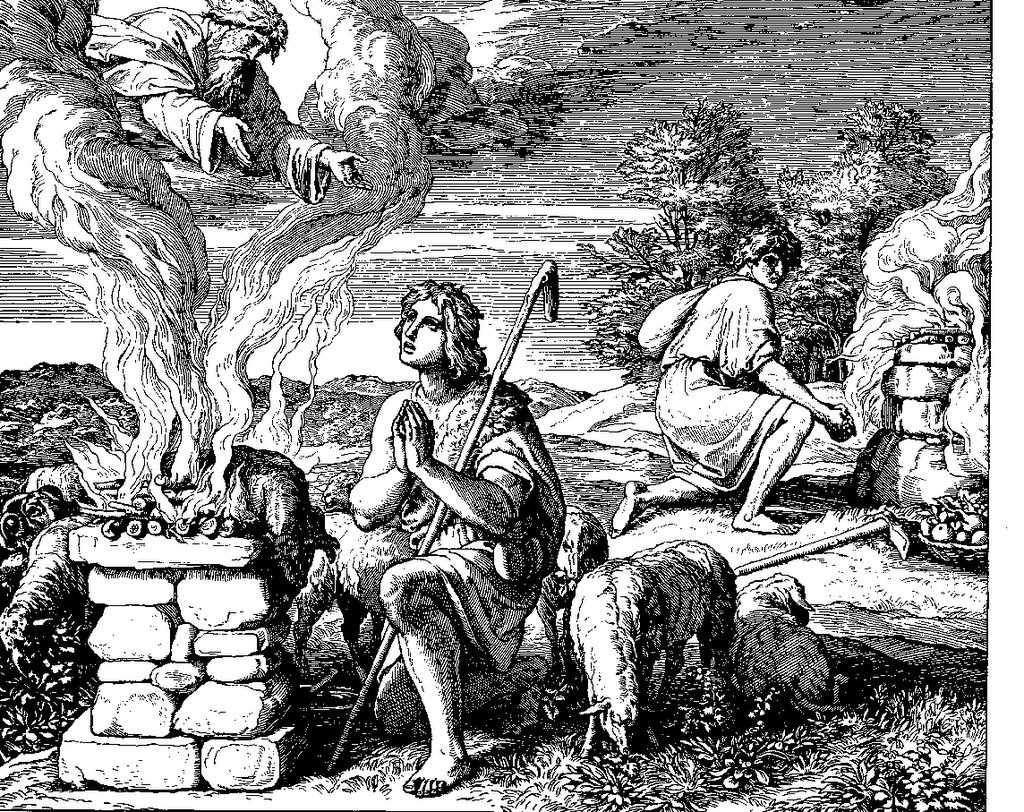
War broke out in Iraq 5,000 years ago. We're still fighting it today, having assumed ages ago that we'd won it. The war in Iraq continues to this day, and we will have to fight in our day like every generation has fought for millenia. This is our time. This is the war between Cain and Abel.A war broke out 5,000 years ago in the Fertile Cresent, Nomads against the Settled. That war continues today in our cities, in the West, across the Earth wherever Men live in struggle against the forces of Nature rather helpless than in its clutches.

We assume that the whole of Mankind is settled and happy in cities and on farms, that those who live in forests and jungles are the tiny minority of extreme primitives who have some special place in the scheme of things, that we must be their keepers, that we must protect them from us, for we would surely kill them otherwise.

5,000 years ago we ruined the Garden of Eden where we wandered around in ignorant bliss, knowing nothing, caring about nothing, provided for by Nature and the Spirit. And then we wrecked a very good deal by seeking knowledge of things we should have left alone. It's been misery and toil since. Now there is pain and death. It's our fault. We are the post-lapsarian killers driving off the few who have remained in a state of Nature, hapyh and free from our knowledge. They, not being part of the captialist revolution, not rampaging and destroying Nature, are pure and authentic. We are our brothers' killers.
***
The West is divided against itself, one side favoring Abel, the other Cain. How do we live rightly? What is the Good?

Below we continue with a closer examination of our assumptions about what the Good is. Is Man meant to live cut off from Nature? Should Man be isolated from his brothers? Are cities good for people? Is Nature important to the point that Man must accomodate himself to it, or is Man supreme? Are we Abels, hunting and gathering and living rightly in touch with Nature? Or are we Men who make our way to the future? Let's question our assumptions about the world of people who live unlike our revolutionary selves. Maybe we are wrong in our approach to this garden that is the Earth.
***

Nature in National Socialist Ideology

The reactionary ecological ideas whose outlines are sketched above exerted a powerful and lasting influence on many of the central figures in the NSDAP. Weimar culture, after all, was fairly awash in such theories, but the Nazis gave them a peculiar inflection. The National Socialist "religion of nature," as one historian has described it, was a volatile admixture of primeval teutonic nature mysticism, pseudo-scientific ecology, irrationalist anti-humanism, and a mythology of racial salvation through a return to the land. Its predominant themes were 'natural order,' organicist holism and denigration of humanity: "Throughout the writings, not only of Hitler, but of most Nazi ideologues, one can discern a fundamental deprecation of humans vis-à-vis nature, and, as a logical corollary to this, an attack upon human efforts to master nature." 25 Quoting a Nazi educator, the same source continues: "anthropocentric views in general had to be rejected. They would be valid only 'if it is assumed that nature has been created only for man. We decisively reject this attitude. According to our conception of nature, man is a link in the living chain of nature just as any other organism '." 26

Such arguments have a chilling currency within contemporary ecological discourse: the key to social-ecological harmony is ascertaining "the eternal laws of nature's processes" (Hitler) and organizing society to correspond to them. The Führer was particularly fond of stressing the "helplessness of humankind in the face of nature's everlasting law." 27 Echoing Haeckel and the Monists, Mein Kampf announces: "When people attempt to rebel against the iron logic of nature, they come into conflict with the very same principles to which they owe their existence as human beings. Their actions against nature must lead to their own downfall."28

The authoritarian implications of this view of humanity and nature become even clearer in the context of the Nazis' emphasis on holism and organicism. In 1934 the director of the Reich Agency for Nature Protection, Walter Schoenichen, established the following objectives for biology curricula: "Very early, the youth must develop an understanding of the civic importance of the 'organism', i.e. the co-ordination of all parts and organs for the benefit of the one and superior task of life." 29 This (by now familiar) unmediated adaptation of biological concepts to social phenomena served to justify not only the totalitarian social order of the Third Reich but also the expansionist politics of Lebensraum (the plan of conquering 'living space' in Eastern Europe for the German people). It also provided the link between environmental purity and racial purity:

Two central themes of biology education follow [according to the Nazis] from the holistic perspective: nature protection and eugenics. If one views nature as a unified whole, students will automatically develop a sense for ecology and environmental conservation. At the same time, the nature protection concept will direct attention to the urbanized and 'overcivilized' modern human race.30

In many varieties of the National Socialist world view ecological themes were linked with traditional agrarian romanticism and hostility to urban civilization, all revolving around the idea of rootedness in nature. This conceptual constellation, especially the search for a lost connection to nature, was most pronounced among the neo-pagan elements in the Nazi leadership, above all Heinrich Himmler, Alfred Rosenberg, and Walther Darré. Rosenberg wrote in his colossal The Myth of the 20th Century: "Today we see the steady stream from the countryside to the city, deadly for the Volk. The cities swell ever larger, unnerving the Volk and destroying the threads which bind humanity to nature; they attract adventurers and profiteers of all colors, thereby fostering racial chaos."31

Such musings, it must be stressed, were not mere rhetoric; they reflected firmly held beliefs and, indeed, practices at the very top of the Nazi hierarchy which are today conventionally associated with ecological attitudes. Hitler and Himmler were both strict vegetarians and animal lovers, attracted to nature mysticism and homeopathic cures, and staunchly opposed to vivisection and cruelty to animals. Himmler even established experimental organic farms to grow herbs for SS medicinal purposes. And Hitler, at times, could sound like a veritable Green utopian, discussing authoritatively and in detail various renewable energy sources (including environmentally appropriate hydropower and producing natural gas from sludge) as alternatives to coal, and declaring "water, winds and tides" as the energy path of the future.32

Even in the midst of war, Nazi leaders maintained their commitment to ecological ideals which were, for them, an essential element of racial rejuvenation. In December 1942, Himmler released a decree "On the Treatment of the Land in the Eastern Territories," referring to the newly annexed portions of Poland. It read in part:

The peasant of our racial stock has always carefully endeavored to increase the natural powers of the soil, plants, and animals, and to preserve the balance of the whole of nature. For him, respect for divine creation is the measure of all culture. If, therefore, the new Lebensräume (living spaces) are to become a homeland for our settlers, the planned arrangement of the landscape to keep it close to nature is a decisive prerequisite. It is one of the bases for fortifying the German Volk.33

This passage recapitulates almost all of the tropes comprised by classical ecofascist ideology: Lebensraum, Heimat, the agrarian mystique, the health of the Volk, closeness to and respect for nature (explicitly constructed as the standard against which society is to be judged), maintaining nature's precarious balance, and the earthy powers of the soil and its creatures. Such motifs were anything but personal idiosyncracies on the part of Hitler, Himmler, or Rosenberg; even Göring -- who was, along with Goebbels, the member of the Nazi inner circle least hospitable to ecological ideas -- appeared at times to be a committed conservationist. 34 These sympathies were also hardly restricted to the upper echelons of the party. A study of the membership rolls of several mainstream Weimar era Naturschutz (nature protection) organizations revealed that by 1939, fully 60 percent of these conservationists had joined the NSDAP (compared to about 10 percent of adult men and 25 percent of teachers and lawyers).35 Clearly the affinities between environmentalism and National Socialism ran deep.

At the level of ideology, then, ecological themes played a vital role in German fascism. It would be a grave mistake, however, to treat these elements as mere propaganda, cleverly deployed to mask Nazism's true character as a technocratic-industrialist juggernaut. The definitive history of German anti-urbanism and agrarian romanticism argues incisively against this view:
Nothing could be more wrong than to suppose that most of the leading National Socialist ideologues had cynically feigned an agrarian romanticism and hostility to urban culture, without any inner conviction and for merely electoral and propaganda purposes, in order to hoodwink the public [ . . . ] In reality, the majority of the leading National Socialist ideologists were without any doubt more or less inclined to agrarian romanticism and anti-urbanism and convinced of the need for a relative re-agrarianization.36

The question remains, however: To what extent did the Nazis actually implement environmental policies during the twelve-year Reich? There is strong evidence that the 'ecological' tendency in the party, though largely ignored today, had considerable success for most of the party's reign. This "green wing" of the NSDAP was represented above all by Walther Darré, Fritz Todt, Alwin Seifert and Rudolf Hess, the four figures who primarily shaped fascist ecology in practice.

***
http://www.spunk.org/library/places/germany/sp001630/peter.html

***

We'll look again next time at the urge to return to Nature, to the life of Abel. Maybe we'll find that our enemies are completely right in their return to the primitive, and we, our brothers' killers, have no right to be anywhere at all.

Friday, December 16, 2005

Assumptions of the Benign (1)


I think it is speciesist to think that the September 11 attack on the World Trade Center was a greater tragedy than what millions of chickens endured that day and what they endure every day... (Karen Davis, PhD (!) Vegan Voice)

http://www.whataretheysaying.org/index.html
***

Animal rights. Well, why not? Everything is one at some point, and we, living in nature and being but one small part of it should respect nature rather than treat it as something of our own for ourselves. What right do we have to kill living things and wreck the world as a united living organism? What, when it comes down to it and in the larger sense, makes a man's life worth more than that of a chicken?

Last time we asked that question we aroused some ire, not from animal rights activists or from religious adherents, but from a nutter who went on about my psychic pain! Spare me. We have to seriously question what makes Man's life worth more than a chicken's life, and we must be serious in asking because there are violent people among us who can't make that distinction, and some of them are us, perhaps not to such extreme degrees as others but to degrees we might not feel comfortable with if we were to closely examine just how close we do come to irrationality and ecofascism as it was practiced by our favorite bogeymen, the Nazis.

We have to question our assumptions about ecology and nature and man's place in it because some of us who practice the beliefs of ecology hold in common with others we might dislike some very unhappy opinions, and we, naively perhaps, might follow along into ways unknown and wrong, ways we would forego if only we knew. So let's know. Let's find out more about ecology and where it leads us, or where it might lead us, and see if it leads us into other dark areas that in turn lead us to conclude for exaple that Islam is a religion of peace, or some such silliness. Let's find out if ecology is part of a vast ideology of communitarianism that is also part of identity politics that groups people rather than one that allows for individuals.

Before we delve into our latest look at ecofascsim, I'd like to point out that "like" is not "same." Wiccans, for example,might have similar ideas to wandervogel kids of the 1920s in Germany, but Wiccans are not the same as the wandervogel kids. It's in the closeness that we must be careful to avoid confusions and at the same time to recognize similarities without fear of scorn. Wiccans and Nazis might be similar in beliefs without being the same, and we must also be able to find out the truth of the sameness if it exists without dismissing it out of hand because we're all rightly sick of the over-use of the pejorative sense of the word. Wiccans might well be fat suburbanite teenage girls who can't get laid and nothing more than that, but to dismiss any investigation into the fascist roots of that kind of nature fetishization on the grounds that it's extreme and shop-worn is to betray ourselves and lay ourselves open to not challenging our own Left dhimmi assumptions. Ecology in itself is neither here nor there to most people, and most feel that over-all it's benign and worthwhile for those who are interested and committed to it. It probably is, and probably too there are only a very few extremists who go so far as the idiot, Davis, above. But where do we draw the line? Is Wicca benign? Is ecology good? Do we really know what it means to support ecologism? As one will have seen many times by now, I feel that ecologism is not a good idea. It has far too much in common with Irrationalist fascism. Ecologists might not be the same as old line Nazis, but they are in many respects similar in beliefs. We can find out where they are similar, and from there we can examine the worth of it and some of the baggage that comes with it, not all of which is pretty or functional.

Below we'll look at how similar are old Nazis and New Age ecologists. Ecology fits in with identity politics, is inseperable from it, and together they create the ground of multiculturalism, which in turn allows for the ground of Left dhimmi fascism. Like but not same.
***

Fascist Ecology:
The "Green Wins" of the Nazi Party and its Historical Antecedents

by Peter Staudenmaier

"We recognize that separating humanity from nature, from the whole of life, leads to humankind's own destruction and to the death of nations. Only through a re-integration of humanity into the whole of nature can our people be made stronger. That is the fundamental point of the biological tasks of our age. Humankind alone is no longer the focus of thought, but rather life as a whole . . . This striving toward connectedness with the totality of life, with nature itself, a nature into which we are born, this is the deepest meaning and the true essence of National Socialist thought." 1

In our zeal to condemn the status quo, radicals often carelessly toss about epithets like "fascist" and "ecofascist," thus contributing to a sort of conceptual inflation that in no way furthers effective social critique. In such a situation, it is easy to overlook the fact that there are still virulent strains of fascism in our political culture which, however marginal, demand our attention. One of the least recognized or understood of these strains is the phenomenon one might call "actually existing ecofascism," that is, the preoccupation of authentically fascist movements with environmentalist concerns. In order to grasp the peculiar intensity and endurance of this affiliation, we would do well to examine more closely its most notorious historical incarnation, the so-called "green wing" of German National Socialism.

Despite an extensive documentary record, the subject remains an elusive one, underappreciated by professional historians and environmental activists alike. In English-speaking countries as well as in Germany itself, the very existence of a "green wing" in the Nazi movement, much less its inspiration, goals, and consequences, has yet to be adequately researched and analyzed. Most of the handful of available interpretations succumb to either an alarming intellectual affinity with their subject." 2 or a naive refusal to examine the full extent of the "ideological overlap between nature conservation and National Socialism ." 3 This article presents a brief and necessarily schematic overview of the ecological components of Nazism, emphasizing both their central role in Nazi ideology and their practical implementation during the Third Reich. A preliminary survey of nineteenth and twentieth century precursors to classical ecofascism should serve to illuminate the conceptual underpinnings common to all forms of reactionary ecology.

Two initial clarifications are in order. First, the terms "environmental" and "ecological" are here used more or less interchangeably to denote ideas, attitudes, and practices commonly associated with the contemporary environmental movement. This is not an anachronism; it simply indicates an interpretive approach which highlights connections to present-day concerns. Second, this approach is not meant to endorse the historiographically discredited notion that pre-1933 historical data can or should be read as "leading inexorably" to the Nazi calamity. Rather, our concern here is with discerning ideological continuities and tracing political genealogies, in an attempt to understand the past in light of our current situation -- to make history relevant to the present social and ecological crisis.
The Roots of the Blood and Soil Mystique

Germany is not only the birthplace of the science of ecology and the site of Green politics' rise to prominence; it has also been home to a peculiar synthesis of naturalism and nationalism forged under the influence of the Romantic tradition's anti-Enlightenment irrationalism. Two nineteenth century figures exemplify this ominous conjunction: Ernst Moritz Arndt and Wilhelm Heinrich Riehl.

[We'll hold off posting further biographical details until a later date.]

While best known in Germany for his fanatical nationalism, Arndt was also dedicated to the cause of the peasantry, which lead him to a concern for the welfare of the land itself. Historians of German environmentalism mention him as the earliest example of 'ecological' thinking in the modern sense. 4 His remarkable 1815 article On the Care and Conservation of Forests, written at the dawn of industrialization in Central Europe, rails against shortsighted exploitation of woodlands and soil, condemning deforestation and its economic causes. At times he wrote in terms strikingly similar to those of contemporary biocentrism: "When one sees nature in a necessary connectedness and interrelationship, then all things are equally important -- shrub, worm, plant, human, stone, nothing first or last, but all one single unity." 5

Arndt's environmentalism, however, was inextricably bound up with virulently xenophobic nationalism . His eloquent and prescient appeals for ecological sensitivity were couched always in terms of the well-being of the German soil and the German people, and his repeated lunatic polemics against miscegenation, demands for teutonic racial purity, and epithets against the French, Slavs, and Jews marked every aspect of his thought. At the very outset of the nineteenth century the deadly connection between love of land and militant racist nationalism was firmly set in place.

Riehl, a student of Arndt, further developed this sinister tradition. In some respects his 'green' streak went significantly deeper than Arndt's; presaging certain tendencies in recent environmental activism, his 1853 essay Field and Forest ended with a call to fight for "the rights of wilderness." But even here nationalist pathos set the tone: "We must save the forest, not only so that our ovens do not become cold in winter, but also so that the pulse of life of the people continues to beat warm and joyfully, so that Germany remains German." 6 Riehl was an implacable opponent of the rise of industrialism and urbanization; his overtly antisemitic glorification of rural peasant values and undifferentiated condemnation of modernity established him as the "founder of agrarian romanticism and anti-urbanism." 7

These latter two fixations matured in the second half of the nineteenth century in the context of the v?lkisch movement, a powerful cultural disposition and social tendency which united ethnocentric populism with nature mysticism. At the heart of the v?lkisch temptation was a pathological response to modernity. In the face of the very real dislocations brought on by the triumph of industrial capitalism and national unification, v?lkisch thinkers preached a return to the land, to the simplicity and wholeness of a life attuned to nature's purity. The mystical effusiveness of this perverted utopianism was matched by its political vulgarity. While "the Volkish movement aspired to reconstruct the society that was sanctioned by history, rooted in nature, and in communion with the cosmic life spirit," 8 it pointedly refused to locate the sources of alienation, rootlessness and environmental destruction in social structures, laying the blame instead to rationalism, cosmopolitanism, and urban civilization. The stand-in for all of these was the age-old object of peasant hatred and middle-class resentment: the Jews. "The Germans were in search of a mysterious wholeness that would restore them to primeval happiness, destroying the hostile milieu of urban industrial civilization that the Jewish conspiracy had foisted on them." 9

Reformulating traditional German antisemitism into nature-friendly terms, the v?lkisch movement carried a volatile amalgam of nineteenth century cultural prejudices, Romantic obsessions with purity, and anti-Enlightenment sentiment into twentieth century political discourse. The emergence of modern ecology forged the final link in the fateful chain which bound together aggressive nationalism, mystically charged racism, and environmentalist predilections . In 1867 the German zoologist Ernst Haeckel coined the term 'ecology' and began to establish it as a scientific discipline dedicated to studying the interactions between organism and environment. Haeckel was also the chief popularizer of Darwin and evolutionary theory for the German-speaking world, and developed a peculiar sort of social darwinist philosophy he called 'monism.' The German Monist League he founded combined scientifically based ecological holism with v?lkisch social views. Haeckel believed in nordic racial superiority, strenuously opposed race mixing and enthusiastically supported racial eugenics. His fervent nationalism became fanatical with the onset of World War I, and he fulminated in antisemitic tones against the post-war Council Republic in Bavaria.

In this way "Haeckel contributed to that special variety of German thought which served as the seed bed for National Socialism. He became one of Germany's major ideologists for racism, nationalism and imperialism." 10 Near the end of his life he joined the Thule Society, "a secret, radically right-wing organization which played a key role in the establishment of the Nazi movement." 11 But more than merely personal continuities are at stake here. The pioneer of scientific ecology, along with his disciples Willibald Hentschel, Wilhelm B?lsche and Bruno Wille, profoundly shaped the thinking of subsequent generations of environmentalists by embedding concern for the natural world in a tightly woven web of regressive social themes. From its very beginnings, then, ecology was bound up in an intensely reactionary political framework.

The specific contours of this early marriage of ecology and authoritarian social views are highly instructive. At the center of this ideological complex is the direct, unmediated application of biological categories to the social realm. Haeckel held that "civilization and the life of nations are governed by the same laws as prevail throughout nature and organic life." 12 This notion of 'natural laws' or 'natural order' has long been a mainstay of reactionary environmental thought. Its concomitant is anti-humanism:

Thus, for the Monists, perhaps the most pernicious feature of European bourgeois civilization was the inflated importance which it attached to the idea of man in general, to his existence and to his talents, and to the belief that through his unique rational faculties man could essentially recreate the world and bring about a universally more harmonious and ethically just social order. [Humankind was] an insignificant creature when viewed as part of and measured against the vastness of the cosmos and the overwhelming forces of nature. 13

Other Monists extended this anti-humanist emphasis and mixed it with the traditional v?lkisch motifs of indiscriminate anti-industrialism and anti-urbanism as well as the newly emerging pseudo-scientific racism. The linchpin, once again, was the conflation of biological and social categories. The biologist Raoul Franc?, founding member of the Monist League, elaborated so-called Lebensgesetze, 'laws of life' through which the natural order determines the social order. He opposed racial mixing, for example, as "unnatural." Franc? is acclaimed by contemporary ecofascists as a "pioneer of the ecology movement." 14

Franc?'s colleague Ludwig Woltmann, another student of Haeckel, insisted on a biological interpretation for all societal phenomena, from cultural attitudes to economic arrangements. He stressed the supposed connection between environmental purity and 'racial' purity: "Woltmann took a negative attitude toward modern industrialism. He claimed that the change from an agrarian to an industrial society had hastened the decline of the race. In contrast to nature, which engendered the harmonic forms of Germanism, there were the big cities, diabolical and inorganic, destroying the virtues of the race ." 15

Thus by the early years of the twentieth century a certain type of 'ecological' argumentation, saturated with right-wing political content, had attained a measure of respectability within the political culture of Germany. During the turbulent period surrounding World War I, the mixture of ethnocentric fanaticism, regressive rejection of modernity and genuine environmental concern proved to be a very potent potion indeed.
http://www.spunk.org/library/places/germany/sp001630/peter.html

Footnotes 1. Ernst Lehmann, Biologischer Wille. Wege und Ziele biologischer Arbeit im neuen Reich, M?nchen, 1934, pp. 10-11. Lehmann was a professor of botany who characterized National Socialism as "politically applied biology."
***

We see that some of our common assumptions about the benign can lead us to false paths, and once we see clearly where we're headed we can change direction and call to the attention of others that we are astray. Knowing what we do now about ecology we can see why Davis above would conclude that chickens are as important as is the life of man. In further posts we'll try to show that this line of feeling, this Irrationalist mode of epistemology leads us not only into fascist ecology but also into fascsit multiculturalism, into Left dhimmitude, into philobarbarism where we stand agape at Palestinian homicide bombers while some of our own say they are resistence fighters. It's all of a paackage, one part being next to the other. We'll continue next post with more of this essay, and we hope you'll join us.

--
Yalla, Dag