Tuesday, January 03, 2006

Metaphor, Authority, and the Moral (2)

Dead, every one of them, and for what? Hundreds of years of criminal lunacy carried out for the sake of personal vanity, for the sake of lust, for greed and glory, and today the world stands aghast, disgusted permanently, sickened by the exploits of the few who corrupted an institution to the core, an infection that rotted the idea beyond redemption in the eyes of the many. So few, and yet the lasting destruction they caused is seen as nearly universal in the eyes of man. These criminals were the Popes of the Catholic Church. They are dead, and they have destroyed the church in the course of their lives.

What do sickening Catholic popes and Protestant reformers in the Middle ages and their push for universal literacy have to do with 21st century jihad? We argue that the lot of them are responsible of the destruction of the concept of universal morality. We argue that the popes are the cause of our current malaise, that the concept of morality is now so vitiated by the evils of the Catholic Church that most people turn in disgust from the very thought of organized religion, from the concept of God, and from the thought of universal morality itself, leaving only ethical behaviour based on contingency and prudence, on opportunism and personality in its place. The collapse of the moral, the destruction of the general view of morality and of the moral of our story as living creatures with a purpose, that is all but destroyed in the minds of men, annihilated by the evils of the few.

Of the Protestant reformers, of Luther and Calvin, we have nothing good to report of them. Religion is disgraced in the eyes of men because of the likes of them. Below we'll look at a brief and simple outline of some Catholic history. It's a mere sketch of part of the history that leads us to today's amoral cultural and emotional nihilism. Why do we live with multiculturalism? Why do we prise philobarbarism? Why do we consider Islam to be the religion of peace? Why do we tolerate evil in its obvious manifestations and find ourselves incapable of discussing it as such? Worse, how do we come to terms with the evil when we have no moral ground to stand on ourselves? How can we condemn evil in others if we are evil ourselves? What makes the life of a man worth more than that of a chicken? And how do we prove anything? What is our authority to do so? What is our moral? Why do we even bother living at all? How can we condemn Islam if we ourselves have nothing better to offer and no authority to object to its evils in the world? Why shouldn't we just give up and die?

We have lost the immediacy of our past moral authority. We can thank the likes of Boniface VIII and Cotton Mather for that. The evils they committed shame the universe of man. No right person can associate with them, and therefore, our morality is shamed and dishonoured beyond redemption. The revulsion we feel is so deep in our minds that we needn't even know the details of these creatures to know we are ashamed. Christianity is seen-- is felt in the soul-- to be evil. And what is left for us?

The Middle Ages in the West, a time known to the general public in the West today as the worst of times, were indeed bad in many respects compared to our lives in our days; but let's get some perspective before we condemn the period as simply a thousand years without a bath. There has to be more, a strain of thought and feeling that is better than what we assume is the total evil of the times.

Looking at our past can show us where we are today. Today, according to me, we are in a mire of secular gnosticism. We cannot fight the evils of Islam if we hate ourselves and our Modernity. We cannot win a fight we feel is worthless. We cannot know the good if we believe there is none. Below we'll see why we have come to our age of moral cynicism and gnostic hatred of morality itself.

In our next post we'll look again more closely at the gnostic fascism of our time. For now, we see Catholicism at its worst.
****

The Church in Moral Crisis: Prelude to the Reformation

Though most students would have some knowledge of the great schism between East and West, few are aware of the historical rifts that occurred within the Roman church between the 13th and 15th centuries. Religious life suffered as a consequence of the schism, for "Christendom looked upon the scandal helpless and depressed, and yet impotent to remove it. With two sections of Christendom each declaring the other lost, each cursing and denouncing the other, men soberly asked who was saved" (Flick, 1930: 293). Doubt and confusion caused many to question the legitimacy and true holiness of the church as an institution. In the West, the excesses that affected the church ultimately called for radical reform through that movement which we now identify with the Protestant Reformation.

This period of moral decline was instrumental in leading to a Western Schism within Christendom, in which three Popes and anti-Popes concurrently contested control over the See of Peter. The popes refused to convene councils to effect reform, and they failed to bring about reform themselves, rather busying themselves with Italian politics and being patrons of the arts. "Thus the papacy emerged as something between an Italian city-state and a European power, without forgetting at the same time the claim to be the vice-regent of Christ. The pope often could not make up his own mind whether he was the successor of Peter or of Caesar. Such vacillation had much to do with the rise and success... of the Reformation" (Bainton, 1952: 15). By the mid-fifteenth century the Church was in urgent need of drastic reform which, when effected, would have lasting impact on the religious and secular history of Europe.

At the death of Nicholas IV in 1292 there was a deadlock in the sacred college of Cardinals which was to last for twenty-seven months before his successor could be elected. The two ruling factions in Italian politics were represented by the powerful Orsini and Colonna families who vied for control of the Papacy. At this time there were only nine cardinals left in that college, three giving their allegiance to the Orsinis, three to the Colonna family, and three were seemingly independent. Pope Nicholas had been an Orsini and they would not accept the loss of papal control. The Colonnas were determined to take it away from them, and they put pressure on the three remaining independent cardinals who were unwilling to offend either family, both of whom had a history of murder and assassination throughout the streets of Rome.

The cardinals squabbled over who should be elected Pope until the plague came to Rome in early in 1294, forcing them to withdraw to the mountains of Perugia in central Italy, still deadlocked. One of the non-partisan cardinals was Cardinal Gaetani who was considered to be a great canon lawyer. He was a cold, calculating, corpulent man with the determination of an assassin. To break the deadlock in his own insidious way, Gaetani told the senior cardinal present, Latino Malabranca, the Cardinal of Ostia that he had received a prophetic letter from a holy eccentric hermit, Peter of Morone, which predicted the punishment of God upon all of them if a Pope were not soon elected.

Malabranca, who was intensely superstitious, took the forgery which Gaetani had given to him with devout seriousness. On the 5th July 1294, after prayful contemplation, he called the handful of cardinals together and read them the letter which he believed had come from the holy hermit. He became so carried away by his own eloquence and his own convictions that he proposed that the hermit Peter of Morone be elected the next Pope. The deadlock was broken by the logic of demonstrating to Colonna and Orsini alike that neither of them needed to prevent the other from winning.

Neither the Colonnas nor the Orsinis bothered to journey to Abruzzi to meet the new Pope, to kiss his feet as every tradition of the sacred college required. However Cardinal Gaetani did pay his homage, taking with him the King of Naples and an enormous following of ordinary people:
In a bleak cave in the Abruzzi mountains, Gaetani told the holy hermit that he had been made Vicar of Christ on earth. The confused frightened old man, who had never seen so many people in his life, nodded to the statement because Gaetani had bellowed at him from that great height, in those rich and beautiful scarlet robes covering the barrel chest and hogshead belly, commanding that Peter now nod his head to signify his acceptance of God's glory. Emaciated, hardly understanding Latin, much less the condition, Peter accepted the rulership of Christendom filled with mortal terror because he would have to leave his cave. He refused to go to Rome. He would rule from Naples. At Gaetani's suggestion, he chose the name Celestine V. From that day forward, Gaetani served the Pope as his lawyer and soothed him by creating a replica of the hermit's mountain cell in the castle Nuovo, which had become the Lateran palace of Naples (Condon, 1984: 24).

Cardinal Gaetani began systematically to ingratiate himself with Celestine - and finally convinced the confused and befuddled pontiff that God really wanted him to resign from the papacy. Fearing that unless he abdicated he would lose his immortal soul, Celestine agreed, and announced his renunciation to his cardinals. Gaetani was elected to the papacy ten days later as the compromise candidate, consecrated and crowned at St. Peter's in Rome, taking the name of Boniface VIII. His first act as Pope was to order the arrest of Celestine, whom he sentenced to death.

As a cardinal Gaetani had acquired rich cities and adjoining territories - and as Pontiff Boniface continued to amass wealth and power which was to bring him into direct confrontation with the Colonnas, who ruled their territory from the hilltop city of Palestrina, twenty-two miles east of Rome. The Colonnas tried to instigate a revolt against the Pontiff by claiming that Boniface's election was invalid as he had usurped power that rightly belonged to Celestine. At the same time, Stephen Colonna attacked and plundered the Pope's gold which was being sent to Caserta to buy yet another city for the Gaetani dynasty. Boniface, blind with fury, threw two of the Colonna cardinals into prison.

The Colonna offered to return the gold but Boniface wanted not only revenge on Stephen Colonna but also the Colonnas' destruction by installing garrisons inside the Colonna cities. This option was totally unacceptable to the Colonna and the next day, Colonna messengers posted manifestos attacking the legitimacy of Boniface's election all over Rome, leaving one tacked to the high altar of St. Peter's. In response, Boniface issued a papal bull, In Excelso Throno, which charged the two imprisoned Colonna cardinals with heresy, excommunicated them and every member of the family. Boniface then announced a religious crusade against the Colonna, using money from all over Europe which had been intended to finance the Crusades in the Holy Land to buy the Knights Templar to crush the Colonna strongholds. An order went out that the Colonna women and children were to be killed or sold into slavery. With the help of his mercenary army, by 1299 all the Colonna cities had been captured. Palestrina was completely razed to the ground, and the Colonna family went to France in exile where they were given refuge by French nobility.

Boniface's fury turned against the French monarch and he forbade him to tax the French clergy. The French king reacted vehemently, and he in turn forbade the export of all money to the Pope. The king prohibited foreigners from living in France, which excluded members of the curia:

Warming to his task, he called an estates-general to charge the Pope with infidelity, loss of the Holy Land, the murder of Celestine V, heresy, fornication, simony, sodomy, sorcery, and idolatry in a list of twenty-nine charges - all of them the sort employed when some faction wants to rid the Church of a Pope, many of them quite valid. The only weapon Boniface had was the solemn excommunication of the King of France, which would release the French people from their allegiance to the king. The publication of this fatal bull was planned for 8 September, 1303 from Agnani, the Pope's summer palace (Condon, 1984: 26).

The bull had to be stopped at any cost. The king sent 2000 troops into Italy under the leadership of Sciarra Colonna into Italy to storm Agnani, Boniface's family stronghold, with the orders to capture Boniface and bring him to France for judgement. Under treachery, Colonna gained access with his troops and with drawn sword, Colonna found the eighty year old pontiff seated on his throne dressed in his pontifical regalia, with the three-tiered tiara on his head, cross in one hand and keys to St. Peter's in the other. Mockingly, Sciarra Colonna ordered his men to strip Boniface naked. Sciarra pressed the tiara down Boniface's eyes, knocked him down, had his men drag him by the feet across down a granite stairway. He was then thrown into a narrow, dark prison where he was beaten, and as a final indignity Sciarra ordered his soldiers to urinate on him. Two nights later, supporters of the Pontiff were able to repel the French and rescued Boniface. But the ill-treatment meted out to him was too much; in sick and debilitated health, he commenced his journey back to the Vatican which he reached on 18 September. There he was to die twenty-four days later.

One of the more important and telling pronouncements of Pope Boniface VIII had been written to Philip IV of France in 1302. It was named Unam Sanctam and is one of the most extreme and arrogant statements of papal superiority over spiritual and temporal matters and gives us an significant insight into the prevalent model of Church at this time of ecclesial history. Read the following and fascinating extract from Unam Sanctam and reflect on the paradigm of Church that existed at the turn of the 14th century :

We are compelled, our faith urging us, to believe and to hold - and we do firmly believe and simply confess - that there is one holy catholic and apostolic church, outside of which there is neither salvation nor remission of sins.... Both swords, the spiritual and the material, therefore, are in the power of the church; the one, indeed, to be wielded for the church, the other by the church; the one by the hand of the priest, the other by the hand of kings and knights, but at the will and sufferance of the priest. One sword, moreover, ought to be under the other, and the temporal authority to be subjected to the spiritual. For when the apostle says "there is no power but God, and the powers that are of God are ordained," they would not be ordained unless sword were under sword and the lesser one, as it were, were led by the other to great deeds. Whoever, therefore, resists this power thus ordained by God, resists the ordination of God, unless he makes believe, like the Manichean, that there are two beginnings. This we consider false and heretical,.... Indeed we declare, announce and define, that it is altogther necessary to salvation for every human creature to be subject to the Roman pontiff. The Lateran, Nov. 14, in our 8th year. As a perpetual memorial of this matter. (Ernest F. Henderson, 1912: 435-37).
After Boniface's death, the new Pope, Benedict X, did not last long, dying within ten months of his election. After many months of intense bargaining Bertrand de Got, Archbishop of Bordeaux and a confidant of the king of France, was elected. This Frenchman, who took the name Clement V, was never to set his foot on Italian soil; he was crowned in Lyons in November 1305 and finally in 1309 settled in Avignon which became the papal court from which the Pope and his Curia ruled. Clement was to be succeeded by six French Popes who, at the resolution of the French king, remained in France. For the next sixty-eight years the seat of ecclesial power was to remain in Avignon, not returning to Rome till 1377 during the pontificate of Gregory VI, who died through apparent poisoning.
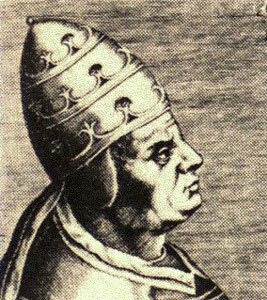
The Italians were desperate to retain the papacy within Italy, and threatened the lives of the sixteen cardinals gathered in Rome to elect Gregory's successor. Italy had become impoverished since the papacy had moved to Avignon, with monies from about two million tourists going to the French since Clement's election. Feeling under pressure the conclave chose the safest Pope - Archbishop Bartolomeo Prigano of Bari, a Neapolitan who had been vice chancellor at the University of Avignon. Prigano took the name of Urban VI.

His autocratic manner coupled with an unbalanced personality was to lead to his downfall. He proved himself to be highly unpopular and the cardinals, now in safe territory, met and declared the election to be null and void on the ground that they had been coerced into electing him in fear of the violence of the Roman mob:

It seems hard to believe but they elected in his place a brute named
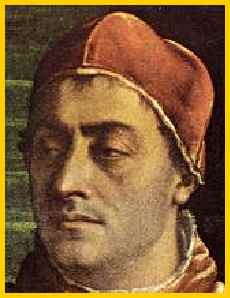
Robert, Cardinal of Geneva - he who was called the Butcher of Cesena because he had ordered his troops to put 3000 women and children to the sword when they objected to the rape of sixty women by his transient soldiers. The Butcher took the name of Clement VII, whereupon Urban VI excommunicated him; then he excommunicated Urban, and the great schism of the Church had begun. There were two Popes who ruled Christendom simultaneously: Urban in Rome, Clement at Avignon. The Cossa family's advocate, Piero Tomacelli, succeeded Urban as Boniface IX (Condon, 1984: 29).

It took considerable monies to keep the bureaucracy of the Church functioning, so Boniface tried to strengthen the Roman Church by selling various ecclesial offices and benefices, particularly special indulgences during Jubilee years. He gained enormous wealth from the Jubilees of 1390 and 1400, and under his pontificate simony reached its great climax through the sale of indulgences. Boniface rapaciously piled tax upon tax, graft upon graft, simony upon simony, taxing the patrons, papal states and properties, and requiring substantial fees from those elected to political or ecclesial office. Everything that was secular or religious was for sale, and ultimately it was out of this worldly environment that urgent calls came for reformation and church renewal.

The REFORMATION of the 15th and 16th CENTURIES

One of the dogmas of the Roman Catholic Church states that the Church is always in a state of renewal (Ecclesia semper reformanda est). From the twelfth century onwards, we note the resurgence of various groups calling for radical changes within the practices of Christian worship. Through your own investigations, you may wish to explore the relationships between them and the established church. In what way did the Cathars, the Albigensians, the Waldensians, and others try to correct the ills of the Church? Why did they fail, and end up condemned by the "official" Church?

The age saw the introduction of the Inquisition, which acted as a protective arm ensuring the supremacy and purity of the 'official' teachings against the radicalism of these primitive reformers. It is interesting to note that Augustine in the 4th century had approved the use of torture in specific cases where the salvation of souls was concerned. His rationale was based on the premise that if secular powers used torture for mere temporal gains, then how more justified would the church be to use brutality for the sake of salvation! Such also was the rationale used by the founders of the most infamous of the Church's agencies of control. Through the establishment of the Inquisition, at the dawn of the Reformation the Church protected its own temporal and spiritual supremacy.

They all lived in the same epoch of the 15th and 16th century, and through their inventive genius, courage and political skill they were to make a unique and lasting impact on the spiritual, geographical, scientific, as well as political and ecclesial horizons of their time. You may wish to explore the state of leadership in church and state at this time: the debauchery of the Borgias culminating in the reign of the profligate Pope Alexander VI; the conquests and concerns of the warrior Pope, Julius II (who somehow has won strange exoneration in history through his patronage of Michaelangelo), the iron-willed Pontiffs of the Counter-Reformation, Paul IV, Pius IV, and Pius V. It was a time when Italians monopolized European banking, and money transformed values, ecclesial and secular, even celebrated in medieval poetry:

Money makes the man, Money makes the stupid pass for bright... Money buys the pleasure-giving women, Money keeps the soul in bliss, The world and fortune being ruled by it, Which even opens, if you want, the doors of paradise. So wise he seems to me who piles up What more than any other virtue Conquers gloom and leavens the whole spirit (Lauro Martines, 1979: 83).

Below I have indicated the key personalities that influenced political and ecclesial history events during the fifteenth and sixteenth centuries. It was also a period of headstrong political leadership unafraid to challenge the power of the Rome weakened by inept and corrupt leadership. Some, like Henry VIII (1509-1547) and Elizabeth I (1558-1603), stood in heretical opposition to Rome for a variety of personal as well as political motives. Others, like Philip II (1555-1598), Ferdinand I (1556-1564) and Christian III (1536-1559), allied themselves to Rome against the voices of Reformation. By 1565 Europe was to be rent by cataclysmic religious wars costing the lives of hundreds of thousands, tearing the religious and political harmony of Europe apart.

The age of Reformation had begun with a promise of new hope and new vision - and this is still reflected in the middle years of Erasmus of Rotterdam. Yet this period of history belongs to three men of diverse personality, religious conviction, and action: Martin Luther (1483-1546), Zwingli (1484-1556) and Calvin (1509-1564). Through their work and efforts, the history of the church was to take a direction which ultimately was to witness the political disintegration of the bilateral duality of church and state.

Although every school child has learnt that: "In 1492, Columbus sailed the ocean blue" and discovered the New World, not too many children have learnt that it was also the same year in which the infamous Borgia Pope, Alexander VI, ascended the papal throne.

http://dlibrary.acu.edu.au/staffhome/yukoszarycz/ecc/MOD6.HTML
****

The Catholic Church destroyed the concepts of morality and of universal religion for many people in our day. We live in a state of horror and cynicism. We have become gnostics. We have become so because of literacy. We have lost our souls because of Tyndale and Gutenberg. Thank God for it! Atheists can now find a true path to morality of universal authority through metaphors previously unimagined.

Monday, January 02, 2006

Metaphor, Authority, and the Moral


The way we know the thing is not the thing in itself but is a metaphoric experience of it. We can know by direct experience only our own minds. The question is what our own minds are, what content therein is of our own making and not the input of outside influence. How truly are we our own beings? We are flooded with information, saturated with it, bloated with it. Gagging on it. Choking. Gasping. Drowning in information.


What is true and what is mere nonsense? And of the true, what is really important? How can we tell the difference? We can't know most things directly. At best we can conjure up metaphors to make sense of reality as we experience it. Is it even close to true? Not likely. Is it useful in our physical existence? Sometimes. We don't often get run over by automobiles if we rely on our sense perceptions. But we don't know automobiles in any deep sense. Not that it matters. What we might know is the kind, the colour, the shape, the physical properties of an automobile, and we might know the social categories of such a thing. But we don't know any great truth from knowing automobiles nor from knowing metallurgy or mechanics. All the math and all the abstract labour that one requires to own a created auto never really makes a person a better person. It's just more information. It's facility with more metaphors. In that sense, the more we know the less we know.

There are those who believe that one can know God directly. Some argue that knowing anything depends on the will of God to maintain reality as it seems to be, and that all that we know is God's projection. The knowledge we have then would be as direct as one could hope for. For the rest of us there is only the metaphorical. Without the authority of God backing up our empirical gold standard of reality, wherefrom do we derive the authority to make any claims to the veracity of our claims to knowledge? What makes my claim that x is x any better than a counter claim that x is y? What authority do I have? I ain't no Muslim, and I don't give a damn for the Koran. So where does my opinion about anything gain any legitimacy? I'm possibly talking through my hat if I make any claims at all outside the confines of knowing of my own existence. Even then, I might only be a figment of God's reality thinking that I am. Maybe I'm not even sure of my own mind's existence. Where do I go to find authority, the final proof of authentic reality?

On what authority do I base my claim that my version of right and wrong is right? If I were a Christian, then my version of authority would be God. If I were a Catholic, my version of my relationship with God would be mediated by an ever ascending hierarchy of clerks. Each of those clerks would, in effect, be a metaphorical stand-in for my relationship with God. I would have the benefit of tradition and reified authority to give legitimacy to any claims I might have, and any doubts therefo I could pass on to a figure in the chain of command and await my orders.

What if I look at the edifice of the authority as it is and think for myself, concluding that I don't trust it's authority and legitimacy? What if the edifice is corrupt and disgusting? Who am I? I'm just one guy.

Below we can look at the very brief entries on some other guys who've preceded us, just ordinary guys who questioned or sometimes challenged the legitimacy of established authority. A couple of those below did so without realizing what they were doing. All of them brought us both closer to the Eden of our own intellectual independence and also brought us into the wilderness of our own intellectual independence. Now that we are free to choose, what do we choose, and how do we know that what we choose is right? What do we base our authority on? Is our morality a crap shoot?
****


Jan Hus (1369 Husinec, Southern BohemiaJuly 6, 1415 Constance) was a religious thinker and reformer. He initiated a religious movement based on the ideas of John Wyclif. His followers became known as Hussites. The Catholic Church did not condone such uprisings, and Hus was excommunicated in 1411, condemned by the Council of Constance, and burned at the stake.

Hus was a precursor to the Protestant movement. His extensive writings earn him a promiment place in Czech literary history. He is also responsible for introducing the use of accents (especially the hacek) into Czech spelling in order to represent each sound by a single symbol. Today, a statue of Jan Hus can be seen at the Prague old town square, the Staroměstsk� n�měst�.
encyclopedia.laborlawtalk.com/Jan_Hus
****

John Wycliffe

Our chapter in the story of the Bible begins with the Vulgate, the version of the Scriptures that Jerome translated from the original Hebrew, Aramaic, and Greek languages into Latin in the late 4th and early 5th centuries. The Vulgate eventually came to dominate the Christian world, and interest in the ancient manuscripts began to fade, as Biblical studies no longer relied on them or the languages in which their authors wrote them. In time, the Latin text was the only version of scriptures in use throughout most of Europe.

John Wycliffe and his associates, the Lollards, translated Jerome's Latin text into English in direct defiance of Papal commands. This work, the first complete translation of the Bible into the English language, appeared in 1382. Complete manuscripts sold for up to five marks (about $600 in modern value), and people are said to have given a load of hay for a few pages of one of the epistles.

Wycliffe made many enemies in the church because of his work and ultimately was denounced as a heretic. The Pope banned his works, and many of the Lollards were either imprisoned or executed. Wycliffe died on New Year's Eve of 1384. After his death, he was condemned on 267 counts of heresy for his translation. In 1408, the Constitutions of Oxford prohibited making or reading a vernacular translation of Scripture on penalty of forfeit of life and goods.

In 1428, forty-four years after his death, Wycliffe's remains were disinterred, burnt, and scattered on the River Swift.
: www.biblical-museum.org/TheMorningStarJohnWyc...
****

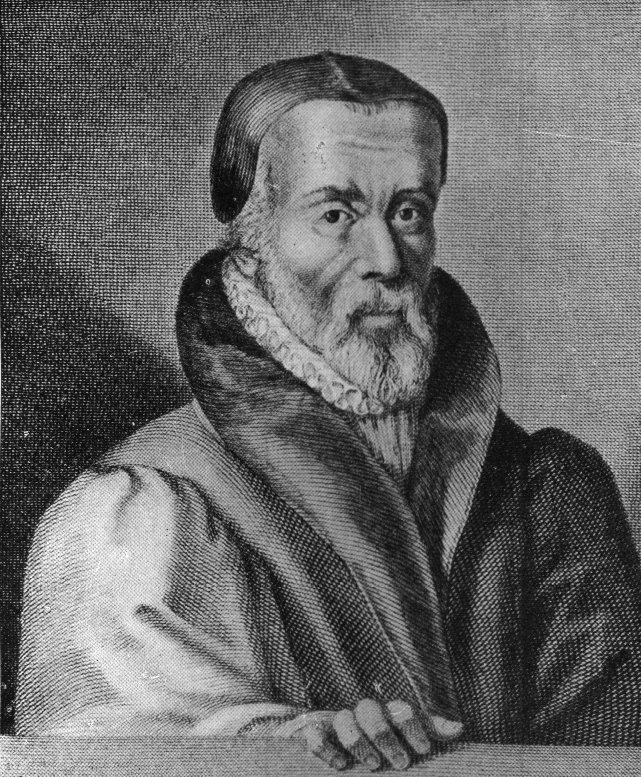
William Tyndale's statement, "I defy the Pope, and all his laws; and if God spare me, I will one day make the boy that drives the plough in England to know more of Scripture than the Pope himself!," is probably from the title page of the work of Erasmus Greek which states that the plowman and the carpenter should know the Bible because it is addressed to them.
www.fbinstitute.com/engbible/7.html
****


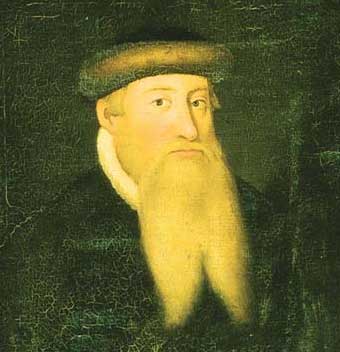
Johannes Gutenberg

Johannes Gutenberg was a German goldsmith and inventor best known for the Gutenberg press, an innovative printing machine that used movable type. Gutenberg was born between 1394 and 1400 and died in 1468. In 1438, Gutenberg began a business arrangement with Andreas Dritzehn, who funded his experiments in printing. In 1450, Gutenberg began a second arrangement with German businessman Johannes Fust. Fust lent Gutenberg the money to start a printing business and build a large Gutenberg Press, their printing projects included the now famous Gutenberg Bible. On September 30, 1452, Johann Guttenberg's Bible was published becoming the first book to be published in volume.
http://inventors.about.com/library/inventors/blJohannesGutenberg.htm
****

John Wesley - Anglican clergyman, evangelist, and cofounder of Methodism. The 15th child of a former nonconformist minister, he graduated from Oxford University and became a priest in the Church of England in 1728. From 1729 he participated in a religious study group in Oxford organized by his brother Charles (1707-1788), its members being dubbed the "Methodists" for their emphasis on methodical study and devotion.
****

Each of the men above was deeply interested in spreading literacy to the masses. The point of the execise was to bring people nearer our God to us. Something went wrong, and we got a lot of information instead. We gained the store of available metaphors, but it seems we lost the moral of the story we once used to know fairly well. Our disiples of literacy have been overtaken by the corruption of our culture's intelligentsia. We'll look again at the state of our world next time. We think it's time to reform it. And yes, likely some of us will burn.

Sunday, January 01, 2006

A New Day Dawns


Our new year brings us not only a new year but a new life. The year 2006 is the end of the old world, and it is the beginning of something we will make on our own, something very different from what we've known for the past 50 years. This is the time when the West changes its mind about our social narratives. The moral of the story is no longer sensible even to the most ideologically driven idiots on the Left. The times they are a changin'. The question is now what change there will be. We might get nasty. We might unleash a fury on the world and kill a whole lot of people. We are facing a course correction, and many will find themselves cut off from the new world, unable to survive in a world of changed circumstances. We have a moral duty to save those who can be saved, and that means we mustn't flinch from doing the worst to those who cannot be saved for the sake of those who can be. We are, in a sense, graduating from our cloistered world into the real world, having spent too much time in a counter-reality that didn't make sense no matter how we looked at it. Now is the time to go on with the future to make of it the best we can.


Neil Postman looks to the past to find lessons for the future. Below he suggests some things we can profitably consider in our march into the future. Thanks to t-ham for bringing this essay to our attention:


MY GRADUATION SPEECH

by Neil Postman

Having sat through two dozen or so graduation speeches, I have naturally wondered why they are so often so bad. One reason, of course, is that the speakers are chosen for their eminence in some field, and not because they are either competent speakers or gifted writers. Another reason is that the audience is eager to be done with all ceremony so that it can proceed to some serious reveling. Thus any speech longer than, say, fifteen minutes will seem tedious, if not entirely pointless. There are other reasons as well, including the difficulty of saying something inspirational without being banal. Here I try my hand at writing a graduation speech, and not merely to discover if I can conquer the form. This is precisely what I would like to say to young people if I had their attention for a few minutes.

If you think my graduation speech is good, I hereby grant you permission to use it, without further approval from or credit to me, should you be in an appropriate situation.


Members of the faculty, parents, guests, and graduates, have no fear. I am well aware that on a day of such high excitement, what you require, first and foremost, of any speaker is brevity. I shall not fail you in this respect. There are exactly eighty-five sentences in my speech, four of which you have just heard. It will take me about twelve minutes to speak all of them and I must tell you that such economy was not easy for me to arrange, because I have chosen as my topic the complex subject of your ancestors. Not, of course, your biological ancestors, about whom I know nothing, but your spiritual ancestors, about whom I know a little. To be specific, I want to tell you about two groups of people who lived many years ago but whose influence is still with us. They were very different from each other, representing opposite values and traditions. I think it is appropriate for you to be reminded of them on this day because, sooner than you know, you must align yourself with the spirit of one or the spirit of the other.

The first group lived about 2,500 years ago in the place which we now call Greece, in a city they called Athens. We do not know as much about their origins as we would like. But we do know a great deal about their accomplishments. They were, for example, the first people to develop a complete alphabet, and therefore they became the first truly literate population on earth. They invented the idea of political democracy, which they practiced with a vigor that puts us to shame. They invented what we call philosophy. And they also invented what we call logic and rhetoric. They came very close to inventing what we call science, and one of them-Democritus by name-conceived of the atomic theory of matter 2,300 years before it occurred to any modern scientist. They composed and sang epic poems of unsurpassed beauty and insight. And they wrote and performed plays that, almost three millennia later, still have the power to make audiences laugh and weep. They even invented what, today, we call the Olympics, and among their values none stood higher than that in all things one should strive for excellence. They believed in reason. They believed in beauty. They believed in moderation. And they invented the word and the idea which we know today as ecology.

About 2,000 years ago, the vitality of their culture declined and these people began to disappear. But not what they had created. Their imagination, art, politics, literature, and language spread all over the world so that, today, it is hardly possible to speak on any subject without repeating what some Athenian said on the matter 2,500 years ago.

The second group of people lived in the place we now call Germany, and flourished about 1,700 years ago. We call them the Visigoths, and you may remember that your sixth or seventh-grade teacher mentioned them. They were spectacularly good horsemen, which is about the only pleasant thing history can say of them. They were marauders-ruthless and brutal. Their language lacked subtlety and depth. Their art was crude and even grotesque. They swept down through Europe destroying everything in their path, and they overran the Roman Empire. There was nothing a Visigoth liked better than to burn a book, desecrate a building, or smash a work of art. From the Visigoths, we have no poetry, no theater, no logic, no science, no humane politics.

Like the Athenians, the Visigoths also disappeared, but not before they had ushered in the period known as the Dark Ages. It took Europe almost a thousand years to recover from the Visigoths.

Now, the point I want to make is that the Athenians and the Visigoths still survive, and they do so through us and the ways in which we conduct our lives. All around us-in this hall, in this community, in our city-there are people whose way of looking at the world reflects the way of the Athenians, and there are people whose way is the way of the Visigoths. I do not mean, of course, that our modern-day Athenians roam abstractedly through the streets reciting poetry and philosophy, or that the modern-day Visigoths are killers. I mean that to be an Athenian or a Visigoth is to organize your life around a set of values. An Athenian is an idea. And a Visigoth is an idea. Let me tell you briefly what these ideas consist of.

To be an Athenian is to hold knowledge and, especially the quest for knowledge in high esteem. To contemplate, to reason, to experiment, to question-these are, to an Athenian, the most exalted activities a person can perform. To a Visigoth, the quest for knowledge is useless unless it can help you to earn money or to gain power over other people.

To be an Athenian is to cherish language because you believe it to be humankind's most precious gift. In their use of language, Athenians strive for grace, precision, and variety. And they admire those who can achieve such skill. To a Visigoth, one word is as good as another, one sentence in distinguishable from another. A Visigoth's language aspires to nothing higher than the cliche.

To be an Athenian is to understand that the thread which holds civilized society together is thin and vulnerable; therefore, Athenians place great value on tradition, social restraint, and continuity. To an Athenian, bad manners are acts of violence against the social order. The modern Visigoth cares very little about any of this. The Visigoths think of themselves as the center of the universe. Tradition exists for their own convenience, good manners are an affectation and a burden, and history is merely what is in yesterday's newspaper.

To be an Athenian is to take an interest in public affairs and the improvement of public behavior. Indeed, the ancient Athenians had a word for people who did not. The word was idiotes, from which we get our word "idiot." A modern Visigoth is interested only in his own affairs and has no sense of the meaning of community.

And, finally, to be an Athenian is to esteem the discipline, skill, and taste that are required to produce enduring art. Therefore, in approaching a work of art, Athenians prepare their imagination through learning and experience. To a Visigoth, there is no measure of artistic excellence except popularity. What catches the fancy of the multitude is good. No other standard is respected or even acknowledged by the Visigoth.

Now, it must be obvious what all of this has to do with you. Eventually, like the rest of us, you must be on one side or the other. You must be an Athenian or a Visigoth. Of course, it is much harder to be an Athenian, for you must learn how to be one, you must work at being one, whereas we are all, in a way, natural-born Visigoths. That is why there are so many more Visigoths than Athenians. And I must tell you that you do not become an Athenian merely by attending school or accumulating academic degrees. My father-in-law was one of the most committed Athenians I have ever known, and he spent his entire adult life working as a dress cutter on Seventh Avenue in New York City. On the other hand, I know physicians, lawyers, and engineers who are Visigoths of unmistakable persuasion. And I must also tell you, as much in sorrow as in shame, that at some of our great universities, perhaps even this one, there are professors of whom we may fairly say they are closet Visigoths. And yet, you must not doubt for a moment that a school, after all, is essentially an Athenian idea. There is a direct link between the cultural achievements of Athens and what the faculty at this university is all about. I have no difficulty imagining that Plato, Aristotle, or Democritus would be quite at home in our class rooms. A Visigoth would merely scrawl obscenities on the wall.

And so, whether you were aware of it or not, the purpose of your having been at this university was to give you a glimpse of the Athenian way, to interest you in the Athenian way. We cannot know on this day how many of you will choose that way and how many will not. You are young and it is not given to us to see your future. But I will tell you this, with which I will close: I can wish for you no higher compliment than that in the future it will be reported that among your graduating class the Athenians mightily outnumbered the Visigoths.

Thank you, and congratulations.
http://www.ditext.com/postman/mgs.html

Saturday, December 31, 2005

Outsiders and the Papa Rays


Socrates says in Plato's Apology: "The unexamined life is not worth living." But is the examined life worth living if one does little else? Below we'll look briefly at two 'outsiders' who examine life and who perhaps come to some conclusions of worth. More importantly, we'll look at those who are insiders on the outs, and we'll see what it means in terms of today's world and our collective future, the future of our modern revolutions, and our lives as revolutionaries.

Many years ago Colin Wilson made a splash writing a book called The Outsider, an unbearably post-adolescent book today, but one then that made the middle classes take notice of the banality of life unexamined by showing the lives of artists and thinkers who worked outside the mainstream of public opinion. Many of those writers and thinkers are today highly valued by our societies. In their times they were generally not highly valued. They were outsiders. We'll look at a couple of short reviews of Wilson's book to get an idea of what he wrote about.

Following Wilson we'll look at another book, translated from the French title L'Etranger, into The Outsider, a person estranged from society and himself, it seems. Or is it not so? Perhaps it's the rest of the world out of sorts. Camus won a Nobel Prize for literature writing this kind of thing.

Finally, our looking at those who write about outsiders brings us to those like our fellow blogger, a west Texan named Papa Ray. On the face of it, Papa Ray is not what one would call an outsider. He doesn't seem to live in a garret, doesn't murder old pawn broker ladies and their nieces with an axe, doesn't repeatedly shoot Arab men for no reason, isn't mooning about reciting poetry. No, Papa Ray seems to be a pretty solid middle class American who worked all of his life after a couple of tours in the army during the Viet Nam War, and now, retired, dotes on his grandchildren. It is our argument here that Papa Ray and those like him are outsiders, not part of the mainstream of Western culture. I tend to think something is wrong when men and women like Papa Ray and his compatriots are outsiders.
****

does not unerstand what he is saying
, April 27, 2005
Reviewer: oinker boinker "anti sellout" (USA) - See all my reviews
obviously colin wishing(but not being) that he was an outsider. he has know idea what he is talking about.

he also thinks he has a right to say what is indifferent in scociety and what isn't. the truth of the matter is that the reason someone is an outsider is that the magority of people think the minority is strange. and it makes the magority mad at the minority because the minority doesn't or likes that the magority is mad at them.

so unless you want a good laugh dont by this assuption built upon assumption.
****

The Outsider is the seminal work on alienation, creativity, and the modern mind-set. First published more than thirty years ago, it made its youthful author England's most controversial intellectual. The Outsider is an individual engaged in an intense self-exploration-a person who lives at the edge, challenges cultural values, and "stands for Truth." Born into a world without perspective, where others simply drift through life, the Outsider creates his own set of rules and lives them in an unsympathetic environment. The relative handful of people who fulfilled Wilson's definition of the Outsider in the 1950s have now become a significant social force, making Wilson's vision more relevant today than ever. Through the works and lives of various artists-including Kafka, Camus, Eliot, Hemingway, Hesse, Lawrence, Van Gogh, Nijinsky, Shaw, Blake, Nietzsche, and Dostoyevski-Wilson explores the psyche of the Outsider, his effect on society, and society's effect on him. Wilson illuminates the struggle of those who seek not only the transformation of Self but also the transformation of society as a whole. The book is essential for everyone who shares Wilson's conviction that "a new religion is needed." http://search.barnesandnoble.com/booksearch/isbnInquiry.asp?endeca=1&isbn=0874772060
****

FIRST published in 1942 and translated into English in 1946, The Outsider (or The Stranger, as it is known in the less felicitous American translation) was a huge success and made a celebrity of its young and previously little known author.
The outsider quickly became a symbolic figure, a representative of all those who feel they do not fit into the mainstream of conventional society. He is at odds with, or in Meursault's case hardly aware of, the outrage he provokes in middle class society. He lives life not by the accepted norms of middle class society but by the truth of his own feelings and is not aware of anything but these. He is one stage before the rebel, Camus' next generic figure, in whom the rejection of society takes much more militant and conscious forms.

The Outsider is a fictional dramatisation of Camus' developing theory of the absurd, the idea that because human existence lacks any ontological (God given) order, and because it ends inevitably in death, it is inherently absurd. But if that absurdity is actively accepted and even embraced, the here and now takes on a new richness and sense of possibility. Meursault discovers not long before his execution that he has been intensely happy.

[....]

What Camus wants to create is a person whose entire existence lies in the present and in the physical. Meursault enjoys swimming, sex, smoking; he evokes sensuous pleasures - ``warm smells of summer, my favourite streets, the sky at evening, Marie's dresses and her laugh''. He is entirely unanalytical, immersed in the immediacy of the moment, and Camus wishes us to see in him a certain kind of innocence, even integrity that the rest of the world finds intolerable.

Camus has written that, ``In our society, any man who doesn't cry at his mother's funeral is liable to be condemned to death'', and also, of Meursault, ``Far from it being true that he lacks all sensibility, a deep tenacious passion animates him, a passion for the absolute and for truth.'' On this reading, he is a kind of hero whose rejection of hypocrisy, contempt for the pieties of religion, and insistence on following his own instincts, make him ``the only Christ we deserve'', according to his creator. This was how he was widely regarded when the book first appeared.

[....]

This passivity, this inability to make any sort of moral choice, seems harmless enough until we realise that life cannot be lived without the exercise of one's will; it simply becomes impossible. When Meursault tells his girlfriend he is willing to marry her but would marry anyone else in a similar situation, it is comic.

[....]

But the actual substance of Meursault's speech is not much more than that death renders all human life unimportant, and his final wish strikes a note of inappropriate bravado: ``For all to be accomplished, for me to feel less lonely, all that remained was to hope that on the day of my execution there should be a huge crowd of spectators and that they should greet me with howls of execration.''

Like most of Camus' fiction, The Outsider suffers from the weight imposed on it of Camus' philosophical speculations. But it remains a fascinating book, written in superbly lucid prose and capable of endless reinterpretation.
http://www.education.theage.com.au/ ****

Ray writes:

Retired, raised poor, enlisted in US Army at 18, two tours in Nam, worked for IBM for 29.5 years. knees shot, get to park in handicapped spaces. Worried now about the future for my Grandchildren. My Special Grand Child, Sarah Ann, the light of my life and reason for living. I also have three Grandsons, I worry that they will have to go and fight to destroy the forces in the world that would harm America and others just because they hate everyone who is not a "true believer" of Islam.
****

One thing Papa Ray and I share today is space outside the mainstream of Western thought and public opinion. Why is the West so dysfunctional that men like Papa Ray are outsiders?

Neil Postman writes of technology and information and education. He writes about Socrates. He writes about values. In a sense he writes about men like Ray. All the information on Earth isn't going to improve a man who loves his kids and grandchildren. It won't make him a better man if he has more and faster information from the Internet. Nor will it make the average dhimmi idiot a better person. If we don't have some basic values of worth to start with, more information isn't going to do us any good, not matter how much faster we can get it. When a man like Papa Ray is an outsider, then I question the worth of our society, and I find it wanting. When the mainstream is so polluted with filth and hatred and evil, and can't even bring themselves to listen to those terms without sneering at our unsophistication, then there is something very wrong with our mainstream. When a man like Ray is an outsider, then what kind of society do we have?

I look forward to this new year. I think there will be an increasing number of normal and decent people in the West who find themselves cast out of the mainstream, and I think they'll find themselves in the vast and growing majority, a majority with the power to say they've had enough of Left dhimmi fascism, enough of Presbyterian dhimmi pandering to Islamic murderers, enough shit poured down from on high, from out so-called mainstream; and I hope to be here next year to wish you all a happy New Year again, in a better world than ours is today.

We all here at the fortress wish you a Happy New Year!

Friday, December 30, 2005

Governing Progerians

We argue here that everyone has the same inalienable Human rights, universally so, regardless of accidents of birth or class or what have you. Everyman is entitled by birth to live as a free man, free to own his own life as his own private property. All men have that right. But not all men are men: some are children.

Neil Postman argues that though children always exist, the concept of the state of childhood is a recent invention. He argues further that the concept of the state of childhood is disappearing. There is a blurring of the lines between childhood and adulthood, that adults are becoming childish and children are becoming old and cynical.

We have argued here many times that the West is becoming increasingly and more rapidly all the time infantalised by a neo-feudalist ethos of government control, of social activism, of Irrationality as philosophy. We have argued that the West is a giant kindergarten. Palestinians, for example, are the western world's darlings who are tended from birth to death by the U.N and NGOs too numerous to count. All of the P.A. is a playground for those who have nothing better to do than mind the Pal.s around the clock, feeding them, building their homes, supplying them with all their needs, both material and emotional, and creating in the process the world's most psychotic population, an entire nation of people obsessed with suicide, murder, mutilation, and hatred. We argue that it is the intention of the Left dhimmis to infantalise all of the world, to return the world's population to a time prior to the French Revolution of 1789, to a time of feudalism wherein the estates ruled by privilege of divine right. We refer to these creatures as philosopher kings, after Plato's ideas in The Republic. We call this fascism. It is a primitive fascism, but none the less, fascism. It is counter-Modernity, and it is a slavery of Man. No man owns his own life, that is owned by the state. Such is the life of Muslims in Palestine. So it is of the lives of men across the face of the world today, and increasingly so. It's not the fascism of jack-boot, rubber truncheons and vicious dogs; it is the fascism of social micro-management of the man.

There is an upcoming federal election in Canada. One issue is the state of childcare. The government here has decided that the people of the nation are too stupid and greedy and impulsive to tend to the needs of their own children. One Liberal went so far as to say that were adults given money to tend to their children, that being tax money they have already paid, they wouldn't spend it on the care of their children but would waste it instead on beer and popcorn. The people of the nation are not to be trusted to tend to the lives of their own children. Only the Liberal government can do that for them. Below we see the clear contempt the government feels for the average citizen. Sowa the average Canadian care? That is extremely doubtful. Until people begin to care about their own lives as private property for which they are responsible there will continue the rule fo the philosopher nannies.
****

Senior Grit staffer apologizes for 'beer' gaffe

Updated Sun. Dec. 11 2005 8:15 PM ET

CTV.ca News Staff

A senior Liberal staffer uttered his party's first major gaffe of the campaign.

In a television interview Sunday, Scott Reid, Prime Minister Paul Martin's director of communications, criticized the Conservative Party's plan to give parents $1,200 per year for each child under six.

Reid said in part: "Don't give people $25 a day to blow on beer and popcorn."

Later, on CTV's Question Period, Liberal spokesman John Duffy said he stood behind Reid's statement, saying, with the Conservative plan, "there is nothing to stop people from spending it on beer or popcorn or a coat or a car, anything."

Reid later sent an email to reporters apologizing for his remarks. "It was a dumb way to make my point and I apologize because obviously, no responsible parent would make that choice. The point remains that Mr. Harper offers a tax cut, not a child care plan."

He said the context of his remarks were that they occurred during a spirited conversation and that the full remarks were: "We are not trying to take people's time away from their grandparents but working families need care. They need care that is regulated, safe and secure and that's what we're building here. Don't give people $25 a day to blow on beer and popcorn. Give them child care spaces that work."

http://www.ctv.ca/servlet/ArticleNews/story/CTVNews/20051208/elxn_campaign_stops_051211/20051211?s_name=election2006&no_ads=
****


The phrase "don't give" comes up often in the piece above. Don't give. Well, it turns out the money the politicians don't want to give to the people is tax money, the people's money in the first place. Son't give it to them? It's theirs. And the government doesn't trust people to use their own money to tend to their own children if they keep their own money. This is a staggering statement of contempt that doesn't seem to have registered with the Canadian public.

Neil Postman describes the state of our world in terms of the origins and evolution of the concept of childhood. As childhood disappears in children's lives it reappears in the lives of adults infantalised. Men are reduced to the state of childhood, and children are raised to the state of cynicism and demanding impulsivity. We are in danger of becoming the world over Palestinians. We are in danger of becoming a psychotic culture of out of control brats tended by idiots.
****

The Disappearance of Childhood

By Steve Berg
Star Tribune National Correspondent

Fifteen years after its initial publication, Neil Postman's "The Disappearance of Childhood" remains perhaps the most insightful and provocative commentary on the decline of innocence in American culture.

Postman vividly describes ours as a society overflowing with doubletalk: We adore our children. Yet we insist on embracing a popular culture that is hostfle and damaging to them.

We happily immerse ourselves - children and adults together - in the movies, TV shows, billboards, music, computer games and other pop influences that destroy the enchantment that childhood once held, Postman says. What's happening, he says, is that adults are becoming more childish in these pop pursuits and that children, with all the secrets" of adulthood now revealed to them in prime time, are becoming more adult.

The idea of childhood is disappearing.

Writing a new preface three years ago for the re-released version of the book, Postman, who teaches media and political culture at New York University, confessed that, "sad to say," he saw little to change in his 1982 text. "What was happening then is happening now. Only worse."

In Postman's view, the postmodern culture is propelling us back to a time not altogether different from the Middle Ages, a time before literacy, a time before childhood had taken hold as an idea. Obviously, there were children in medieval times, but no real childhood, he says, because there was no distinction between what adults and children knew.

Postman's book recalls the coarse village festivals depicted in medieval paintings - men and women besotted with drink, groping one another with children all around them. It describes the feculent conditions and manners drawn from the writings of Erasmus and others in which adults and children shared open lives of lust and squalor.

"The absence of literacy, the absence of the idea of education, the absence of the idea of shame - these are the reasons why the idea of childhood did not exist in the medieval world," Postman writes.

Childhood over by 1950

Only after the development of the printing press, and of literacy, did childhood begin to emerge, he says. Despite pressures on children to work in the mines and factories of an industrial age, the need for literacy and education gradually became apparent, first among the elite, then among the masses. Childhood became defined as the time it took to nurture and transform a child into a civilized adult who could read and comprehend complex information. The view American settlers was that only gradually could children attain civility and adulthood through "literacy, education, reason, self-control and shame."

It was during that time, Postman notes, that public education flourished, that children began celebrating birthdays and that a popular culture especially for kids developed around games and songs. Postman places the high-water mark for childhood at between 1850 and 1950.

But the seeds for childhood's demise were sown even before 1850 with the advent of the telegraph. For the first time, electronic messages could be transmitted faster than the human ability to travel.

The most profound meaning of the telegraph (and of its electronic successors) was that the information transmitted on it didn't need real content. The medium itself was the message.

It's an observation that only a few people understood at the time. Henry David Thoreau was among them. When told it was possible for people in Maine and Texas to exchange electric messages, Thoreau remarked, "But what do they have to say to one another?"

Postman sees Thoreau as a prophet. The point is that electronic messages in a free-market society tend to be uncontrollable and banal. News becomes a product. Advertising becomes ubiquitous. Self-restraint and deferred gratification collapse. Celebrity takes over.

Television especially vaporizes the hierarchy that adults once held over children, Postman argues. Pictures dominate. Unlike a child learning gradually to read and to grasp ideas, no one needs to learn how to watch TV. No one gets better at TV watching by doing more of it. Its images are simply there for everyone, adult and child, to absorb.

By its nature, commercial TV feels compelled to take on taboos, nearly always in glib tones, Postman says. "Don't go away," he mimics. "Tomorrow we'll take a quick look at incest."

"Electronic media find it impossible to withhold any secrets," Postman writes, letting the reader's mind drift backward to the Middle Ages. "Without secrets, there can be no such thing as childhood." The electronic media thus pose a challenge both to the authority of adults and to the curiosity of children, he argues. Children's curiosity is replaced by cynicism and arrogance. "We are left with children who are given answers to questions they never asked."

Violence, for example, is offered without the mediation of a mother's voice. It's governed by no theory of child development. Rather, it's there because it makes for interesting TV.

Toys are us

Postman worries less about fiction than news. "To what extent does the depiction of the world as it is undermine a child's belief in adult rationality, in the possibility of an ordered world, in a hopeful future?" he asks.

Postman saves some of his harshest words for advertising. The graphic / electronic revolution has rendered Commercial Man irrational, he says, and has upset some key assumptions of the free market. One such assumption is that a buyer and seller can make a trade based on rational self-interest. Traditionally, children have been excluded from this assumption. Laws protect children because they aren't considered yet capable of making rational transactions.

But the TV commercial makes no appeal to rationality. As any parent can tell you, its message is to be felt, not understood.

I clearly recall my own son's first intelligible complete sentence. It was this: "We'll be right back after these messages." And, when he was older, I remember his explanation for wanting toy after toy that he had seen advertised on TV. "Dad," he would plead, "I feel like it."

This is true, of course, for adults, too, as the line blurs between us and our children. Toys, as it turns out, are us. We display the same desires for instant gratification as our kids. We even play some of their computer games. We ferry them to their ballet lessons and sit for hours watching their exploits on the hockey rink or soccer field. When they score, we score.

For middle-class kids, this meshing of adult and child worlds is surely one of the biggest differences between today's childhoods and those of earlier times, say the 1950s.

Our parents never saw us play ball. They never knew that sometimes we hung out in the rail yards, or stole apples from neighbors' trees. They didn't know the games we played because they were ours. On summer mornings, we disappeared into neighborhood - kid enchantment, emerging only briefly for lunch before plunging back into our conspiracies. We had no play dates. It was assumed we'd return before dinner – safely.

Now, middle-class parents feel the need to be all over their kids' lives. Rarely do you see middle-class kids playing unattended in city parks. Kids are tightly scheduled: ballet, swim team, computer camp. Postman writes about a scuffle that broke out among parents at a massive kids' soccer tournament, and then, afterward, about how parents congratulated one another for a wonderful event.

But Postman's question was this: What were 4.000 kids doing at a soccer tournament? Surely they couldn't have organized such an event themselves, for their own enjoyment. He concludes that kids' sports have less to do with children's fun than parents' gratification. Play has become serious business. As childhood disappears, so does a child's idea of play. And of innocence.

Were he to write a 1997 version, it might conclude with the tragic case of Jon Benet Ramies, Postman said this week. It's not the killing that interests him but that her parents were so intent on making her up to be something other than a child.

"They tried to make this small child into a sexy woman, and at the time I first wrote the book I wouldn't have believed that anyone would do that - but I'm told that thousands of children are made to do these things.

Wherever one looks, one sees more evidence that childhood is disappearing."


http://www.luminet.net/~wenonah/new/childhod.htm
****

I'm going back to bed where it's nice and warm. I have the world's coolest music toy to play. Islam is a religion of peace. The government will take care of things. It's Bush's fault my rent is over-due. I'm a victim of society. Waaaah! I might look ancient but I'm merely the child of the government.

Thursday, December 29, 2005

Islamic Flat Earth News Bulletin!


Burton Lamb
by Ali Yayah
Islamic Flat Earth News

The Burton family of England, kidnapped recently by poor suffering Palestinian! People!, it is now known, have been eaten. Muslims, driven to madness by the constant bombardment of Zionist propaganda commercials advertising fast food take-aways, have plunged into a volcano of hatred and eaten the Burton family. The International Red Cross is shipping in Tums and Rolaids as part of an emergency airlift to relieve the further suffering of the Palestinian! People!, the only people on Earth who suffer. The U.N. is supervising the distribution of the medical supplies, and will grant further aid in the form of "bitters" for stomach ailments.

"It's a fuckin' tragedy," stormed one U.N. aid worker. "After all the suffering the Palestinian! People! have had to suffer, now they have to suffer this too. No one else suffers. It makes me want to kill the Jooooos."

We interviewed one of the cooks at the Feast of al-Bur tun and found this amazing story of Palestinian! People! suffering.

"First we cut their throats," said Haj Wadi Jebel, "to purify the infidel flesh; then we sauteed the chunks in a deep layer of olive oil seasoned with garlic and fennil. We used two whole cloves per kilogram for the light meat and four for the dark meat. Once we'd finished the saute, which seals in the juices, we spitted the meat and roasted the pieces over a low charcoal fire on the brazier until it was nicely cooked, a bit crusty on the outside, and tender at the bones. The eyes, brains, and unclean parts we fed to our women, but the better parts we had with rice and fuul, tomatoes, onions, and pita."

Then we rested for a while with our habibi's heads on our laps, stroking their fine faces and singing songs of paradise, until suddenly we felt ill, our bowels cramping, our suffering becoming intolerable. We cried out to Allah: 'Allah, have mercy on our bowels.' But Allah is all merciful, and our pain continued."

The problem, Haj Wadi Jebil explained, was the Zionist death rays beamed into the city of Gaza.

"We will defeat the Zionist plague and drive them into the sea," he said. We will ride giant spiders like those we saw on the television in Iraq, and the Zionists will all die, even if they hide behind rocks and trees. All we must do is rid ourselves of these terrible shits first, Allah willing."

France condemned the Zionist occupiers in the U.N. when word reached them. Said Guy Mange-Merd, head chef of the Sorbonne Academie du Bouffe: "The poor Palestinians! Peoples! have suffered enough. From now on, only the finest Burtons will be sent to Gaza to be prepared by our very own highest class graduands. In memories of the suffering Palestinians! Peoples! I have made this recipe I call Burton le Merd, in honour of myself and the suffering gourmands of Gaza."

The hated Zionists had no comment.

Palstinian! liberation fighters vowed to unleash a further stinking volcano of hatred in the direction of the Zionist entity in retaliation.

Woman Kidnapped; Please Return Her.


Kate Burton, the 25-year-old dhimmi terrorist bitch kidnapped in the Gaza Strip. Picture: Getty

Medusa Burton, the 25-year-old woman minding her own business kidnapped in the Gaza Strip.

Anyone knowing the whereabouts of Medusa is urged to contact this blog. We want Medusa back.

Sisyphus

In Into Thin Air : A Personal Account of the Mt. Everest Disaster by Jon Krakauer one character is stranded and abandoned by his mates in a storm as they all try to descend the mountain. The character they leave behind is abrasive and obnoxious, one many of us would be happy to see the end of. But, as the larger group stops at one point to rest and get their bearings, the man they left to die comes out of nowhere and sits with them, frozen and speechless. The group decide to leave again because the man they deserted is too close to death to worry about. They continue on. When they stop, he reappears. The man will not die. And they keep leaving him even as those who run fall off along the way. Eight climbers died. The loud guy survived. He survived only because he had the will to live. He is my hero.
****


(Angus Reid Global Scan) – The number of French adults who express sympathy with the views of Jean-Marie Le Pen remains stable, according to a poll by TNS-Sofres released by Le Monde and RTL. 24 per cent of respondents say they agree with the ideas of the National Front (FN) leader.

Current French president Jacques Chirac won the 1995 election, and earned a second term in a run-off over Le Pen in May 2002. Le Pen's political organization—deemed as extreme right—has been severely criticized for its stance on immigration.

On Oct. 27, riots broke out in the Paris suburb of Clichy-sous-Bois after the death of two teenagers who allegedly were being pursued by police officers. On Nov. 17, French authorities declared a "return to normalcy" in the whole country. Over 20 nights of violence—which spread to 19 French provinces—at least 8,973 vehicles were torched, 2,888 people were arrested, 126 police officers were injured, and one person died.

Le Pen declared last month, "In the past 15 days, our party has acquired several thousand new members. We've received thousands of e-mails, faxes and letters from people who say, 'At last we have understood. You were right, Monsieur Le Pen. They said you were an extremist, but you were a visionary.'"

Earlier this month, FN member and European Parliament lawmaker Bruno Gollnisch was stripped of his immunity after casting doubts on the Holocaust. The European legislative body decided to allow for the prosecution of Gollnisch, claiming his remarks were made in a personal capacity.

Polling Data

Would you say that you agree or disagree with the ideas defended by Jean-Marie Le Pen?


Dec. 2005

Mar. 2004

Nov. 2003

Agree

24%

24%

22%

Disagree

73%

73%

75%

No opinion

3%

3%

1%

Source: TNS-Sofres / Le Monde / RTL
Methodology: Telephone interviews with 1,000 French adults, conducted on Dec. 7 and Dec. 8, 2005. No margin of error was provided.

http://www.angus-reid.com/polls/index.cfm/fuseaction/viewItem/itemID/10271
****

While France remains distracted, Jean Marie Le Pen lies in wait, still hoping to catch it in his net. At 77, the xenophobic leader of the National Front has still not lost hope of subduing France and gaining control of it. In the past few years he has remained static, but the state is constantly moving toward him. By gradual, hesitant steps, perhaps, but with a chilling constancy.

Now, as well, a few weeks after the immigrant revolt, the French have been turning to him to save them. Le Pen is at his best when the French are panicking. The scenes of public buildings going up in flames, of thousands of cars going up in flames, of schools and kindergartens going up in flames, have shattered their equanimity.

A poll that appeared Wednesday in Le Monde showed that the xenophobic ideas of the National Front are seeping in and finding an attentive audience. The poll demonstrated dramatic changes among the French due to the riots and due to the central government's helplessness and silence.

Some 33 percent of respondents said they believe Le Pen will get through to the second round of the presidential elections in the spring of 2007. If that happens, it would be the second time Le Pen beat the candidate of one of the large parties and entered the decisive round. In 2002, Le Pen astonished Europe when he beat the prime minister, Lionel Jospin, and made it through to the second round, against the president. He received extraordinary levels of support in outlying settlements, in "French" cities, in mixed cities with large immigrant populations, and in areas with high unemployment rates. Marseilles, Nice and other southern cities that have absorbed many immigrants from North Africa, gave Le Pen 25-30 percent of the vote.

Only 39 percent of the French feel Le Pen's opinions are unacceptable. In other words, most French consider him an absolutely legitimate candidate. Some 73 percent responded that the traditional values of France are not adequately protected. Sixty-three percent feel there are too many immigrants in France, and 44 percent said they do not feel at home in their own country.

From the first, it was clear that the combination of dangerous violence by the immigrants and the paralysis of the government institutions would generate more extremist views in the public. This was the case in 2002, when the state was negligent in its protection of the Jews and was reticent to deal with the violence. In the past few years, Le Pen has warned that the day is not far when the Muslims will arise against France to Islamize it. Now he is reaping the yields.
http://www.haaretz.com/hasen/spages/658649.html
****

It's hard to care at all about people who don't care about themselves. God knows I have my faults, which is as good a reason for atheism as any I can think of, but faults or no, I don't recall hearing myself complain about my life. But if ever I do I'm pretty sure I won't blame anything I do on the worthless French. No, I'll find someone worthy to blame my faults on.

I climbed Mount Olympus once. I saw a fat guy my age pick up his fat ugly twelve year old kid and carry him down the mountain because the kid had sore feet. If it came to it I would have carried the father. To hell with the kid.

Our Social Narrative

The moral of the story? That would be the moral of your story. The question is about your life. Forget what you do for a living or how (whatever) you might be; the question is :What is the moral of your story? Why are you alive? What is it about your life, not about you as a figure but as a person, that makes your life important to us who don't even know you? What is it that makes us willing to give up our lives to save yours? It's not because of what you do, not because of who you are. It's something different: it's because you are. And what is that? There is something about you that makes you important almost regardless of who you are and what you do. You have an innate value as you, even to an atheist like myself who doesn't refer to your worth in terms of God. Something makes you worthwhile, even if you piss me off.

In another place and another time I might not feel the way I do toward my fellow men. If I were a Muslim, for example, your life wouldn't mean anything to me, nor would my own. If I were a Spartan I might chuck babies off a cliff if I didn't like the look of them. I will say that I might have done evil deeds if I were the same man in different circumstances. I won't claim that I'd be a good man doing ordinary things if I did things I know now are evil. Call me old fashioned, if you must, but I argue that killing babies is a bad thing, regardless of the social utility. Bad then, bad now, bad forever. A bad thing isn't good just because everyone else is doing it. It's a bad thing.

Some people claim to be moral relativists, which is another way of confessing to be moral idiots and idiots. However, our lovely world is full of idiots, and unfortunately we have to live with them. If many people are tossing babies, they too will toss. There are those who have no moral foundation. those people require a societal foundation based on law to keep them from the worst idiocies they might otherwise indulge in, and still do in spite of it all. Some do not have an innate sense of your right to be, regardless of your being. Those who have no sense of you are those the rest of us rely on the police to protect us from. To have police to enforce the laws against murder and mayhem we have to have laws against it they can enforce, and courts to try those who didn't get it. To have those systems we have to have a society that does get it, and we have to have a society that gets it right, at least mostly.

If we live in a society that is morally psychotic, such as one Islamic, we are more or less lost from the get-go. Rather than morals, they obsess over the minutest trivia of appearances. We who live in the modern West do not forego morality in favor of orthopraxy, the proper practice of ritual behaviour. We do not obsess over the way you shave your heinie. We tend to consider it more important that you don't kill people at random. That could well be different. Without a moral foundation we could instantly change our minds about random murder and find many good things to claim for it. It might still be illegal, though, and rather than go to prison or be sentenced to months of anger management counselling we behave ourselves. But we could, if we wanted to, change the laws so it's OK to kill people who are goofy or creepy. then killing people would be OK and perhaps even good. We don't change our laws to allow for killing creepy people. Something stops us. Something about creepy people still speaks to us, telling us that even they have a right to live. Something speaks to us, and what is that something if we are neither religious nor insane? What is the voice of authority? Where does the authority come from? How do we know? How do we know that we can't ignore that voice or change our minds about what we thought we heard then but don't hear now? If it was OK to kill babies before, maybe it'll be OK to do so later. How would we know? how can we convince others that if it's wrong now it'll still be wrong then? And if it's possible that it's not going to be wrong later, then maybe we're all full of shit today and we should kill babies and creepy people.

If what is true today isn't true for tomorrow, then what is true today isn't worth much now. Facts can change, but not the truth. Our opinions can change but the truth must be true always as it is or it's not the truth to start with, it is a falsity. How do we know the difference if we're not convinced by reasons religious? I might think your life is worthwhile simply because you are Human. But that's today, and I'm checking my watch. If I change my mind about your innate worth, what's to show me I'm immoral? I could become a Muslim in the time it takes to type this line. Then what's the worth of you? Sorry, friend, but you'd become worthless on the spot. Or would you? If your life is worth life in itself right now, then that cannot change. If it can, then I was mistaken and you are counting the minutes.

I got the coolest music toy for Christmas. I also got an electric blanket and a slinky blanket that I use to entice girls to sleep with me. Those things make me a nicer person to be around, but they don't make me moral. Maybe I stole them. Our stuff doesn't make us moral. What does? What makes a person worth living? How do we know? What is so certain that even an atheist like me cannot rightly change his mind about that? Cool stuff helps but it's not quite enough.

Either there is something innately valuable about you as a single person or I am sorely mistaken and soon to be embarrassed. If I can change my mind about the value of your life, I can do that with anyone's life, mine included. So, it's important to understand the worth of Human life if only to keep me from sitting down and starving to death from depression.


Two hundred and fifty years ago Humanity opened a new door into the world of life. No, not everyone, and not even many, really, but the door opened onto a new world of life. Some of us are the children of those who passed through. Some of us who live now in our mental world are unhappy with it and wish to return to the old places of the mind. They don't like our Modernity. They don't like our revolutions. They prefer the old world of Muslims and savages of all sorts. Some of our friends int he modern world want us all to return to the old places and forget about this brave new world of ours. And those in the old place are so flummoxed they're committing suicide in their rages against us. Still, some of us go on into further Modernity. But what are we getting ourselves into? Are we getting anything more than the old stuff with new and better toys? Is our morality getting any better? Our lives might become better from our adventures into Modernity, but are we better? Are we even worth living? Do we have a moral to our story any more? Maybe we are no better than the savages of Islam except that our toys are so much cooler. If that's the case, then I must take back all I wrote above about your life being worth something to me.

Neil Postman wonders about our social values. He argues that we are so obsessed by our toys that we've sometimes lost sight of the worth of Man. I'm going to take time off to finish his book, and I'll leave you with a couple of short reviews culled from amason.com.

Yes, I still feel and believe, in spite of the evidence, that your life is inherently valuable. No, do not try to change my mind.
****

Building a Bridge to the 18th Century : How the Past Can Improve Our Future (Vintage)

Amazon.com

The problem with the world today, says Neil Postman, is that we've become so caught up in hurtling towards the future that we've lost our societal "narrative," a humane cultural tradition that creates "a sense of purpose and continuity"--in other words, something to believe in. "In order to have an agreeable encounter with the twenty-first century," he asserts, "we will have to take into it some good ideas. And in order to do that, we need to look back to take stock of the good ideas available to us." He finds rich source material in the Enlightenment, the salad days for philosophers such as Goethe, Voltaire, Diderot, Paine, and Jefferson, "the beginnings of much that is worthwhile about the modern world." Yet Building a Bridge to the Eighteenth Century is a call for cultural progress, not regression: "I am not suggesting that we become the eighteenth century," Postman notes, "only that we use it for what it is worth and all it is worth." Chief among the values Postman cites is the development of the intellect; it plays a part in many of his recommendations, from the cultivation of a healthy skepticism towards overhyped technology to sweeping educational reforms that include replacing grammar instruction with logic and rhetoric and introducing courses on comparative religion and the history of science. He also lashes out at postmodernists who start with the premise that language "is a major factor in producing our perceptions, judgments, knowledge, and institutions" and conclude that language is therefore tenuously connected to reality at best. Enlightenment thinkers knew that language molded perception, he notes, but they also believed that "it is possible to use language to say things about the world that are true" and "to communicate ideas to oneself and to others." Postman is excessively curmudgeonly at times, as in his reference to philosopher Jean Baudrillard as "a Frenchman, of all things," or his remarks on the ancient Athenians: "I know they are the classic example of Dead White Males, but we should probably listen to them anyway." But for anybody with a stake in the culture wars, or who wants to apply the lessons of philosophy to the modern world, Building a Bridge to the Eighteenth Century will make for provocative reading.

From Publishers Weekly
"I am not suggesting that we become the eighteenth century, only that we use it for what it is worth and for all it is worth," Postman (Amusing Ourselves to Death; Technopoly) argues in this penetrating, extended essay. Though other periods are rich with learning and wisdom, Postman believes the 18th-century Enlightenment is uniquely valuable and relevant to today's world. It gave us the rationalist notion of human progress expressed and supported by science and technology and the romantic critique, with its idea of inward progress and its suspicion of the machine. It gave us discursive narrative prose as the prototypical model of thought, along with more subtle, less hysterical critiques of language than postmodernists offer today. It gave us floods of new information, yet ridiculed information as an end in itself, urging a healthy respect for context and purpose. It gave us the idea of childhood as a distinct life stage linked to education and nurturance, illuminated by two contrasting visions, Locke's blank slate to be written on and Rousseau's plant to be cultivated. And it gave us representative democracy. All these were expressions of a world in which the dominant media, unlike today, was the printed word. As that environment fades, the complex tensions Postman illuminates are replaced by shallow sloganeering by those who present themselves as the embodiment of novelty and daring. Postman forcefully argues that we can use the complex legacy of the past to resist being swept into a shiny, simpleminded new dark age. (Oct.)
Copyright 1999 Reed Business Information, Inc.
****

We are the inheritors of the Age of Enlightenment. It is our privilege to be alive in our time. We have the luxury of being able to think and judge and search for the worth of Man. Who knows what we'll discover when we look. We might not find anything, and Man will be worth no more than the life of a chicken after all. Call me silly, but I still have hope that you are worth while-- if only because you're Human.