Wednesday, August 29, 2012

Iquitos, Peru: Hostel La Casa del Frances

Those with a sharp eye will see locations from Werner Herzog's film Fitzcarraldo in the following photos. Claudia Cardinale was here along with the ever lunatic Klaus Kinski shooting after Jason Robarts and Mick Jagger gave up and sailed away.

Herzog Film Poster


Mostly Spanish at the hostel I now call home, but many speak French as well, and some also speak German. I had a friend here who spoke Italian, another who spoke Dutch, and some speak languages I can't begin to understand. The hostel is home to us all, at least for a while.


I sit sometimes by the pots at the entrance inside the hostel and I watch people beyond the gate on the sidewalk, and i think about almost nothing at all.


Many of us sit at the table in the morning and have breakfast and plot our days.


There are children in the morning....


and during the heat of day, some take time off to rest.


Some stand and think about adventures to come.


Some sit, living the life of family and home.


I have found that family is the meaning of life. 
Here at the hostel I sit sometimes and smile at the little girl who is so charming I want to have a dozen kids like her. I am happy beyond recall.


I often just sit. Sometimes I stand. Some stand proud and tall and grin that life should be so good to the undeserving. That would be me. Not that I complain.

In the kitchen at the Frances Hostel. The most macho teeshirt I have ever owned, with the possible exception of "East River Surf Boys" from New York City, picturing a cartoon rat on a surfboard. My wife at the time accidentally poured bleach all over it. This teeshirt is too dangerous to get near.

Such is my life this day at the hostel in Iquitos.

One of the many plaques announcing the importance of a building in Peru.


For a very different view of life, consider turning to this link for my current book, An Occasional Walker. Or, one might read reviews at this link, "Dagness at Noon."

Monday, August 27, 2012

Iquitos, Peru: Belen Market (Part 2 of 4)


To read the rest of this story, please turn to the following link;
http://www.amazon.com/Iquitos-Peru-D-W-Walker/dp/098776151X


Travel is a personal experience so different from one to another that one must wonder if there is such a thing at all as travel or if there is a multiverse of confusion colliding with the indiscriminate manifestation of others one cannot begin to know.

I see things at Belen Market that others seemingly do not see, that being beauty and life intense. Others see the illegal, the forbidden, the ugly and dirty, the dangerous and bizarre. I see life ending and beginning and continuing in all its dirty and violent eruptions. But I travel with the same people who see something altogether otherwise. I don't begin to understand others. I sit and watch and wonder, and I call this traveling. I don't know if I have moved at all.

At the opposite end of town from Belen Market one finds peace

One finds tranquility
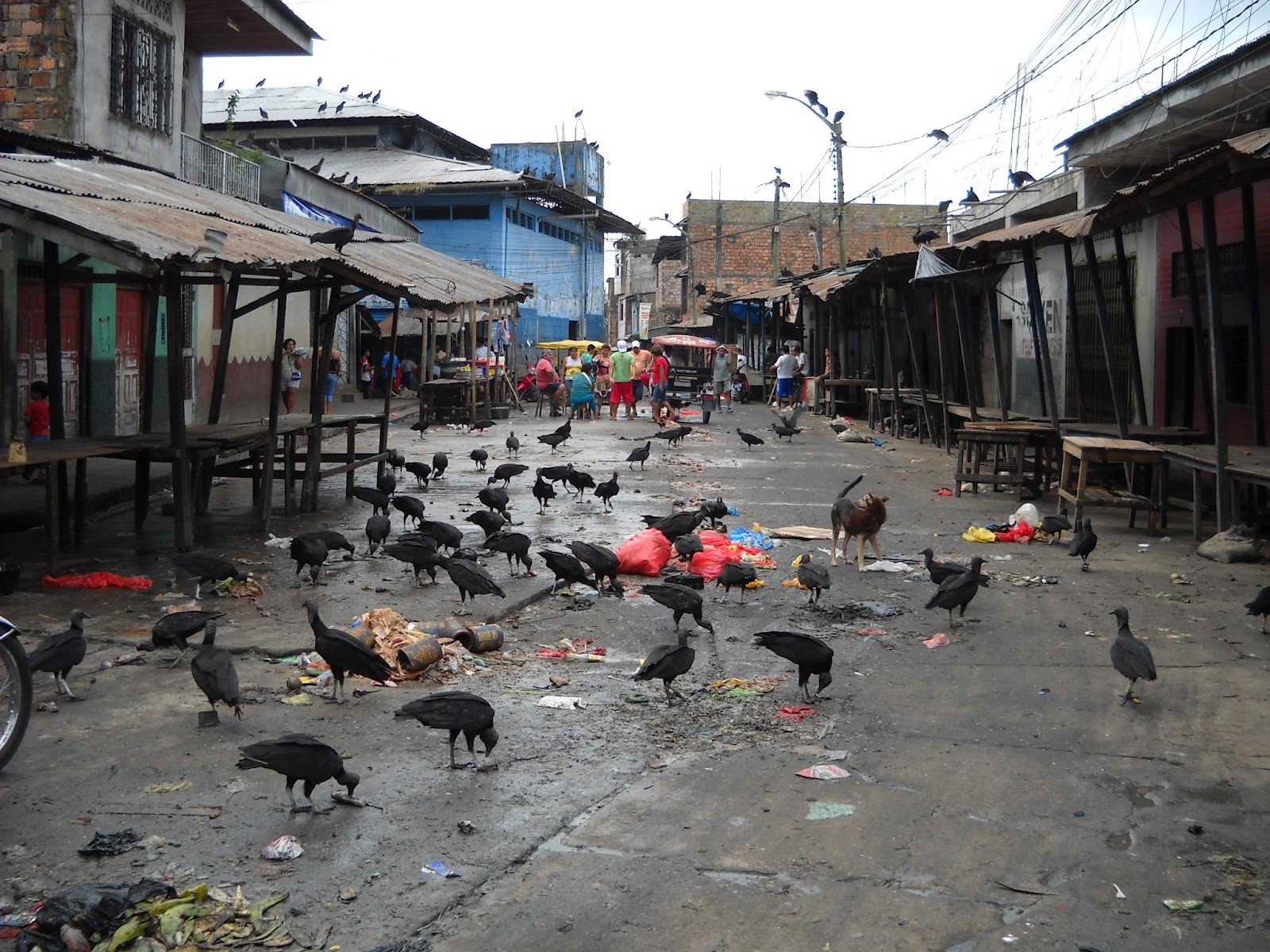
Near the entrance at Belen Market one finds stuff.


At the bottom of Belen Market one finds boats

At the bottom of Belen Market one finds junk
At the bottom of Belen Market one finds homes

At the bottom of Belen Market one finds romance

At the bottom of Belen Market one finds promises
Inside Belen Market one finds strangeness
Inside Belen Market one finds common good for all and terror for the confused
From top to bottom at Belen Market, Iquitos, Peru one finds things unlikely to be found in the Modern world. It's a challenge to move among the dogs and vultures and the slime on the muddy paths that separate the buyers from the sellers, the steady from the wandering. I see homes others will never live in, and i see them shudder at the sight of DDT, thinking surely life cannot be so wrong. Monkey skulls on a table. The horror. Filth and decay. And the babies? "They don't do anything with them," as I heard recently.

The market is for life. To me it is a grand mystery. I will come back to it again to attempt an explanation.

 http://nodhimmitude.blogspot.com/2012/08/belen-market-iquitos-peru.html

http://nodhimmitude.blogspot.com/2012/08/iquitos-belen-market-2.html

http://nodhimmitude.blogspot.com/2012/08/belen-market-iquitos-3.html

A gentle reminder that my book, An Occasional Walker, is available at the link here:

http://www.amazon.com/Occasional-Walker-D-W/dp/0987761501/ref=sr_1_1?s=books&ie=UTF8&qid=1331063095&sr=1-1

And here are some reviews and comments on said book:

http://nodhimmitude.blogspot.com/2012/04/dagness-at-noon.html

Sunday, August 26, 2012

Iquitos, Peru: Belen Market (Part 1 of 4)


To read the rest of this story, please turn to the following link;
http://www.amazon.com/Iquitos-Peru-D-W-Walker/dp/098776151X


Iquitos, Peru is a city of about a half million people, though it seems small to me as I walk the main streets of the place, seeing the same people daily, some of whom I have now an acquaintanceship that allows me to stop and chat a bit. I know some people slightly, and thus the city seems small enough to be sort of like a familiar place, if not exactly home. I live in Iquitos as much as I live anywhere, meaning I am here, happy enough, and don't mind if I stay longer. I feel that way about a number of places I've been in Peru and Bolivia, though some places are really those I could be happy to return to for the duration should such ever be possible for my wandering nature. Here in Iquitos I find myself as much at home as I can think possible for now, and one place within the place is really what draws me and keeps me, which is the Belen Market area. Belen, Spanish for Bethlehem.


Belen Market


It is there that I found a pair of cayman skin boots in a back alley where a hugely obese man sat on a plain wooden stool shirtless in the heat and worked by hand to repair worn out shoes. He has no shop, just his regular place on the ground where his shoes are spread all around him and his tools and threads are close at hand, as is the ubiquitous garbage and buzzards sorting through it all. He sat and stitched and gabbed with his mates as they too worked on shoes. They all sweated, their teeshirts rolled up their bellies to their armpits, men in shorts and plastic flip-flops mechanically stitching old shoes day after day for the duration of their lives. It's a social life. It has it's charm, I think, like being in school forever without the harassment of lessons and teachers, just a group of boys hanging out for the day.At the Belen Market the closer one is to the river the lower on is on the socio-economic ladder, I think. The poverty is clearer, the garbage thicker, the stench a lot stronger. It is there I found the cobblers and saw a pair of boots so ugly I thought I might be ill from the sight. Alligator skin boots, not at all the works of art I didn't buy in Trinidad, Bolivia when I had a chance. I saw a pair of boots that were homemade rather than hand made. The skin was filthy and greyish and stiff. The heels were flat and too long to work as catches for ones stirrups, and they were just poorly put together overall, the soles nailed on over top of other soles falling apart. And the cobbler, when I asked, said he wanted 30 soles for them, or $12.00 U.S. give or take. I feigned outrage and offered him ten soles, about $4.00, to take them away. We settled on 18 soles. I even got a bad to haul them out of the depths of the market. I was unhappy that the alligator skin boots I wanted so badly were actually such poor things as my new boots. But life is often compromise. I had a project to work on to give my days some focus. I walked through the market and made my way home to make these boots as good as I could.


alligator skin boots from Belen Market


I had a pair of nice cowboy boots from Bolivia but I fear I have done permanent damage to my feet by walking in them for so long. The boots, very nicely made and good looking, were the largest size I could find in Bolivia, and they were at least a size too small for me.I needed the boots I bought, sort of, to replace the ones crippling me. But the new boots were so ugly I couldn't bring myself to wear them in public. I thus went in search of a shoe repair shop, which I found later close to the market, and there I met a girl, 30 something, whom I have been seeing infrequently since. But I got nowhere with the boots' repair. They were in such bad shape the cobbler at the shop gave up entirely. The boots had been painted black, latex paint gobbed all over, and the cobbler didn't want to deal with it. The soles need replacing, and he claimed not to have the size or anything close. So I got the girl but didn't fix the boots. Such is metaphorically at least the nature  of my time at the Belen Market.
View of the Amazon River from Belen Market

I went in search of paint remover over the next few days when it became clear to me that though I could pick off the paint with my hunting knife I could never do a good job of it. I went to shoe repair shops and finally I though of a paint store to find paint remover. I got a small bottle of it and took it home to fix up my boots right. I've used paint remover often over the years in restoring furniture, and when I applied the stuff to my boots I didn't get the right effect at all. I found that the shop had sold me, not paint remover but lacquer. I had to then remove that to get back to the horror of my boots in their primary condition. After a tantrum at the paint store I went back home and pondered my state. Belen Market had boots unavailable most places, and thus it could be possible there would be other things for me I couldn't expect to find elsewhere, something to fit my skins. Little did I realise how right that would be, if not a perfect fit for my boots.

The Sky, as rulers of the market survey their domain.

Everything dies, and it's at such an accelerated pace at the market and especially in the jungle that one comes to breathe easier for it, death being so close all the time that ones fears become faint, the end so close it becomes part of life at last. Everything dies, and much of it ends up at the market to be consumed in some way, often enough as mere garbage flowing slowly toward the river through the layers of oozing mud on the walkways, sometimes more productively as food, clothing, medicine. Sometimes death produces what might be food and medicine for the mind, perhaps for the soul.


Shop at witches' alley, the Street of the Exotic, formally Pasaje Paquito, Belen Market

Everything in the Amazon, and elsewhere of course, is slowly-- sometimes rapidly-- made into smaller. Death is everywhere and death means that what was its size in life becomes parts and bits and particles. It could be a pornographic display of private life on public display. Or it could be life itself as is.


Belen Medical Market

Oten things are a harm to us, and part of my medical treatment for things that ail me is a walk through the market to look at how life is lived in a zone beyond my usual experience.But no. I mean that I like the weird and hate the boring. I like looking at strange and exotic stuff and behaviour even if it sometimes sickens me and sometimes outrages me. I have no idea what I see most times, but I have a reaction, based on my life to date. And then I ask and think and wonder and come away a stranger more than strange. I know less and less the more I live and learn. And I know less because of trips daily through the market place of death and rampant life that is Belen Market.


Herbal remedies, jaguar skins, and illegal drugs for sale.
Peruvians are a happy lot, it seems to me. I have a full account in my notebooks detailing what I know or think I know and what I have at least written about as if I know. I love Peruvians generally in the same way I hate Muslims generally. But not all Muslims are always primitive animal people deserving of extermination, and not all Peruvians are the people I love being among. Peruvians are so often killers that I wonder how they can be otherwise so decent and lovable and kind. They kill just about everything that they see. Much of the killing is gratuitous. Great people. But they kill a lot.

Anaconda skin for sale with drugs and skulls, Belen Market.
Even when I write that I much like a person I am reluctant to put a picture on the Internet. I might like the person, but that person might suffer from being associated with me. I'm not always the kind of man one would brag about knowing. So, the Dutch girl who came with me one day to the market is not shown here. She was less than sensitive about taking pictures of people, and I suggested that to ease whatever nervousness people might have about her taking photos of them that she show them what the photo looks like. She took a picture of the lady below, and as luck would have it, as the lady timidly reached to take the camera she had an attack of shyness and didn't actually take the camera at all. We see here the end of her fishing the Dutch girl's camera out of a vat of hot sauce. The Dutch girl said her camera smelled great all day. It also dried out and worked just fine.

She dropped a camera in the hot sauce

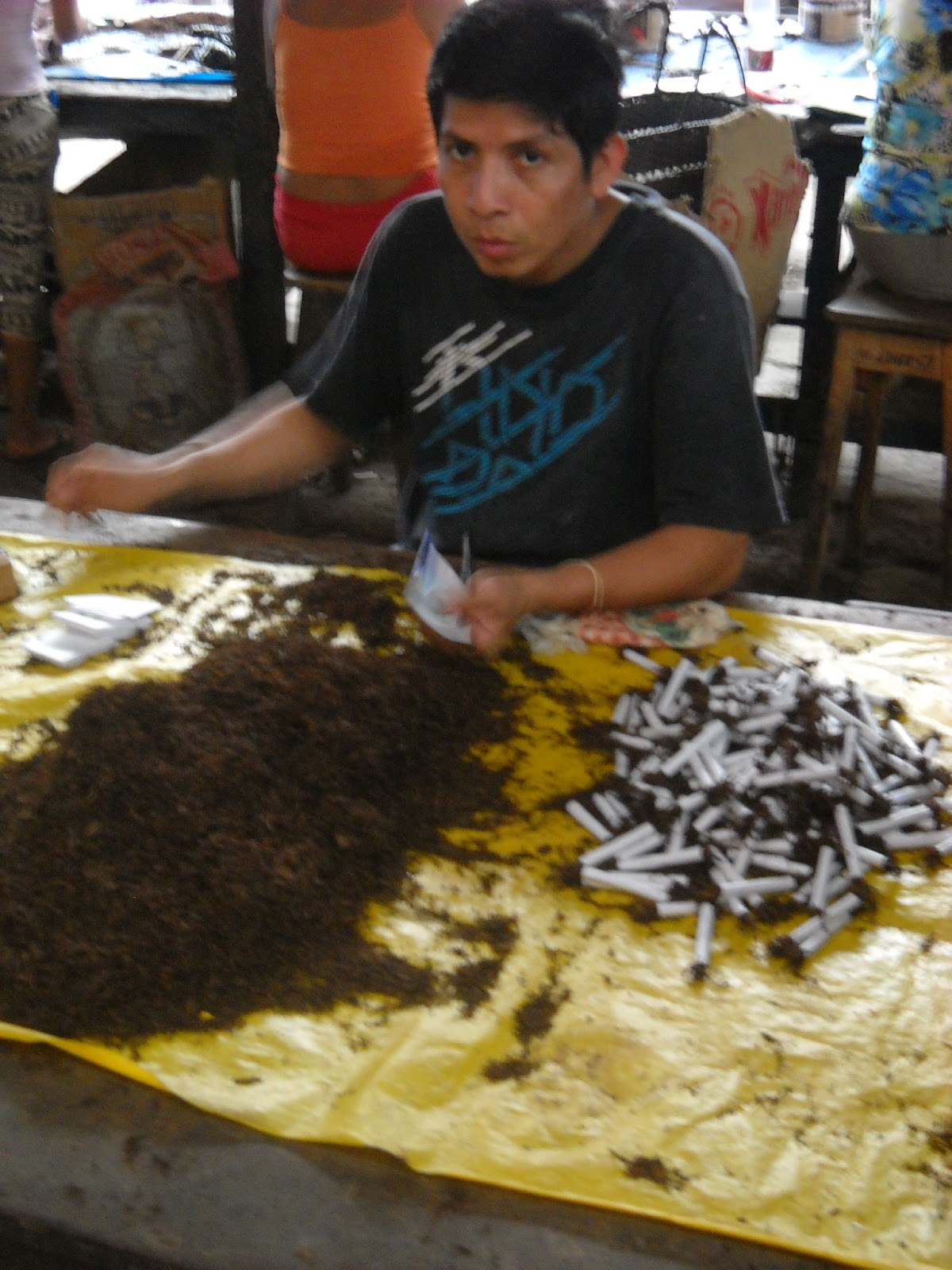
Much of Peruvian life would be not only frowned upon by the usual social engineering crowd and much would even be illegal in the Modern world, five people on a motorcycle, none with helmets, no seat belts, no stopping at the intersection for red lights, no much of nothing that we take as part of normal life in the police states of Modernity. And what could be more offensive to the social engineer that making money by making cigarettes for the poor? At the market there are dozens of tables at which sit men and women and children rolling tobacco into cigarettes. There is no tax. There is no control. For the fascism of Modernity this alone must be as horrible a sight as any one would find in Peru.

Tobacco sellers making handmade cigarettes, Belen Maket

The cigarette makers move faster than my camera's shutter speed as they grab a bit of tobacco and a piece of molding paper and press it with a stick to insert a chunky-looking piece of paper into the mix to make a cigarette from tobacco that must blacken the lungs immediately.


.

Smoking is some kind of leisure activity for the poor. The tobacco is "organic" here. It might approach healthiness in such case. If not healthy, it at least produces some nice local art. Snake at at the bottom of the tree is probably a moral statement!


Health is what this particular street in the market is all about. Every day I am greeted by smiling people who are keen to sell me things to make my eyesight better. Everything else in that section of the market is illegal in the Modern world. But for those who need a stuffed anaconda, the market is the ticket.


One of the vendors I chat with daily at Belen Market. 

One can pick up things for fun, like piranha head key chains. 


 Or one can get plants for whatever medicinal purpose they might have. I got three of them for no reason I can think of. But the uses for yucca are endless, especially good in making bread.


I am a lover of Modernity, but I hate fascism.I see fascism (the real thing about which I have written a full length and well researched book full of quotations and footnotes and such academic bullshit to shore up my proven thesis) and I see it to the point I hated living in Canada so much that I would have preferred living in a Muslim hell-hole to living with the Freak Show police of Modernity as it is so often today. I hate Canada with such passion that I could almost celebrate if it were to slip into the ocean like Atlantis, never to be seen again. Canada is a police state. Ask yourself when you last had chicken for dinner. What did it look like when you bought it. Or in this case, goose, I think.


Goose guts for dinner


I don't hate the police, and I'm not a violent lunatic anarchist who wants to smash everything. In fact, some of the few people I can say have been about as close to friends as I have had in Peru and Paraguay and Bolivia are police. Police and fascists have, mostly, little in common. The police state has little in common with a state filled with police. The police act within the law to maintain the legal order. They like rules at a personal level, and as much as that they like the group life of police. That's what I like about the police I've met. The police state Canada, to use a place I have had recent familiarity with and loathe so passionately that I cannot write about it further or I would end up deleting hours of hard-done typing, is so psychotic that it is unbearable to me any longer, and yet the Latin American authoritarian states I have visited for this past year are freedom itself in comparison. How can this be?

I was walking home one evening when a staggering drunk passed my by, and he, being a nasty drunk, decided he was going to take out his anger on a parked motorbike. Without exaggeration I will write that there could be as many as a quarter million motorbikes in Iquitos. The drunk tried to kick on the the two hundred of so lining the street he was on, and as he went to kick, he lost his balance and fell over. Not my problem. I didn't kick him, either. I just looked as I got out my camera for a snap shot. But this is Peru, and this is not the police state of a typical Modernist nation. This is something different, and that difference has changed my mind about life as we know it. Along with my indifference to slaughtering animals in the jungle, I am coming to see clearly the benefits of the ethnic nation. Yes, idiots often refer to me as a racist, and I know what racism is, again having written a whole book on the subject, as per above. But I see ethnicity now as something valuable and right in the world, much of my current vision of this right coming directly from the Belen Market. So, there on the street was the bleeding drunk.

If I had been alone in the dark with this arsehole I probably would have taken the opportunity to piss on him. I might have kicked him in the balls as well. In the Modern world such as he are the worst of parasites, calling down the full force of social engineering to save him from himself so he can continue being a piece of shit at the public's expence, i.e. costing not only tax dollars to fund the police state of social workers and other fascist minders but also infuriating the public with his shit behaviour while being lauded as a victim of normalcy. If I could get away with it I might even have killed this guy. That's how disgusted and off the chart angry I am with the Freak Show of post-Modernity. But this is Peru, so I just took a picture and watched as a crowd of people came to see the fellow lying on the street bleeding. This is Peru, and the fellow on the street is Peruvian, just like nearly everyone else around him. To me he's a piece of shit.


Drunk missed the bike he was trying to kick.

A lady knelt down beside this arsehole and stroked his hair and asked him if he was OK. A couple of men called the police on cell phones, and a man knelt down and felt the drunks chest to ensure he was still breathing. Everyone in the area came by to tend to this creep. Not me, of course. I waited for the police. I wanted to see the Death Squads at work here. I haven't seen anything remotely violent so far, and this seemed like a good chance to find the Latin American Banana Republic at its most stereotypically evil. I can like that in some of my moods.

At least five minutes into this minidrama a couple of traffic police came by and called in the drunk and asked for instructions. Then they hauled the drunk up and got him more or less on his feet, though they had to hold him up. They held his wrists as he tried to punch. One officer held the drunk like a child because the other officer had to bend down and straighten the drunk's leg. The cops chatted with the guy, coaxed him to settle down, and one cop stroked the drunk's face. The police didn't shoot this puke. He's Peruvian. He's one of theirs. He's family in some sense that makes sense to them. They didn't smash him. They didn't shoot him. They didn't disappear him. It was clear they were seriously concerned about him and wanted to help him get home to safety. Everyone here knows first hand how seriously dangerous this life is. This is not a sanitized bubble as is Modernity generally. Here life is on the line every minute of ones life. Everything dies. Everything is eaten.

Turtle soup in the works

I love the Mercado Belen because it is a death house of epic scale. But that's only one half of the market. The other half will have to wait till I return, assuming so.

Closing time at Belen Market

Till next time, enjoy this life while it lasts. I'll be out for a walk around. I want to think about how to present the next half of my time at the market. It shocks me. I hope to get it right when I try to put it to words here.

http://nodhimmitude.blogspot.com/2012/08/belen-market-iquitos-peru.html

http://nodhimmitude.blogspot.com/2012/08/iquitos-belen-market-2.html

http://nodhimmitude.blogspot.com/2012/08/belen-market-iquitos-3.html

A gentle reminder that my book, An Occasional Walker, is available at the link here:
http://www.amazon.com/Occasional-Walker-D-W/dp/0987761501/ref=sr_1_1?s=books&ie=UTF8&qid=1331063095&sr=1-1
And here are some reviews and comments on said book:

http://nodhimmitude.blogspot.com/2012/04/dagness-at-noon.htm

Saturday, August 25, 2012

Iquitos Facts and Fictions

[I'm experiencing some technical difficulties. Will complete this post as I am able.]

For me, the Amazon doesn't become more interesting as I go farther into it; it becomes less interesting because it becomes huge and generic. Iquitos allows for the specific as it were if one is determined to dig a bit into the muck of jungle that surrounds the local life of eating and normal living. One is often faced with "jungle guides" hoping to take out tourists to see wildlife and so on, but I find the most exotic animal to be something one need not look far to find. This is, for me, a life-changing journey that explodes most of my assumptions about life and its meaning to date. Such will be the main focus of the rest of this installment of my travel notes about Iquitos, the strangest animals on the planet. Allow me to digress, of course.

I left Pucallpa for Iquitos to travel for six or so nights by cargo boat, in this case a leap into luxury compared to a similar trip by boat in Bolivia. This trip was also boring because of my extreme adventures previously, though it was far from the comfort most people expect, I would think, given the ubiquity of Norwegian floatels in the Caribbean.


But the chef was nice. Very nice. Very homosexual.


I made sure to wink at him and smile before dinner.


Often we would stop along the Ucayali river to unload and to find the boat visited by locals selling things.


Those living the local life live it as if there is no other, and they are as happy as one can hope for. Perhaps one travels to see what normal can be.

[add photo]

Normal has its differences from place to place.


Having arrived in Iquitos I took a taxi into town.

This is my return to Iquitos after a miserable time at Leticia, Columbia up river from Iquitos, four days or so by boat, a trip I took in a state of high expectation of beauty and adventure, not much of which happened for me. Thus, I returned to Iquitos, and here I am at a second or even third or, as I think it through, a fourth hostel here. I am staying at La Casa del Frances just off the main square.

More about that to come.

To read the rest of this story, please turn to the following link;
http://www.amazon.com/Iquitos-Peru-D-W-Walker/dp/098776151X


Iquitos background

Iquitos, circa 1910.
Iquitos, Peru is filled with tourists most days, and many of them of two types: there are those who fly in from Lima or Cuzco, as a rule, and who sit in large groups at the local American owned outdoor cafe. Many of these tourists come as an organised group and stay together as they move from one place and "experience" to another. One such group I met consisted of people in their 30s and 40s who hailed from Chicago, Washington, D.C., and California. When I mentioned to one such group sitting out that I am from the north west and that all points beyond North Dakota are, to me, east, I was immediately raged at by an intense and angry woman who demanded to know what I meant exactly by saying "Everything beyond North Dakota is white." I'm still puzzled by the fascist Left's reach to find "racism" at every turn. The woman was obviously wealthy and socially successful and probably has a stunningly important job in government. I, on the other hand, am more like the second group of tourist/traveler in Iquitos.


I am one of those who comes by boat. The boat I came to Iquitos on is not significantly different in look from the larger one above. Little, in fact, has changed in the past 100 years of travel to this remotish place in the Amazon. Today boats bring different faces and different cargo, but life on the Amazon River carries on much as always.


 People walk the Malecon and meet and greet and dine outdoors and enjoy life. Work carries on apace. People here have children. Life is quite and relatively good.


Some come to Iquitos as tourists; others come to work in the oil and mineral industries. I am a tourist, all things said and done.

The second kind of tourist in Iquitos arrives by boat rather than charter plane and in an organised group. Many if not most of the boat people come with backpacks, stay a few days, perhaps go on a jungle safari of sorts and fly back to the city. Some, and they are substantial in number, come to Iquitos to take hallucinogenic jungle drugs, primarily ayahuasca with DMT.

Others, and they seem to be few in number, are serious scholars at universities studying plants, animals, and sometimes local history. But most non-locals are souvenir hunters, including Peruvians themselves.

The locals live in this city of half a million by doing ordinary jobs suited to the location and local opportunities, which is to say that though there is great opportunity to be involved in cocaine business I haven't seen any of it and doubt that many here bother with it, preferring to live normal and longer lives, if somewhat poorer in terms of money. It's a busy city, and it needs food constantly to survive, which is the major scene I encounter all day, the buying and selling of food, much of it fish from the local rivers. Cocaine is for the distant. Fish is everywhere. Here are some local details.
Iquitos is the largest city in the Peruvian rainforest. Located in northeast Peru, on the left bank of the largest river in South America, the Amazon....

European-Peruvians established Iquitos as a Jesuit mission to the indigenous peoples in the 1750s. In 1864 it started to grow when the settlers created the Loreto Region and made Iquitos its capital. It is the seat of a Roman Catholic Apostolic Vicariate.

Among the unique communities formed by the 19th-century rubber boom immigration was one of Sephardic Jews from Morocco. Many of the men married Peruvian women and made families in Iquitos. They established a synagogue and the Jewish Cemetery. By the end of the 20th century, four or five generations later, most descendants were no longer practicing Jews. In the 1990s, a descendant of a Jewish settler undertook serious study of the religion and began to revive Judaism among his family, friends, and other Sephardim descendants. After years of study, with the help of a sympathetic Conservative rabbi in Lima and another from Brooklyn, New York, eventually a few hundred people learned and practiced and converted. (Conversion was necessary as their mothers were not Jewish.) Many of the converts emigrated to Israel under its "right of return" policy. 

[http://en.wikipedia.org/wiki/Iquitos

And.


Iquitos, Iquitos: Central Plaza [Credit: Walter Aguiar/EB Inc.] Amazon River port, northeastern Peru. It is located about 2,300 miles (3,700 km) upstream from the Atlantic Ocean and 640 miles (1,030 km) north-northeast of Lima. It was founded in 1864 at the site of an Indian village and became the chief shipping port for the region during the rubber boom of the late 19th century. After 1912, when production dropped drastically, the city’s population declined.
Iquitos remained stagnant until the 1950s, when interest in the economic development of eastern Peru was renewed.

http://www.britannica.com/EBchecked/topic/293337/Iquitos


I've met tourists in packaged groups, hippie drug takers, wandering college kids, and scholars here in Iquitos. To my surprise I met an orthodox Jew who zips around the town on a motorcycle, one of the few people in the town who wears a helmet, which alone caught my eye, and a blue helmet with a huge Star of David on it.

To read the rest of this story, please turn to the following link;
http://www.amazon.com/Iquitos-Peru-D-W-Walker/dp/098776151X


A gentle reminder that my book, An Occasional Walker, is available at the link below.

http://www.amazon.com/Occasional-Walker-D-W/dp/0987761501/ref=sr_1_1?s=books&ie=UTF8&qid=1331063095&sr=1-1

And here are some reviews and comments on said book:

http://nodhimmitude.blogspot.com/2012/04/dagness-at-noon.html


Friday, August 24, 2012

Iquitos, Peru


To read the rest of this story, please turn to the following link;
http://www.amazon.com/Iquitos-Peru-D-W-Walker/dp/098776151X


I first arrived in Iquitos for a few days of sightseeing in July 2012, my intention being to catch a cargo boat upriver for seven or eight days to the frontier with Ecuador, my destination when I first arrived in Peru in Sept. 2011. I travel slowly. But I didn't expect to travel this slowly. It's now Dec. 2012 and I'm not going anywhere voluntarily for some time yet. This is Iquitos, and I like it. I like it so much that I have now enough copy to publish a whole book about how I like it. But there's the details, you see, that make the liking more than just a matter of an easy place to hang out. Her name is.... Well, that can wait. I have a lot of reasons for being here and for staying. Over the course of these months I've written much about the city and its history, and here I want to add a bit from a fellow who was here about 100 years ago, a man I wish I had met, a man whose spirit continues in others I do meet.

The course of my writing has changed radically since I began this session on Iquitos. Everything has changed, and much promises to change still. In a way, it's a boom time. this is how it was then. Following this, for many posts and hundreds of pages, is how I see it today, as that evolved and evolves now. Here's a guy then:
IQUITOS sprang from the necessity for a receiving and distributing centre for rubber and merchandise respectively for the Upper Amazon system, corresponding to Manaos and Pará for the Lower. It was composed for all practical purposes, like so many riverside towns, of one long street with its one-and occasional two-story adobe (mud) houses with corrugated iron roofs (how unromantic) in which were to be found the offices and warehouses of the local branches of American and European houses, and for the rest, a number of lazy and careless side-streets where lived the native population of cholas and Indians (canoemen and rubber-workers) and Peruvian caucheros.

The houses in these back-streets were built of laced bamboo with thatched roofs; the walls were transparent in places, their only virtues being their coolness, cleanliness and cheapness. Telegraphs, telephones, sewers, electric light, ice-plants and pavements were refinements of civilization which had not yet penetrated into this community. Water was carried from springs along the river-front in earthernware jars by the native servants. The town sprang up like a "boom town" in the West, doomed to exist only as long as the commercial possibilities of which it was born should last. When I was there the population must have numbered about three thousand; later it grew to be a town of 20,000 inhabitants.
Today Iquitos is a boom town of closer to quarter of a million people, as many as 1,000 American per week flying in, others from around the world at least as many. It can still be a wild and open city. Often, though, it's a great place to spend a few days taking in the sights of the Amazon, walking around, just being, and using credit cards rather than wheelbarrows full of silver dollars.

The town is fifteen days in a twin-screw steamer from Pará, some 2,500 miles. It is situated near the junction of several big tributary rivers, by which the rubber used to be brought down to the main stream from the camps, its site marking the limit of practical navigation for ocean-going steamers all the year round. In the year 1900 Captain Todd of the gunboat Wilmington, U.S.N., stated in his official report of his cruise up the Amazon that the average depth in the rainy season from Iquitos to the sea is 120 feet.
Most people fly in and fly out. A hundred years ago, and for some today, the going was by boat, and somewhat harder. 
[W]e were not ashamed to call on the first rubber-merchants we found, Messrs. Marius and Levy, and dispose of our cargo. Having frustrated these gentlemen's attempts to "short-weight" us, we brought a cart round to carry our money away. It weighed 120 lbs. There was no paper money in Iquitos. Silver was the only circulating medium. It was the custom to go shopping with a wheel-barrow.
The civil system is easier to cope with as well, no armed insurrections against the local boss needed to save ones skin from a skinning at the duty office.
And so it happened that the Governorship of the province of Iquitos was not only a post of great personal responsibility, but also a very lucrative one.

In the absence of a civil police force, the town was under a kind of martial law controlled by the military, with the Governor at their head. Bribery and corruption were rife, and each successive Governor strove to make his fortune more quickly than his predecessors. Catch-as-catch-can was the order of the day. With the inexhaustible supply of rubber on the one hand, and the undying demand for it by the civilized world on the other, every ambitious free lance had his eye on the Governorship.
I'm liking it here after all these months, and if someone likes me too, then perhaps I might stay ever longer still. Or, like the narrator above, I might sometime write my own version of this below: 
The first, somewhat laconic, entry in my journal records our departure under the date of Friday, June 13th, 1899...

"Finally left Iquitos to-day after nearly two months of `mañana.' "

    And so we could say "good-bye" at last:

    "Chug puncha cama, Iguitos!"

Fritz W. Up de Graff, Head Hunters of the Amazon: Seven Years of
Exploration and Adventure
. (Garden City, New York: Garden City
Publishing Co.) 1923; pp. 125-144
http://etext.lib.virginia.edu/toc/modeng/public/UpdHead.html

But I haven't gone yet.

Dag Walker
Iquitos, Peru
Dec. 2012

I've been traveling in south America for close to one year, and I am close to exhaustion when it comes to writing about it all. I write 2-2,500 words per day every day, and though I haven't been posting much of this, I have it on paper, adding ever more weight to my pack as I stuff yet another full notebook into the crawl space that I was sure last time couldn't hold anything else at all. Lots of writing. But I get tired, even if it's interesting work, and here I find I am almost out of energy to write about a town in the Amazon that I like enough to have returned to and will be staying at again for a fairly long time, I hope so I can regain some energy for the next year or so of travel and writing about it. Here in Iquitos, Peru I took some time over the past few days to sit out and drink coffee and read a bit. I blew through The Girl Who Kicked the Hornet's Nest, Stieg Larson's last installment of a book about a young woman with Asperger's syndrome, as I read it. I found the books to be worthless, the last nothing much more than a trite rework of any conspiracy at the top of the secret service agencies, best done in the movies, for example, Three Days of the Condor, and many others. But it's light reading, even if at heart it's a sly propaganda effort to justify the Communist Party and to bash anti-Communism. Ironically, this series of books will leave the Swedish Communist Party filthy rich, Larson having left the royalties to them rather than his wife. I needed a break, and I break by reading novels. I read a women's romance novel about Israel, Bodie Thoene, Return to Zion, and a sequel, A Light in Zion. In the Amazon, even in a heavily touristed town like Iquitos, a good selection of English language books is hard to come by. I did read Oedipus Rex in Spanish. But more to the point here is that I read a book I'd heard of but new nothing of, James Redfield, The Celestine Prophecy. It's bad. I read it because I'd read everything else I could find and that was all that was left for now. I read it too because it's set in an imaginary Peru and an even more imaginary town of Iquitos, the very place I sat as I read it. My best guess it that author might have set down in this town once on a tour with other coastal American yuppies, that he might have spent some time looking around the craft stalls down the street from me where he would have bought a wad of fabric bracelets to give to friends back home to show he is thoughtful. But he doesn't display any familiarity with Iquitos itself. The book is cringingly bad, both shallow to the nth degree as philosophy, even for "New Age" drivel, but worse, it's so badly written I nearly gagged as I sped through it. Still, Redfield is hugely popular, and I certainly am not. He's sold millions of copies of his book. I haven't sold even one million copies of mine. [Here's your chance to help that score.] REdfield is very popular, and I am very not popular, to put it mildly. But I am in a position to write, in spite of my exhaustion and reluctance to write much at all at this time, some clearer and more honest and informed account of Iquitos, Peru. It's an interesting place worthy of attention, particularly because it is a much visited and semi-well-known place in Peru. Some of what's to come will repel many readers. Such is life. An honest account is far better than that of a middle aged man who sits in California dreaming about what Iquitos is like.

Ad for shipping to Iauitos


I'm in Iquitos, Peru for the second time, having returned rercently from Leticia, Colombia, a place I found unattractive in the highest. I'd gone by canoe from the Peruvian border town of Santa Rosa in the middle of the Amazon River to the border town of Leticia, Colombia. I arrived at Leticia via a sewage filled backwater. I stayed as long as I could bear and now I am pleased to be back in this jungle city on the Amazon where I feel more comfortable, where I am not faced with Colombia's round-the-clock discos blaring competing accordion music and recorded karaoke singers wailing about their heart conditions: "My heart is broken, aching, melting, stinking, empty, and otherwise in need of an operation." Back in Iquitos, thank the gods.
Downtown Iquitos
Colombia, after so many had praised it so highly, was Hell for this weary traveler, and returning to Iquitos is as close to paradise as one can hope for, even if the stark contrast makes it so much easier to like Iquitos, a town some will be familiar with as the setting of much of the so-called novel The Celestine Prophecy, not a novel at all but a poorly conceived and poorly written essay on one man's utopian day dream about the future of all Californian yuppies. I'm in Iquitos. I must wonder if the writer of The Celestine Prophecy has been here himself, though he sets most of his book in Peru and much of that in Iquitos itself.


My Iquitos' church as opposed to the fictional church of Redfield's book is a block or two from the town centre, a not particularly interesting building at the corner of the Plaza de Armas downtown. Iquitos is a small town and thus has nothing much of interest in architectural charms outside some imported tile covering generic 19th century warehouses. It would be a mistake to come here expecting to see an interesting city.

One flies in or takes a boat.
Redfield, the author of the Celestine Prophecy, sets his characters in conflict with an imaginary classically reactionary cardinal, as if a place Iquitos would have a bishop at all, let alone one who has created a palatial monstrosity of indoctrination and political intrigue from which he plots to keep the world from knowledge of an Aramaic language text of 7th century California-style hippiedom recently discovered in-- Peru! (If you haven't read the book, believe me, I did not make that up.) The church in town is run by an old guy who didn't get far in the hierarchy of the Catholic organisation. He's not at all sinister. He's a priest. He's an old guy. Don't expect much from a visit to the church in town. If you haven't read the Celestine Prophecy but were considering it, try instead the less dreadful but equally inept "science" version of utopia by B.F. Skinner, Walden II. It's slightly more interesting and far more plausible. It truly sucks, but not as badly as The Celestine Prophecy.

Boats coming to Iquitos have changed very little since 1900 or so.
I'll write more about Iquitos as it really is, though it's not going to make everyone excited about this city in the Amazon jungle. Some will be outraged. I like it here. More to come. 

A gentle reminder that my book, An Occasional Walker, is available at the link here:

http://www.amazon.com/Occasional-Walker-D-W/dp/0987761501/ref=sr_1_1?s=books&ie=UTF8&qid=1331063095&sr=1-1

And here are some reviews and comments on said book:

http://nodhimmitude.blogspot.com/2012/04/dagness-at-noon.html

Saturday, July 28, 2012

Boots. Real Boots.

I´m in the riverside city of Iquitos, Peru after a boring but easy trip up the Rio Ucayali from Pucallpa. I´ve been in Iquitos for five or six days now and am waiting for a boat that might show up to take me to the deeper jungles at the frontier with Ecuador. I don´t know when the boat will come and when it will go. That depends of things. No one can say for sure what those things are. So, I take this as an opportunity to go shopping, and the first thing I bought was a handmade pair, or closer to homemade pair, of caiman skin cowboy boots. These boots would look just right on the feet of any cowboy tramping around the 19th century. Man, these here boots are... handmade. These boots are so clumsy looking and so tough, being alligator skin, that I stare at them and can´t quite believe this would be normal for a working man 150 years ago. I like them.


To read the rest of this story, please turn to the following link;
http://www.amazon.com/Iquitos-Peru-D-W-Walker/dp/098776151X


A gentle reminder that my book, An Occasional Walker, is available at the link here:

http://www.amazon.com/Occasional-Walker-D-W/dp/0987761501/ref=sr_1_1?s=books&ie=UTF8&qid=1331063095&sr=1-1

And here are some reviews and comments on said book:

http://nodhimmitude.blogspot.com/2012/04/dagness-at-noon.html