

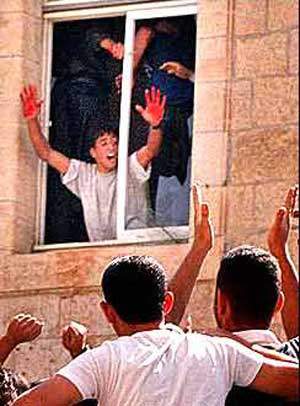
"I can't believe they are doing all this for two captives," said Ali Sharara.

http://www.news24.com/News24/World/Middle_East/0,,2-10-2075_1969477,00.html
****

 Posts
All Comments
Posts
All Comments
"I can't believe they are doing all this for two captives," said Ali Sharara.
http://www.news24.com/News24/World/Middle_East/0,,2-10-2075_1969477,00.html
****
 Hindus are not pacifists. For over 12,00 years Hindus have suffered the worst treatment of any people on Earth at the hands of their Muslim conquerors.Today it's more of the same, and it is the same treatment others can expect at the hands of Muslims, as history and our current news flashes show too clearly. Hindus are not pacifists, and neither can any of us be in the face of Islamic jihad.
The war we face is eternal, and this is only one battle in it. It is a battle between good and evil. The question is only which side one chooses to fight for, there being no third way but death of the soul and shame eternal.
"The Supreme Lord said: I am death, the mighty destroyer of the world, out to destroy. Even without your participation all the warriors standing arrayed in the opposing armies shall cease to exist.
Therefore, get up and attain glory. Conquer your enemies and enjoy a prosperous kingdom. All these (warriors) have already been destroyed by Me. You are only an instrument, O Arjuna."
Bhagavad Gita, chapter 11, verses 31-33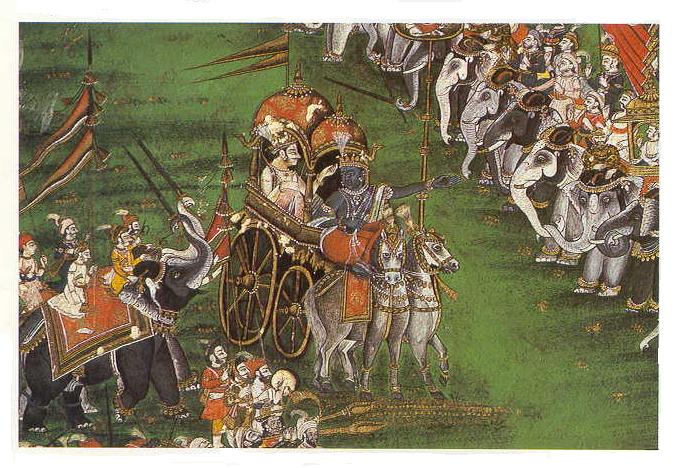
There is no end to the struggle against Islam, not here, not there. Muslims will turn to further violence till all the world is like Pakistan as Naipaul describes it:
"His world had shrunk to a hut in a crumbling village. He was prepared for even that to crumble away further, once the faith was served."
Among the Believers, Penguin: p. 89.
****



 Social activism is a recent development in Human history. It presupposes the concept of "progress" and linear history. It requires of people the very concept that there is such a thing as "change." The idea of change is not so simple as most of us would assume. Many of the finest minds in Western philosophy have argued very well that there is no such thing, that what we think of as difference from one to another is illusion or mistaken interpretation. Most non-Western religion and philosophy takes the above position. It is a hallmark of Modernity to claim that there is progress in a meaningful sense, and that people have a hand in creating and guiding it as they will. If we take for granted our concept of progress, then we cut off our understanding of the misoneism of the primitive world, those who are the current majority of the world's population and those who were, until c. 1750, roughly, everyone. We hurt ourselves in not recognising our revolutionary lives as Modernists. We few in the Western world believe in progress, and we are few indeed. The world's majority not only do not believe in the concept of Progress, they hate the idea, and when and where they can they kill those who propound it. We who live in the mind of the Modernist West not only believe in progress as obvious, but we believe it to be a good, and we believe we can make it happen faster by our own efforts. We indulge in "social activism" to make the progressive changes we demand.
 in my isolation here, the phrase, "apostate church." That church might well be all about me and my sensitivities. That would be a church I know nothing about me, and one I would not care to know. The church of "Jesus Loves Dag" is a church I would call my mirror. I could like that. I am not a harsh judge of my own character. My mirror loves me. One of these days I'll even clean off the picture of Cary Grant that hangs over it. But I'm not ever going to some damned church that offers me jazz vespers and hugs at the doorway. Nor will I darken the doorway of a church that ponders " the thought and teachings of Jesus."
It turns out God is alive and well in Canada. So are angels, heaven, and ESP
BRIAN BETHUNE
[....]
But as Bibby's series of public opinion surveys shows, a funny thing happened on the way to an atheist Canada: rumours of Christianity's demise have been greatly exaggerated. Eighty-one per cent of Canadians believe in God, and two-thirds of us that Jesus Christ is His divine son. Belief in angels, heaven and (to a lesser extent) hell, is almost as prevalent. Crunch Bibby's 2005 numbers how you will -- based on age, on weekly or monthly visits, on denomination -- and the attendance decline not only levels off but shows a turn toward growth since 2000.
[....]
Just as it was the decline in attendance among Catholics that drove down the national attendance rate, it is the recent 10 per cent increase in Catholic church-going outside Quebec that has seen those numbers turn around. The uptick makes Bibby think Canada could be in for a "significant revitalization of organized religion." Especially since research indicates that perhaps two-thirds of the 16 per cent-strong No Religion group will "re-identify" with their birth faiths as they seek rites of passage relating to marriage, children, and death.
[....]
In a result that will seem, in the post-9/11 climate, both unsurprising and somewhat alarming, 18 per cent of respondents are uneasy in the presence of a Muslim. But this is hardly evidence of the much-feared anti-Islamic backlash. Canadians save their real suspicion for born-again Christians: 31 per cent of us are unhappy merely to meet one. (Jews, presumably viewed as more of an ethnic than a religious group, disturb only five per cent of Canadians.)
It's hard to guess what images formed in respondents' minds when they were given such stereotypical labels. In the case of born-again Christians, the current U.S. administration is so deeply unpopular here -- among secular Canadians as much for its religiosity as its policies -- that the image may well have been of President George W. Bush. That in itself would have been enough to spike the negative numbers upwards. But almost 80 per cent of Canadians, according to the 2001 census, identify themselves as Christian, and that means unease about born-agains comes from within the faith as well. It's reasonable to conclude that some of the negative attitude toward fundamentalists, Christians and Muslims both, comes from hostility towards fire-and-brimstone religion. And that's never more true than when people fear a political agenda: the proposed introduction of sharia law in Ontario, for instance, or restrictions on abortion or same-sex marriage.
"That 31 per cent number doesn't surprise me at all," comments Rev. Mary Joseph, pastor of Pathways, a United Church-affiliated "progressive Christian community" open to anyone interested in the thought and teachings of Jesus. "This is a fairly religious country, with a huge Christian base. But many people resent the element of judgment in fundamentalist churches." A lot of it, Joseph concurs, flows from the same severe stance on sexual matters -- abortion and homosexuality, divorce and remarriage, premarital sex and birth control -- that did so much to empty the mainstream churches in the first place. But there's another element as well, she adds: "People interested in alternative spiritual ways feel harshly judged and unwelcome too, like all those Christians who are interested in Buddhist meditation."
... A third of us believe in astrology, and more than half (57 per cent) are fairly sure ESP exists. Two-thirds think there's life after death, more than believe in either heaven or hell. Slightly more than 31 per cent consider it likely that we can communicate with the dead, although 46 per cent think we can do so with the spirit world. It seems a glaring contradiction that the number of people who believe we can communicate with spirits is 50 per cent greater than those who think we can talk to the dead -- especially since millions of Christians pray daily to saints, all of whom are dead....

