Tuesday, May 02, 2006

You may be treading on someone’s dreams.


Stogie and I and others are in agreement regarding the nature of our reactions to the story of the child beaten by the imam. There are those who are in disagreement.

  1. Yom Says:

    Oh come on, an idiot commits an injust act and the whole Muslim community is blamed.

    The imam is not divine, for all I know, he may not even be qualified to teach.

    Enough of your verbal diarrhea ok?

  2. John G. Says:

    Yom,
    you are wasting your time pleading for reasonable,rational thought on this site.The majority here are blind to anything except their own fantasies and fanaticisms. That apart, mind you, they are probably nice, pleasant people away from here but they have some problems separating their desire to free Europe from the threat of cultural vandalism and the excitement they feel discussing fantastic ideas to achieve that aim.
    So, just remember, don’t be too critical, you may be treading on someone’s dreams.
    John G.

Cops Lost Cop-killer?

Is it possible that a man was released from prison and not deported to Somalia but was instead allowed to continue his criminal carreer to the point that he murdered an on-duty policewoman during the course of a robbery? Am I misreading this story?

****

Was Beshenivsky suspect passed over for deportation?
(Filed: 02/05/2006)

The Home Office is trying to discover whether one of the supects in the killing of WPc Sharon Beshenivsky was among 1023 foreign criminals mistakenly released from prison instead of being considered for deportation.

According to the Times Online website, Mustaf Jama, who is thought to have left the country, had served half of a three-year prison sentence for robbery after being convicted at Sheffield Crown Court.

Jama, 25, had been granted permission to remain in the UK for seven years after arriving in the country from Somalia in 2000, the website claimed.

But thirteen months ago the Home Office gave prison governors detailed rules about deporting foreign prisoners.
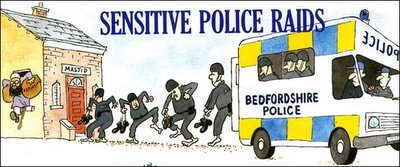

A separate 90-page Home Office circular set out a strict timetable for considering each foreign prisoner for deportation.

Earlier, in a severe embarrassment for Home Secretary Charles Clarke, it emerged that a stream of non-UK convicts was being released into the community for a whole year after the new rules should have come into force.

A Home Office spokesman confirmed that an investigation had been launched to establish whether Jamma was among the criminals who was set free in error.

"We are looking into it but we are unable to provide any further details," she said.

Jama is believed to have been given the right to stay in the UK. But it is unclear when, and no details of previous brushes with the law are yet available.

Police have warned that Jama, thought to have been born in Somalia, may have tried to leave the UK.

Five other men are in custody awaiting trial for the Pc's murder.


Charles Clarke is to make a new statement about the foreign criminals blunder in the Commons tomorrow.

Shadow home secretary David Davis said: "Yet again we see that the levers at the Home Office are not connected to anything.

"The Home Secretary and his ministers need to realise they need to do more than just issue ineffective 90-page circulars."
http://www.telegraph.co.uk/


Was suspect freed in error?

****

Wondering how this could be true? Look at the link below:

http://nodhimmitude.blogspot.com/2005/11/brit-coppers-dance-to-muslim-tunes.html
****

Monday, May 01, 2006

Leadership Quiz

What do you think? Hitler? Stalin? Mao?

I found a personality quiz at http://baconeatingatheistjew.blogspot.com/, and here it is. I think it's broken in my case, though it seems to sum him up really well.


WHAT FAMOUS LEADER ARE YOU?


I think it's really broken in my case.
****

Corporal Punishment; Islamic Lesson.


2006/04/19 - Tétouan, MOROCCO.

When Nihad, a 6 year old girl, walked on a prayer carpet belonging to Moustafa LAZRAK, a "f'qih" and imam, he beat her.

On April 19th, in Tétouan, Morocco, a "f'qih", whose role is to teach Islam, attacked the 6 year old girl at the Sidi Ahmed El Bekkal School. In Morocco the "f'qih" is a public education occupation in Islamic law: the position is of 'imam/teacher' in Koranic schools.

Moustafa LAZRAK was praying in the early afternoon, in the classroom, although it was time to begin the class. Entering the room, little Nihad inadvertently stepped on the prayer carpet of the "f'qih". Lazrak then beat the child.

Later in the afternoon, after the beating, the school phoned Fatima, the girl's mother, explaining her that her daughter had "fallen". When Fatima discovered her daughter' condition, she questioned the persons in charge, who delivered another version of the story.

The child confirmed the facts. The imam-teacher hit her violently and she fell on the ground.

The mother was alerted two hours later. Fatima drove Nihad to the hospital where doctors confirmed the gravity of the lesions and trauma. The child's family decided to take legal action against Moustafa Lazrak.

Further facts came to light: this wasn't Moustafa LAZRAK's first violent attack against children.
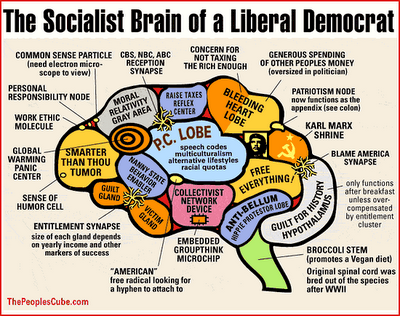
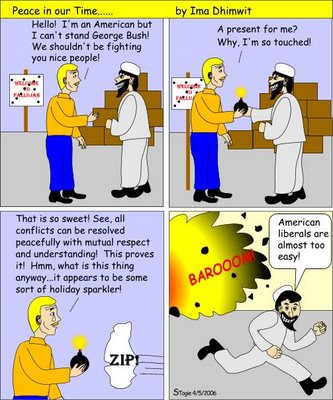
According to a person in charge of Human Rights the Sidi Ahmed El Bekkal school administration pressured the children who witnessed the attack to deny the facts.
http://en.france-echos.com/?p=86#more-86

Original translation by SUXXES
[Ed. Dag.]

Sunday, April 30, 2006

This comes from a site I go to daily:


http://pedestrianinfidel.blogspot.com/
****

That's the theoretical part. Here's Stogie's version of the practical side of socialist idiots:


http://saberpoint.blogspot.com/
****

Thanks, folks.

The Shame that is Islam

"What matters is manners rather than morals," D J Enright observed, in writing about Genji. "And shame lies less in being naughty than in being so maladroit as to be discovered"
****

"If they find out, we're in real trouble."
"It's OK, we won't get caught."
****

America does not understand the language of manners and principles, so we are addressing it using the language it understands.

bin Laden's 'Letter to America'

http://observer.guardian.co.uk/worldview/story/0,11581,845725,00.html

****

Islam is orthopraxy. There is no morality in Islam. It is not a religion in any sense that non-Muslims can agree to. Islam is a matter of correct behaviour according to Islam-only. REgardless ot the innateness of anything, nothing of it matters outside the precepts of Islam, not morality, not truth, not even common Human decency. Islam is a shallow orthopraxy, a matter of right behaviour within the confines of "Islam itself and nothing else." It is right manners and behaviour according to Islam. A religion of murder and terrorism robbery, rape and ruin,
a religion of murder and terrorism. So long as one practices the formulae acording to set ritual and is never caught doing otherwise, then all is acceptable. Murder your children? Why not? It's fine with Islam so long as it's Islamic.
****

Saturday, April 29, 2006

Jirga to kill anyone reporting honour killing cases to police By Zahid Jan

DIR: Anyone reporting an honour killing case to the police or filing a case with the court will be killed by the jirga (tribal court) since the publicising of such cases has brought a bad name to the area, Malik Faiz Muhammad, a member of the Nihag-Wari jirga in Upper Dir, said on Friday.

The Nihag-Dara Wari jirga had issued a controversial verdict in favour of honour killing around 15 days ago, declaring it a permissible act.

"We stick to our verdict that honour killing is permissible and those who commit it will not be liable to any punishment. We will also not allow the aggrieved party to report the case to the police or file the case before a court. We will kill those who will violate the jirga verdict," he said.

http://www.dailytimes.com.pk/default.asp?page=2006%5C04%5C29%5Cstory_29-4-2006_pg7_1
****

Next we'll look at the childish and ugly side of shame culture, the kind of culture that produces the story above.
****

"Trial by media" is very much a feature of political life at the moment, and it works largely because it seems that the public has different standards of proof for misdemeanours among those in public life from those it maintains for private citizens. In public life it is enough to be "tainted" with suspicion for one's future to be blighted. In practice, the same is probably true of people accused of offences in their own small social world, and yet we maintain formally that justice operates on much more rigorous principles.

In other words, the rules about responsibility and blame are not the same across cultures or even across different sectors of the same culture. Clichés about there being "no smoke without fire" and "mud sticks" on the one hand, and being "innocent until proven guilty" on the other, for example, represent fundamentally different assumptions.

I remember watching then-President Nixon on television trying to exculpate himself from the Watergate affair, and thinking then, "What proof could he conceivably - even in principle if not in reality - adduce which would lead people to believe him?" The answer, of course, was "none".

A useful distinction for articulating these different assumptions and rules is that between "shame" culture, and "guilt" culture.

They were articulated by Dodds (1951). Discussing ancient Greek epics and drama, he traced an increasing sophistication in their development, from a conception of the world and the moral order as arbitrary and subject to the whim of the gods, through to a later understanding of the limits of moral responsibility. Even among the great tragedians, for example, Aeschylus' Oresteian Trilogy is about individuals simply caught up in the workings out of the curse of Atreus; Sophocles makes the issue of responsibility more problematic, and for Euripides it resides more fully in the individual. Aristotle eventually identified "hamartia" or "tragic fault" as an attribute of the individual. Dodds typifies the distinction as that between "shame" and personal "guilt"

Benedict (1946; rpr 1967) spells out the distinction in more detail in her discussion of Japanese culture, prepared during WW2 to help Americans to understand their enemies. She distinguishes between the "guilt culture" with which the West is familiar from its criminal justice system, and the "shame culture" of more collectivist Japan.

We are familiar with the rules of a guilt-culture: it is after all the staple of crime stories in literature, film and TV. The wrongly-accused person, even someone who is "framed", struggles to demonstrate innocence and be vindicated - or wrestles with his (usually "his") conscience over an undetected crime. The rules can be expressed thus:

Guilt-
culture

Other people believe:

I believe

I didn't do it

I did it

I didn't do it

No problem

I protest my innocence and fight the accusation

I did it

I am expected to feel guilty regardless

I am guilty and am punished


There are two parties to the process: myself and other people. The matrix is set up in terms of what we believe about my wrong-doing (we are only talking about wrong-doing here: credit for good works gets more complicated). I could have put what I know about my wrong-doing in the vertical column, but there are circumstances in which I may mistakenly believe I have done wrong (and feel deeply guilty about it), so belief rather than knowledge underpins this process.

In both cultures there is no problem if we all believe I did nothing wrong. Similarly, there is not much of a problem if we all agree I did it (although there may be arguments about the extent of my culpability). The issues arise in the face of disagreement. In a guilt-culture I will defend my innocence even if everyone else is blaming me. My internal and individualistic judgement is what counts. But by the same token, I may be wracked with secret guilt even if the world believes me innocent.

The positive aspect of guilt-culture at its best is its concern for truth and justice and the preservation of individual rights. The sense of guilt might also preserve us from engaging in wrong-doing which no-one would ever discover: but it can also be misplaced and potentially neurotic.

Shame-
culture

Other people believe:

I believe

I didn't do it

I did it

I didn't do it

No problem

I am shamed and dishonoured by their belief

I did it

No-one knows, so I am not shamed

I am guilty and am punished


In a shame-culture (sometimes referred to as "honour-shame culture), what other people believe is much more powerful. Indeed, my principles may be derived from the desire to preserve my honour or avoid shame to the exclusion of all else. The down-side is the licence it appears to give to engage in secret wrong-doing.

It may motivate me to ensure that I am not only innocent but am seen to be innocent: that I not only do not engage directly in criminal or antisocial behaviour, but that I stay far enough away from it not to be tainted by association in any way. This is the standard the media seem to expect of politicians and other public servants, because (as quoted above) "mud sticks", and there is "no smoke without fire".

On the other hand, suspicion becomes sufficient to convict in judicial terms. Moreover, in a pluralist society, culpability (I'm trying to avoid saying "guilt") may be determined by one powerful sector of society and in ignorance of the facts of the case, since there is less incentive to prove them. And in that plural society, if my particular sector or reference group think there is "nothing wrong with", say, driving after drinking alcohol or stealing from one's workplace or cheating an insurance company, it may not exert any influence on my behaviour in that respect. If we are to believe the myths, the Mafia is run on shame-culture.

The sources I cited have located shame-culture principally in the more collectivist societies of the East, but of course the two cultures co-exist (perhaps with different relative influences) everywhere.

The European and North American cultures, claiming a Judeao-Christian heritage, claim guilt-cultures. Psychologically, guilt is proclaimed to be a more "advanced" emotion than shame: Erikson's popular model of personality development (which respects other cultures than the North American) sees the emergence of basic shame as part of the second stage in the growth of the ego, but guilt as the third. He follows Freud, for whom the Oedipal stage was central to the development of the super-ego, with its capacity for generating guilt, which creates a social conscience. (Roughly!)

But shame is everywhere in the informal justice practised in families, schools and work-places.

"You are not coming out with me looking like that! You'll show me up!"

"One more sound out of this class, and you will all be kept in after school!"

Trivial, but shame-culture driven. Bernstein touches in passing on how positional ("Because I say so") rather than rational authority, tends to inculcate shame-culture. Even in the formal justice system, it has been argued that a "welfare" rather than "justice"-oriented approach particularly to young offenders - making the punishment fit the criminal rather than the crime - has shame-culture connotations.

Neither culture is perfect: neither is alien to our experience. Expressions of "fault" and "fairness" can be found in both, but they operate according to very different rules.

"What matters is manners rather than morals," D J Enright observed, in writing about Genji. "And shame lies less in being naughty than in being so maladroit as to be discovered"
http://www.doceo.co.uk/background/shame_guilt.htm
****

Islam is a 7th century Arabian Penninsula tribal code made into a violent poligion, a political religion for ten year old adluts. It's a formula of behaviour for primitives. It has no right place in the modern world. Our pretenses and our sentimentalities are disgusting and hateful. When we allow the continuation of Islam anywhere we are truly guilty of allowing crime to flourish. We should be ashamed.

Saturday, April 29, 2006

Stogie at Saberpoint has a sensitive and sane post on United 93.

http://saberpoint.blogspot.com/2006/04/flight-93-tale-of-heroism-and-courage.html
http://saberpoint.blogspot.com/

****

Anti-Americanism and French Manifest Destiny: Update


As time allows I'll come back to this post during the day to add details of language chauvinism and the concept of French Manifest Destiny. We might by the end see a pattern of French triumphalism and exceptionalism, a pattern of thought in the French national mind that begins long before the Revolution, that comes from the forming of France as a nation through the dictionary project of the Academie Francaise. To start, we can look at the current French elitists as inheritors of pre-revolutionary entitlement. The elitists of the Academy are still elitists to this day. The French, no matter that Napoleon is gone, still harbour designs to rule the world. And the Dreyfus Affair is still with us in the anti-Americanism of the French. France is still a feudal "nation."

Below is a first look at the people who would ban Google from Europe and who would control the Internet for chavinistic reasons, for the benefit of the elitist phantasies of the gnostics. If we try to make sense of the anti-Americanism of Europe today we do well to look to the past for some of our clues.
****

The Académie française, or French Academy, is the pre-eminent French learned body on matters pertaining to the French language. The Académie was officially established in 1635 by Cardinal Richelieu, the chief minister to King Louis XIII. Suppressed in 1793 during the French Revolution, it was restored in 1803 by Napoleon Bonaparte. It is the oldest of the five académies of the Institut de France.

The Académie consists of forty members, known as immortels (immortals). New members are elected by the members of the Académie itself. Academicians hold office for life, but they may be removed for misconduct. The body has the task of acting as an official authority on the language; it is charged with publishing an official dictionary of the language. Its rulings, however, are only advisory, not binding on either the public or the government.

http://en.wikipedia.org/wiki/Acad%C3%A9mie_fran%C3%A7aise
****

We see directly above that the elitists of the French academy are few in number, great in power and status. More, they are nation builders within France. They are the few who determine what is legitimately "French." Their primary concern is French language purity. For those with the time and the interest we suggest looking further into the posts below on Herder and Fichte in the archives to see the reactionary developments of language purity and identity politics that so horribly plague us today. Otherwise, continue on to see how today the French still struggle against nature and history to hold back the free flow of Humanity's development through language strangulation. Prior it was the dictionary; today it is the Internet.
****

Google, The French, And World Domination; The Culture War Begins
Jason Lee Miller

Published: 2005-05-13


"[T]he Internet [is] the most recent and the most sinister facet of American cultural imperialism to emerge: the Internet is anchored in the United States; the vast majority of World Wide Web sites are based in the U.S and are in English; most software used to navigate the Internet is in English; and search engines are in English (Kim, 1998)".

A cloud is moving toward Europe. It carries with it the thunderous, electrical, (digitized?) calling card of storm-fronted majesty, raining in streams of zeros and ones, boisterous, anarchical, bellowing the dirges of Europe's heyday, reeking of Yankee imposition, a new brand of manifest destiny wearing a name tag pregnant with the usual oddity of foreign names-a name that gurgles from it foghorn style as it moves across the sea-Gooooooo-gle!

Was that a tad dramatic? Judging from France and the EU, it may be an accurate description of how they feel about it.

When Google announced a 10-year, $200 million plan to digitize the literary world, invoking the assistance of Harvard, Stanford, Oxford, Michigan University, and the New York Public Library, France's National Library president Jean-Noel Jeanneney spun around in his chair and called up President Chirac.

In protest to what the French press soon called "omnigooglization," and what Jeanneney called a decidedly "Anglo-Saxon" affront, the national librarian wrote a scathing letter to Chirac. In the letter, though he didn't condemn the effort, Jeanneney voiced his fear of what that meant for the representation of France and Europe.

Here are some excerpts from the letter published in Le Monde:

"The real issue is elsewhere. And it is immense. It is confirmation of the risk of a crushing American domination in the definition of how future generations conceive the world."

"[T]heir criteria for selection will be profoundly marked by the Anglo-Saxon outlook."

"It would have meant The Scarlet Pimpernel triumphing over Ninety-three (Victor Hugo's eulogistic account of the revolution)."

Motivated by the fear that French and other European languages, ideas, and cultural heritages would be lost or obscured in an Anglo-Saxon digitized library, the whole of the EU, except for, of course, Anglo-Saxon Britain, met to begin efforts to create a European online library.

The national libraries of 19 countries committed to the mammoth project of digitizing 4.5 billion pages of text, including Austria, Belgium, the Czech Republic, Denmark, Estonia, Finland, France, Germany, Greece, Hungary, Italy, Lithuania, Luxembourg, Netherlands, Poland, Slovenia, Slovakia, Spain and Sweden.

Luxembourg P.M., Jean-Claude Juncker seemed especially incensed, saying, "…Europe must not submit in the face of virulent attacks from others."

As I am writing this, I realize that it is difficult to decide how to react to such claims. Nineteen whole countries mobilized against an American search engine?

At first, it's laughable. And then, angering. And then laughable again.

At the very least, from an American perspective, it is hard to understand. You can barely quiet the giant "so what?" boulder ping-ponging though your skull long enough process it. Could they really be that threatened by a research tool living in some abstract realm of space?

French feelings of insecurity are nothing new. They have feared intrusion of American culture for years. There are a number of laws regarding public use of language-guarding against the use of "Franglais," or English-French mutations. The word "cheeseburger" was vilified, and there is a law that at least 40% of radio content must be in French.

Add that to a famous Internet prank, where a Canadian student googlebombed the "I'm Feeling Lucky" feature of Google to the end that when a user typed in "French military victories," a page turns up finding no examples and asking, "Did you mean 'French military defeats?'"

But truthfully, this goes beyond America's love-hate relationship with France. It seems the entire world is forming a love-hate relationship with America.

Take, for example, the musings of Canadian writer, Robin Matthews. Though he recognizes the appeal of US culture, the "dazzle, the variety, the abundance, and the vigor," he goes on to call it an "invading culture" comparable to the Nazis, and those who buy into it, "collaborators."

And this perceived cultural domination is transforming from what one scholar termed as "McDonaldization" to what many are calling "Googlization."

Europe had begun limiting America's technical reach before this fear of Google emerged by slapping Microsoft with antitrust litigation. China's emerging Internet market has caught the ever-expanding hungry eyes of Yahoo, Ebay, and Google.

The appetite seems to go both ways. People worldwide, the general consumer at least, are embracing what American companies have to sell. Understandably, these companies are, in turn, exploiting the markets. This is the nature of a global economy, and along with it comes, perhaps to an extreme, nationalistic outrage and rejection of what is perceived as cultural imperialism.

But realistically, isn't it as simple as America having something to sell, and the world wants to buy it? Is that a conspiracy? Or is it a challenge to the rest of the world to produce?

Those questions aside, it is becoming clear to the Europeans that a presence on the Internet has become extremely important. In the words of Hungarian Culture Minister Andras Bozoki, the concern is "that something not registered on the Net will not be seen as existing."

So the fear is not necessarily economic. It is the fear of losing identity. It is the fear of one global culture dominated by gray-suited American executives.

But the apparent hypocrisy (and racism/culturalism?) has to be noted that what Europe is doing in the name of nationalistic inclusion smacks of extreme exclusivity.

And though Houman Samadi, cultural assistant at the Washington, D.C. chapter of Alliance Fracaise, contends that France and the EU desire "plural worlds with plural points of view," it would appear that the plural world cannot contain anything remotely American.
Google The French and World Domination The Culture War Begins

****

French Manifest Destiny and chavinism continue today as usrely as in the age of Richelieu. Today it emerges most clearly as anti-Americanism.

****

To continue:

The following details on the origins and actions of the Academie might seem to the causal reader somewhat irrelevant to the questions of fascist Islam and Left dhimmi fascism in our modern times. I argue, however, that these details below will show clearly the roots of French and European anti-Americanism very clearly to the benefit of us all, and that we will see the problems of anti-Americanism and French manifest destinarianism in a look at the Academie Francaise's Dictionary.

Compare the ethos of the Continental nation-builders to that of the English in the making of dictionaries. Formal nations in the modern sense began in 1648 with the making of the Treaty of Westphalia. But what is a nation other than control of restricted and legally recognized land boundaries? What makes a people nationally coherent and valid as a nation? Prior to modern nationality there was the identity of religion, such as we find today in the primitive politics of the caliphate of Islam, the ummah, and the ulema. Below that we find the tribal ties of many primitives, tribes, clans, and family, some of that extending so far as to ethnicity and "race" so-called. but what is a nation? What makes America, for example, a nation? What makes a Black man from New Jersey as American as a Mexican immigrant or a Korean in Los Angeles? According to the Germans Herder and Fichte and others, the commonality is language. Language makes one German regardless of ones place in any other sphere of national life, whether one be a peasant or a lord, whether one is German in Prussia or in Prague. Language is first in identity. (Refer to past posts here if you will on Herder and Fichte or continue here.)

To create a unified national identity one needs a hegemonic language. Latin served that purpose for a thousand years. It was the language of Catholicism. In France as a specific place, Latin gave way to the vernacular Parisian. What good is that to a Norman? None. The source of political power comes from legitimate authority, and that comes from command and obedience. force is not legitimate. Shouting in a foreign language is ineffective. Language hegemony is effective and legitimate authority. Those who communicate in French, for example, share a common and collective mind. To be French is to speak French. To speak a "pure" French is to be more French than those who speak creole or patois. To speak French as a French person is to be French rather that to be other. The less one speaks another language the more one is French. To exclude is to be exclusive and therefore more legitimate and more authentic than the synthetic. The Academie sought purity and Frenchness in a unified language set down for all time in the first Dictionnaire.

Thanks to the catastrophic defeat during the Battle of Hastings of 1066 the English developed a dual language of Germanic and Latinate. English borrowed for the duration and will continue to do so, while the French, victorious in that battle did nothing more than celebrate and gloat. To this day the French fight a rearguard action to keep language purified of borrowed words in a futile attempt akin to keeping rain out of a lake.

To be French is to speak French and to be "not non-French." The French, obsessed with dreams of empire, seek language hegemony across the world, find it possible to assimilate French speakers into the empire on the basis of any pretence of French language skills at all, such as inclusion in Francophonie of for example the nation of Roumania, based on a pretentious French speaking royal court in the 18th century. In this mad and idiotic scamble for hegemony and empire any lie will do if it can be spoken in French. And anything is potetially French so long as it's not Anglo, particularly American Anglo. We see as a result the insanity of deliberate ethnocide in the form of Eurabia. The endof France as a nation begins even before the concept of nationhood.
****

Dictionnaire de l'Académie Française

« On dit d'un mauvais traducteur, qu'il fait sa traduction à coups de Dictionnaire. »

The Académie française was founded by Cardinal Richelieu in 1635 with the primary goal of creating a French dictionary. A total of eight editions have been published in the years since its foundation, from the first edition in 1694 up until the eighth edition in 1935. The ninth edition is currently in progress. The ARTFL Project, in collaboration with the Projet d'informatisation du Dictionnaire de l'Académie française, is pleased to offer electronic versions of the first (1694), 4th (1762), 5th (1798), 6th (1835), and 8th (1932-5) editions.

http://www.lib.uchicago.edu/efts/ARTFL/projects/dicos/ ________________________________


The Académie is France's official authority on the usages, vocabulary, and grammar of the French language, although its recommendations carry no legal power. Sometimes, even governmental authorities disregard the Académie's rulings. The Académie publishes the official dictionary of the French language, known as the Dictionnaire de l'Académie française.

A special Commission composed of several (but not all) of the members of the Académie undertakes the compilation of the work. The Académie has completed eight editions of the dictionary, which have been published in 1694, 1718, 1740, 1762, 1798, 1835, 1878, and 1935. It continues work on the ninth edition, of which the first volume (A to Enzyme) appeared in 1992, and the second volume (Éocène to Mappemonde) in 2000. In 1778, the Académie attempted to compile a "historical dictionary" of the French language; this idea, however, was later abandoned, the work never progressing past the letter A. As French culture has come under increasing pressure with the widespread availability of English media, the Académie has tried to prevent the anglicisation of the French language. For example, the Académie has replaced loanwords from English (such as walkman and software) with French equivalents (baladeur and logiciel, respectively).
http://en.wikipedia.org/wiki/Acad%C3%A9mie_fran%C3%A7aise
****

We follow the view that today's West is in a state of reactionary violence against the democracies of the Enlightenment project. When the French, for example, attempt to restrict access to the Internet, they do so in the same way the Medieval Church banned literacy from the laity. When the state attempts to guarantee employment to the working classes we see it as the same social relationship as that between manorial lord and serf, the serf indentured to the land and its holder by feudal obligation of labour in exchange for security of arms and provision in times of famine. The neo-serf is indentured to the state in the same way the serf of old was indentured to the estate manor. In the pseudo-capitalist state socialist economies of Europe the serf now works his allotted days in the service of the state to which the serf, rather than owing labour owes taxes through labour. Analogous to church tithes is the payment made to the media for its communications monopoly, the recasting of reality to the masses. The education system, like the scholastics of the Middle Ages, is governed and perpetuated by the professors of the Academies. The entitled aristocracies of the old days are the new aristocrats of the European Union. We see a flight to the future via the past. This is a return to the Middle Ages. We'll look at feudalism first and then at neo-feudalism.

From wikipedia we pick up some brief history of the term "Feudalism." Regardless of the facts of it, we use the term at least metaphorically here to provide a sense of social relations between members of an economic base. The point is to provide context for our argument that today's Europe is a continuation of Medieval feudalism, today's neo-feudalism in the form of State Socialism.
****

The word "feudalism", first coined in the 17th century, is based on the Late Latin feudum, which was borrowed from Germanic * fehu, a commonly used term in the Middle Ages for a fief (land held under certain obligations by feodati).

Even though the word components are from the Middle Ages, the concept of feudalism was not invented until the modern era. Feudalism refers to a general set of reciprocal legal and military obligations among the warrior nobility of Europe during the Middle Ages, revolving around the three key concepts of lords, vassals, and fiefs.

The word feudalism was not a medieval term. It was invented by French and English lawyers in the 17th century to describe certain traditional obligations between members of the warrior aristocracy. The term first reached a popular and wide audience in Montesquieu's De L'Esprit des Lois (The Spirit of the Laws) in 1748. Since then it has been redefined and used by many different people in different ways.

French historian Marc Bloch, is arguably the most influential medieval historian of the twentieth century. Bloch approached feudalism not so much from a legal and military point of view but from a sociological one. He developed his ideas in Feudal Society (1961). Bloch conceived of feudalism as a type of society that was not limited solely to the nobility. Like Ganshof, he recognized that there was a hierarchal relationship between lords and vassals, but saw as well a similar relationship obtaining between lords and peasants.

It is this radical notion that peasants were part of the feudal relationship that sets Bloch apart from his peers. While the vassal performed military service in exchange for the fief, the peasant performed physical labour in return for protection. Both are a form of feudal relationship. According to Bloch, other elements of society can be seen in feudal terms; all the aspects of life were centered on "lordship", and so we can speak usefully of a feudal church structure, a feudal courtly (and anti-courtly) literature, a feudal economy. (See Feudal society.)
http://en.wikipedia.org/wiki/Feudalism

The vast majority of the population living in feudal Europe was legally bound to provide farming, husbandry and other agricultural services on land held by the nobility either directly or as appanage. In return, the lord offered protection and some measure of localized stability.
http://en.wikipedia.org/wiki/Neofeudalism
****


Friday, April 28, 2006

BBC Muslim/Terrorism Film Review


I'm coming close to thinking outright that what we have today is the same old version of anti-Semitism now dressed up in p.c. and including hatred of America. I call it anti-semericanism. Hate Jews, hate Americans, it's the same Nazi crap all over again. It's the same people in newer bodies but the mind is the same.

Have I ever mentioned that I hate those people? Look, for example, at today's BBC to find a review of the movie everyone's talking about. No, Not United 93:

At the Tribeca Film Festival in New York there has been an enthusiastic reception for what is said to be the most expensive Egyptian film ever made.

The Yacoubian Building (Omaret Yacoubian) is a film version of Alaa Al Aswany's 2002 novel of the same name which depicts the interlinked lives of the residents of a Cairo apartment block.

The Yacoubian Building is a handsomely staged, ambitious and certainly expensive account of modern life in Cairo.

In the west attention will undoubtedly concentrate on The Yacoubian Building's account of how one young man turns to a violent form of extreme Islam in the face of social isolation.

TV star Peter Krause plays Terry - an American made so paranoid about Arabs that when one moves in next door he eventually turns to violence.

He convinces himself his neighbour - played by Egyptian Khaled Abol Naga - is a terrorist. In fact the story leaves that ambiguous.

The producer Andrew Lanter says a commercial thriller can carry a bigger theme about international relations.

"There's a very strong political message about two sides of a story and shouting one over another and voices not being heard, and what happens in those situations," he said.
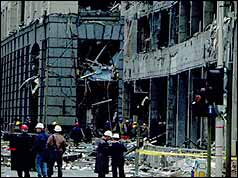

Huh?!

There's some mention of United 93 at the bottom of the article:

The Tribeca Festival opened this week with United 93 - about one of the planes hijacked on 9/11. That opens commercially in the US on Friday.

Some research suggests Americans are not yet ready to go to cinemas in large numbers to confront such a topic... although United 93's generally good reviews may help.
http://news.bbc.co.uk/1/hi/entertainment/4954932.stm

Did I mention that I hate these people?

Let me make it plain: I hate these people.
news.bbc.co.uk/.../24/newsid_2523000/2523345.stm

Did I mention that sometimes I love the IRA?
****

Thursday, April 27, 2006

Headline too foul to print.

This comes from Elder of Ziyon, one of my favorite bloggers. Following Elder's piece is some nonsense from a Leftist Christian outfit, link below. And just because I can, a link to some photographs of Presbyterians at the final link.

****

I just read a bizarre article from looney left cartoonist Ted Rall, pretty much praising Hamas and ranting against the West, saying Israel should give Hamas lots of money and that Hamas has proven its peaceful intentions, plus some moonbat ravings at neocons for good measure. In his worldview, there is nothing good about the West and nothing bad about radical Islam. For example:

The Bushies might have lost Afghanistan and Iraq, but they got exactly what they wanted in Palestine: democratic elections, a peaceful transfer of power, a radical Islamist group ready to disavow terrorism and transform itself into a parliamentary political party, a majority party willing to work with Israel and her allies. It was a staggering victory for the neoconservative agenda, a golden opportunity to co-opt one of the most prominent organizations of militant Muslims in the world, and proof positive that democracy prevails over terrorism.
http://elderofziyon.blogspot.com/2006/04/what-liberals-and-muslims-have-in.html

****

Christians on the West Bank face more fire bomb attacks -26/04/06

A Roman Catholic parish school and a Protestant Bible-study centre in the West Bank have been fire-bombed twice since the Islamist Hamas movement won a legislative election in January 2006, according to Christian clerics in the region.

According to the Presbyterian Church USA News Service, a priest at the Roman Catholic Al-Ahliyya College in the West Bank city of Ramallah says that several fire-bombs were thrown into a school sports room in early March 2006, causing serious damage and destroying equipment stored there.

About a month earlier, said the same priest, several petrol bombs were thrown into an Al-Ahliyya classroom.

In other recent incidents, a Protestant Bible-study centre in the town of Bir-Zeit near Ramallah was attacked, and phrases from the Qur'an were daubed on its doors. Windows in a Lutheran church in Ramallah were also shattered by unknown assailants.

"Our college, our parish school was established in 1856, and during the history of our school such things have never happened before," the parish priest, Father Ibrahim, told Michele Green of Ecumenical News International.

He said he did not know who was behind the violence, but he did not believe that Hamas was involved. He said leaders of the movement who visited his parish after hearing of the attacks offered to send guards to protect the compound.

One theory is that the violence is the work of the rival Fatah faction, aimed at discrediting Hamas and creating chaos in the Palestinian territories.

"We reported it to the police, and up until now we know nothing," Father Ibrahim declared.

A Christian humanitarian worker in the Gaza Strip said a Baptist Bible-study centre that serves as a charity arm for the local Christian community was threatened with fire-bombing if it didn't close its doors.

"Fliers handed out in downtown Gaza City ordered them to shut down their work in Gaza," the aid worker said, "and if they didn't do it, then their building would be burned down. They continued to work there. Some people received threats from an unknown group."

Christians in the Holy Land account for less than 2 per cent of the population these days. There are long-term fears for the future of the historic churches in the region, and Christian leaders in other parts of the world are calling on people to support them.
http://www.ekklesia.co.uk/content/news_syndication/article_060426wbank.shtml
****

Here are some very cool photographs of Presbyterians:

www.presbyterians-r-us.com/

****