Tuesday, November 22, 2005

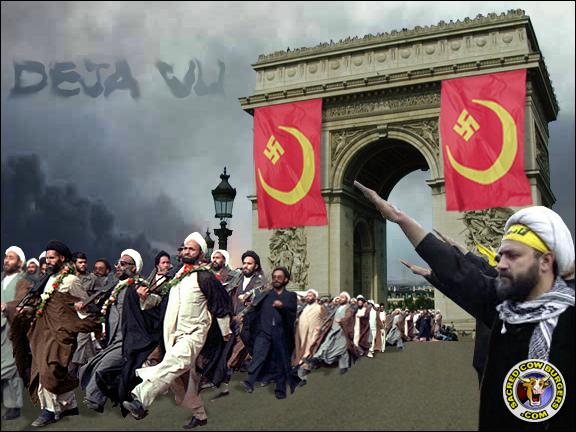
Identity Fascism (5)


Multi-culturalism is the politics of group identity. It is a collectivist politic that defines the person as part of a group rather than the group as a collection of individual people. In the realm of identity politic ideology, the worst thing one can do is devalue the group, such as when one devalues the person by claiming he is "x," which reflects from him and onto the group identity: for example, if a man riots in the streets of Paris he is not a rioter but an expressive agent of Islamic rage; and if he is arrested he is not a criminal but a victim of racism inherent in the system that attacks him and his whole religious community by singling out the rioter and thereby imprisoning the entire group by proxy. If one were to claim that one man is a vandal, then by extension, one is a racist, blaming all members of the man's group for vandalism. One for all and all for all within the group. The origins of this collectivist and tribalist nonsense lie in the origins of Humanity, and it is we in the modern West who are the minority in our approach to man as a private individual free to make his own decisions and accept his own consequences good or bad therefrom. But it is only since the late 18th century that this idea is intellectualized for the masses. It is only in the past short span of years that multi-culturalism has gained credence in the modern West as coeternal with democracy and individualism; and yet the two cannot co-exist. The time is come for us as residents of the West to determine whether we are individualists or collectivists. We are free men and women with the inherent right to privacy that Life demands or we are members of our groups and beholden to the group for our identity and being as free men and women. It cannot be both ways at once.


The question arises when one asks "Who am I?" We get an answer from the German philosopher Fichte that will seem reasonable on the surface, not an answer likely to send us from the room in a screaming rage, but it might with a bit of inquiry into the nature of the answer.


Those who have followed this thesis carefully over the past six months will recall that Herder and Jung and Darre for example all define people from negativism, like a photographic negative rather than negative in a pejorative sense. A person is what he is not. In other words, I am me only if I am not infinite and continuous. I am me only if there is another to limit me and give me definition, boundaries, and identity. I am only me if there is something I am not, not you, for example. Being not you doesn't give me a great deal of identity as me. I must be something within the fact of my existence, other than a simple existence myself. What is being me? It is my mind, for one thing. My mind is nothing if it's empty of things other than pure instinct, leaving me to be as little or nothing more than an animal. What makes me Human is reason, and Reason is the ability to communicate with others through language.


When Napoleon invaded the Germanic areas in the early 19th century the Germanic people were not a united nation of Germans but a collection of disparate men and women living in feudal conditions, owned by Church and landowner and feudal baron. When the French invaded the Germanic lands, what then did the Germanic people have to offer by way of resistance to the French that made them not French and worthy of resisting? They had no national identity, not state to rally to, no overlord calling them to defend anything against invaders from France. What made the Germanic people not French? Their identity as Germans, of course, but what did that mean in a non-national context? It meant, roughly, nothing at all.


Identity comes into play here when Herder wrote that German people have a collective non-French identity because they speak German. The otherwise empty-minded animal being who has language is able to communicate with others and know he is not them and is therefore himself because he is not them; and also, he is able to speak to other German speakers and know that though he is not them he is similar, he is in fact part of a distinguishable group of not-French. But so what? That in itself doesn't give validity to him as a resister to the French invader of other Germanic lands and people, only himself. He might have more in common with the average French soldier than he does with a far removed German aristocrat on the whole. So Herder looks on Germans as a untied identity group legitimate in resistance to French invasion thus: having in common with all other peasants on Earth, the German does not have in common with them his collective identity as a man. No. Though there is a world-wide monoculture of peasantry that varies little from one side of the Earth to the other peasants have nothing in common with those who live close-- if they are not of his identity group, and that identity is what makes the one part of the group in his mind, the means by which we know him as Human.


The individual man is nothing unless he is in contrast to another so he might know what he is not. But, to be simple not other is insufficient: one must be something to be someone. One is identifiable as something by language, the very thing that makes the form of the mind unidentifiable even to the owner of the mind. If you can't think, you're not very Human. And to think, according to Herder and others, you need words, you need language. The language, the words you use, become your identifiable mind and person. If you have a language no one else understands, then your thoughts and identity are wasted and you are not really Human in terms of life's practicalities. Truly, to be Human you must be able to talk to others, and others must be able to understand you. The shared language, the words you use, that gives you identity, and it is only so if it's shared. You can't be Human all by yourself.


If you find someone to speak to who can understand you and you him, then you are a person. Where do you get the very words you use? You get them not from your own making but form your birth group. You get your words from your nation. The nation is your boundary that makes you specifically not another, and that gives you form and identity as a single individual. You, sorry to say, do not define the nation and are nothing without it. You cannot be anything without language, and the very language you speak determines the kind of you you are. If you speak German words, you think in German ways, and it makes you German, not French, no mater how much you have in common with the French peasant standing next to you who can't understand you. You have, in fact, more in common with the baron hundreds of miles away with whom you can speak meaningfully. You and he share your German identity by virtue of knowing things from the depths of German knowledge of yourself and him collectively. Your mind is German and so is his. You are not French. You do not share a mental world with a Frenchman, but you do with a German, no matter how removed he might be from you. When you think, you think in German, and your mind, your being as a man, is German. Your whole personal mental shape and form come to you from language and the thoughts it allows you to have. You are you when you are not another. And you are you if you can be something other than a vacuum, which requires the content of the defining language, the very stuff that makes you something specifically you. You have an identity. You are one of the group and not one of the others.


So what? Much ado about nothing. Except that if you are you and we are we, then we are not them, and they are not only not us but they are others. I am only meaningful in relation to you and my own group, having no identity as a person outside my own group. My privacy as a being in meaningless in itself, only being valid if I have a part in the group identity, and the group being the factor that gives me reality as a being is supreme to anything a small fragment such as myself could be. In short, my person interests in my own life are trivial beyond expression in comparison to the group.The group is the highest expression of my own existence. My group, based on language that gives shape and meaning to me as a being, is supreme always and ever. My language group is not something that sprang up last night with the mushrooms. It is organic in that it has existed from time itself. I, not being anything on my own but only as a part of my group, am also tied to the organic growth of my language group. I being part of the whole, have extension beyond myself as an individual, going back to the mists of the beginning of creation, having always been part of the group identity. One drop is rain, but many drops are an ocean, and the ocean is eternal and independent of the drop. But the drop is one drop that is external in identity as the ocean. Personal identity transcends the personal and is part of the eternal. I am German, and I have always been German in that Germans have always been Germans, and I bei ng here now, am part of the ocean of eternity of Germanness.


I am not a scum rioter in France. I am a Muslim, part of the ummah of Islam. If you imprison me for looting and burning, you imprison my identity as a Muslim, and that is an assault on all of my Islamness and other Muslims.


When we start thinking in terms of identity groups rather than in terms of privacy and individuals, which our mutli-culturalist friends in the West often do, then we are in danger of aiding and abetting Left dhimmi fascism naively. We accept ideas and actions we don't like but don't know how to say no to. We accept the evilness of racism, but we lose sight of the fact that it's not a race that commits crimes only the individual. We recoil from accusations of racism and let criminals go rather than accept that he is not a race and that we are not attacking the identity of the group but only the actor. If we can't distinguish between the actor and the group we will continue to allow our Western Modernity to crumble under the weight of identity fascist idiocy.

In coming posts we'll look at the writings of an anthropologist who argues from a positon of idntity fascism. Once we see this argument for what it is we might become less nervous about identitifying it in public as fascsiim rather than as something we should bend to from fear of personal immorality, of racism, sexism, or homophobia. We might come away from these installments on identity facism less willing to tolerate it.

Monday, November 21, 2005

Oh, No Particular Ocassion

Philobarbarist Fascism and Identity


Social determinists are deeply concerned about the People. The rest of us are interested in people. One might control the masses through sophisticated social engineering projects but no one can ever have a cup of coffee at Tim Horton's with the masses. Those who treat people like bacteria in a social Petri dish like to call themselves social scientists, objective and rational and oh so smart. We, being not so smart as the average social scientist, have no long and Latinate words to describe them, falling back instead on the four letter standards. No, not having any control models and statistical norms to measure social behaviour we sort of sit and listen and chat in the coffee bar with friends and try to pay attention on those occasions when we're not preparing our next bon mot.

Social scientists are all too often more impressed by their own theories than they are by anything resembling reality or good sense. So long as the social scientist doesn't see, as we do here at the fortress daily, the wreckage of socialism in the flesh, so long as the People remain statistics, then the models are lovely. And the further one is from the reality of the ruin the more likely one is to love the work of social science, and that, of course, means loving the People all the more. [Insert some four letter words here.] We see the little fat guy in the white uniform pull up on the street and take out the folding stretcher from the white coroner's van. We see him come almost daily to haul away the remains of the latest drug over-dose victim or shooting victim or beating victim or suicide victim. We don't see models of social change and activism, we see dead bodies, dead from socialism. [Insert more four letter words.]

We work in a working-class area that has gone to Hell. We aren't sentimental about the People. We meet people daily, real ones, and many of them are scary and disgusting, and we work in the fortress here barricaded and monitored to keep ourselves safe from them. And in spite of that they are not our enemies, many of them greet us on the streets and do us small favors and show some common Humanity in their behaviour at times. We take them as they are, and that changes from moment to moment, but they are consistently, always, people, and never, not even once in their whole miserable lives, masses. From an office across town the people who bang on our doors and try to sneak through the windows might be statistics, but to us they are men and women. We don't get sentimental about them. Those who do don't know them or care a shit for them. We do our best.

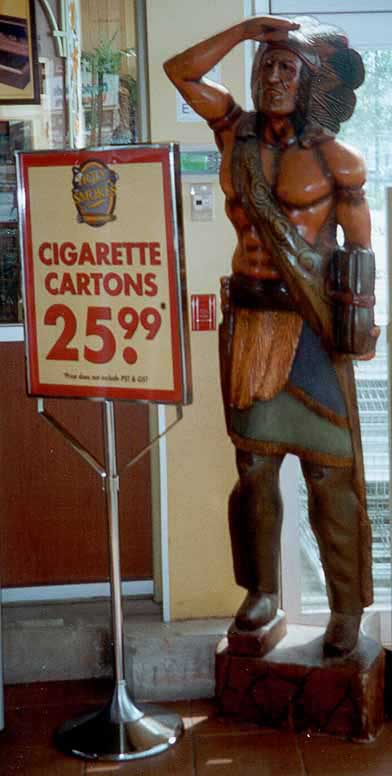
The following story comes from a Canadian newspaper I'm starting to like a lot. This story takes about ten minutes to read. It's anecdotal. It's not a social science survey of First Nations Peoples. It's about a school teacher and her students and their parents and the lives they live. These are not the cigar store Indians most social scientists see when they read statistical reports.
***

All the lost boys and girls
As a teacher in Kashechewan, the author's idealized view of native communities was beset by a classroom of uncontrollable children, heirs to generations of neglect and a dying culture
Laurie Gough
National Post

Saturday, November 19, 2005

In recent days, the Canadian media has focused its collective gaze on Kashechewan, the tiny native community on the shores of James Bay in Ontario. Much has been made of the town's contaminated water, which has sickened hundreds of residents and forced many to be evacuated. But having lived and worked in Kashechewan, I can report that water problems are just the tip of the iceberg. In almost every respect, Kashechewan is a very sick place.

I am a teacher, a graduate of Nipissing Teachers' College in North Bay, where I took a specialization in native education. I chose Nipissing because I wanted to teach in a different culture than my own and because I'd always had an interest in native people and their history. But nothing I learned at Nipissing could prepare me for the realities of teaching natives on an impoverished reserve.

My experience in Kashechewan generated a complete unravelling of almost everything I believed. Until then, I romanticized Third World and native cultures. Unfairly, I put those people on a pedestal, somehow expecting them to be wiser than people from my own culture, more connected to the land, perhaps even possessing an ancient knowledge that our culture had lost eons ago.

When Kashechewan's band-run school offered me a job, I was thrilled, even though the job interview should have made me nervous. A man on the hiring committee asked me only one question: "What would you do if a kid in your class set something on fire?"

That first morning, I had everything prepared. I was going to have the children make name tags out of coloured paper in the shapes of various local animals -- moose, geese, fish. On their desks I arranged crayons, glue, paper and scissors.

"Be firm but kind," I kept telling myself, as if I were the teacher on Little House on the Prairie, and an obedient group of timid children were about to enter the room. As I waited for 9 a.m., I looked over the list of names again: Elkanah, Zachariah, Malachai, Shem, Sue-Helen, Betty-Ann and Verna. How strange, I thought, this mix of biblical boys' names and all-American '50s girls' names on a fly-in, sub-Arctic reserve as far away from Israel and apple pie as one could get.

The bell rang, and my heart thudded as I rushed out to greet my new students. They weren't shy at all and looked me squarely in the eye. Later, I asked another teacher why some of my Third Grade students were so big. She told me some were 11 years old and had never been to school before.

The kids began bombarding me with questions -- "What your name?" "Why you wear that?" and let me know where I stood -- "Me hate school" and "Me go inside now." Before I could stop them, a storm of kids charged inside without me, shrieking, running, shoving and punching each other in the head.

Let me relate some highlights of that first morning: Dead animals were thrown around the classroom -- mice, sparrows, small rats. At one point, something I thought was the tail of a mink torpedoed toward me. When the rusty-coloured object landed on my desk, I looked down in horror at the braid of my hair. I reached up to feel my newly cropped hairstyle. Somehow, during the chaos, one of the kids had put his or her scissors to use. The curtains were torn down and used as a giant hammock. Books were cut up, scribbled upon and chewed. Nothing I did to try to prevent any of this had any effect. I was a non-entity. Already I'd aged five years and lost my voice. My hands were shaking. It was 10 a.m. I'd "get used to it," the other teachers told me.

The other teachers were wrong. I never got used to it. It never got better. But at least I had the advantage of knowing that if I really wanted to I could escape that sad little ice village and join my own culture again. These children and their parents were caught in a no-man's land, lost between two worlds -- one foreign, the other going extinct.

As time went by, I realized that very little native culture remains today in sub-Arctic Canada. Once, small bands of nomadic Cree roamed the territory, hunting, fishing and gathering. Today, most live in villages year-round in pre-fab houses, unemployed, on welfare and getting their highly processed food at the Hudson's Bay store. The vast quantities of sugar consumed daily by the kids is evident in their rotting teeth. Here and there, some of the old ways still exist: Twice a year, school is shut down for a week-long goose hunt. (The children were excellent goose callers, as they demonstrated daily in class.) But otherwise, it's simply a squalid imitation of the white man's world.

I was astounded by the discipline problems in the school -- until I observed the cause: These children's lives weren't structured in the way of most children's lives in the south. Children are rarely told what to do or not to do. They may sleep at a different house every night. Meals are rarely eaten together as a family. When I would ask the kids what they had for lunch, Mars bars, Coke and potato chips were the usual replies.

Television, it seemed to me, was the main culprit in destroying what little the people had left of their culture. Within a year of the first TV's arrival in the village in the late 1980s, the nurses told me, children began to fight regularly and swear at the teachers -- behaviour that had previously been rare. No longer were they content with their homemade toys; they wanted plastic guns instead.

In the times when the Cree embraced a traditional hunter-gatherer lifestyle, their ancestors' parenting methods would have worked. Allowing children to roam freely without rules helps them develop useful survival skills. But now that the people no longer hunt and gather to survive, this child-rearing method no longer works. Children typically become depressed and hostile by their early teens. The anger lasts into adulthood, where it's often accompanied by hatred toward all outsiders. Teachers would sometimes be pelted with rocks and snowballs as we walked down the road. Across the river, someone had hung the female principal's dog by a noose so it dangled dead on her front porch when she stepped out to work one morning.

Most parents were not the least bit interested in encouraging education or reading to their children. One reason, I had to remind myself, was that up until the 1960s, generations of parents had been taken away to residential schools at early ages. No wonder many of these adults had few parenting skills: They'd never had the chance to learn such skills from their own parents.

It was also evident that the very few who did manage to get away from the reserve to complete their educations rarely returned. This was understandable -- but it meant the community had few educated, positive role models.

I dreaded going to work every day. The male principal of the school seemed to have permanently shut himself up in his office, even though most of the classes, mine especially, were completely out of control. Even among a problem school, my class stood out as especially bad. Twenty of my 29 students were boys. Every day in class, these boys performed wrestling manoeuvres on each other, which usually ended with a pile-up of all 20. The fattest boy, who weighed more than I did, waited to jump on at the end as he roared out an attack call. Not a day passed when I didn't see blood.

The day after Halloween, all the kids brought bags of candy to school, and one chubby girl ate so much that she defecated right there in the classroom. She was so enraged when the boys teased her about it that she reached into her underwear to remove the offending rank mass and began throwing it around the room. I distinctly recall the considerably large contents of her bowels splattering on the blackboard -- way too close to where I was standing. All I could do was yell, "Hit the deck!" to warn the others, then hide under a desk myself. I figure that a kid who hurls her own feces at other children inside a classroom might be participating in an activity that even the worst problem kids in inner-city schools would consider unseemly.

Efforts to connect with the children through their culture produced dead ends. One day I tried some native drumming in my class. Some of the kids brought in drums, and we also made a few. Days later, a group of native elders came to tell me to stop the drumming because they didn't want "evil Indian ways against Jesus."

After three months, I began waking up with headaches and dark circles under my eyes. One day in class, I think it was the day when the kids had stolen my house keys -- they regularly stole things, but I really needed those keys -- I felt so defeated and exhausted that something in me simply gave up. I sat at my desk and watched bleary-eyed as they whirled around the room like dervishes, destroyed every remaining book and sprayed glue into each other's faces. I couldn't fight it anymore. In one last-ditch effort, I invited the parents into my class to help me, but none of them showed up.

When I left the job at Christmas, I was a different person. A few days after I returned to my hometown of Guelph, a woman I knew who saw me on the street looked at me aghast and asked what had happened, as if I was suffering from some incurable wasting disease. Other than my physical appearance, something else in me had changed. No longer was I a bright-eyed idealist yearning to live in a teepee and voice the virtues of native culture. I'd lost something essential on the reserve, perhaps faith in humankind.

I had gone to Kashechewan naively looking for a culture that no longer exists. Instead, I found abuse everywhere -- of children, women, animals and even the land itself, supposedly the subject of so much cultural veneration. On the reserve, open sewage was emptied into the streams; garbage was thrown all over the place; and every year, on Dead Dog Day, stray dogs were shot and thrown into the river, turning the water an alarming, brilliant red.

I have no idea what the answers are. But I do know I came away with the feeling that somewhere along the line, a great injustice had been done to those kids. In time, they will turn into equally dysfunctional adults, never having had the chance to succeed and thrive in a healthy community.

http://www.canada.com/national/nationalpost/news/story.html?

****
Philobarbarism is the idealisation of barbarians. Those who indulge in that kind of evil phantasy dehumanize individuals. People lose their identities as people and become Peoples. They become identifiable group-members, and that group identity becomes the person's identity, which we here have reduced to a form of fascism.

The philobarbarist collectivises men and women, turns them into cartoons and caricitures of men and women. Social science models do indeed have an effect on Peoples. Just watch for the little fat guy in the white uniform coming with the stretcher.

You Don't Need a Weatherman

Quentin Crisp, author of The Naked Civil Servant, begins his book with an anecdote about his youth at the beginning of WWII when he, a flamboyant homosexual with little money bought two pounds of henna to dye his hair and sat in tea shops to stay warm because he couldn't afford the gas meter in his room, being unemployed, as one might well imagine. He relates that in the run-up to the war in the 1940s he was at the very centre of outlandish nose-thumbing at conventional society, so outrageous that he was alone in the centre of social rebellion. He continues that by staying the same as he'd been the world moved around him and beyond him to the point that he found himself in the very suburbs of conventionality by simply not changing.

Look at us now. Look at how many of us who began as normal and ordinary middle-class liberal-minded Democrats and moderate conservative Republicans and just plain folk, as it were, are now so far from the mainstream of the political norms that we might well find ourselves in the company of Quentin Crisp, exiled to the furthest fringes of looniness simply for being and for remaining the same ordinary and normal people we were.

I have argued many times that the government does not fail the people: people fail the government. We, living in nations under the rule of legitimate law and able to elect our representatives, have sat at home and let the whole of the West slide into a muck-pit of sickening political corruption. I argue that we cannot blame our politicians for acting by the lights of their own persons, they being scum people to begin with; instead, I accuse our own for allowing this to happen when we had the power to stop it and to reverse it and to improve on what we had to make our nations good. We've betrayed our own democracies and our own people, and therefore we've betrayed the entire world's people by not maintaining and expanding our glorious revolutions of Modernity. Worse, we've let scum people run our public institutions and we've allowed hate-filled ideologues to capture our public and nation discourses. We, being reasonable and sane, have sat on our good principles and watched as the maniacs among us have marched off to the new centre, leaving us stranded in the wilderness of normalcy.

That sword cuts both ways. While our leaders and intelligentsia are off in some cloud cuckoo-land concocting political stews of the eyes of newts we can cut them off as easily as snapping our fingers. They are for the most part so far gone from the principles of Jefferson and Theodor Roosevelt that one cannot these days recognize the nation. Where is Locke and J.S. Mill? What happened to Jean-Paul Marat and Leon Blum? What happened to G.E. Lessing and Edoard Bernstein? They sit in the area reserved for the normal. It's time to rally around our past principled thinkers. It's time to gather the normal among us who sit in the political wilderness of sanity and simply cut off the tiny minority of loonies who have hijacked our social and political agendas. It's time for us to lop off both ends of the political spectrum and form a meaningful party of normal people from the centre, a coalition of Democrats and Republicans in America, as an example, forming one third party of the majority of normal people in the West. The Left and the Right, these terms are meaningless today. And so, I argue are terms such as Republican, Democrat, Labour, Conservative, and so on. I argue for the creation of a third, middle party, comprising normal people with a Modernist agenda. The 19th century was fun while it lasted, but it's over now, and I think it's time we move on to something else. I think it's time we stop gazing in horror at ourselves in the mirror wondering how we got to be so old and outcast, and that we stand up and take control again of our nations. Let's toss the henna and worry more about getting back to work to get the heat back on.

Most of us are likely still as fit as a bull moose.

Sunday, November 20, 2005

Unarmed Police Constable Shot to Death


It's likely crazed Anglicans on a rampage in Bradford, England: Two police constables, both female, were shot during a robbery, and one is dead. Yup, Anglicans.

The suspects, who have been in the UK for some time, were taken from London to Yorkshire yesterday morning in a high-speed, heavily guarded armed convoy and were interviewed at police stations across West Yorkshire. Forensic science searches also continued at the Universal Express travel agency in Bradford city centre.
[....]
Within two minutes of reaching the travel agency on Friday, the women encountered raiders as they left with money deposited by residents for dispatch to families in Pakistan. PC Beshenivsky was killed by a single bullet which penetrated her lightly armoured vest and hit her in the chest
http://news.independent.co.uk/uk/crime/article328264.ece
***

Through the window the robbers — two black, one Asian, all aged in their twenties — spotted the fluorescent yellow jackets. They burst out. Before the officers could respond, a shot rang out. Mrs Beshenivsky was hit in the chest.
http://www.timesonline.co.uk/article/0,,2-1881606,00.html
***

FIVE Somalis were being questioned by police last night about the murder of a woman police officer in Bradford.

All six suspects are understood to be members of the Somali community who have lived in Britain for a number of years and have links to the Thamesmead area of southeast London. Police have released few details about the suspects in case they are eventually charged.
http://www.timesonline.co.uk/article/0,,2-1881605,00.html
***

Mohammed Bashir owns a restaurant inside the cordon.

He said: "The restaurant has been closed and we can't go in and my food is there... (the policeman) can't let me go in and set all the foods up."

His colleague Yasin Khan added: "The loss of the officer is sad and as a community we condemn this. Obviously it's affected the businesses and at the weekend we have a lot of trade."
http://news.bbc.co.uk/1/hi/england/bradford/4452626.stm
***

Well, they were still likely Anglicans.

Curiosity and Triage


Is it a bad thing to quarantine the Third World and let their local populations live as they will while we outside live? If we in the Modern world continue to build fences to keep out the losers in life's race to survive and excel, fences such as those in Israel and Spanish Morocco, even the proposed fence across the U.S. -Mexican border, are we morally wrong to do so? The truth in practice is that if we do not continuously rescue the Third World people from themselves they will certainly die, starving to death within a month of the Modern world cutting off foreign aid to feed them, for example. Is that a bad thing?

Many Third World people are primitive and incapable of adapting to Modernity, even after generations of living in the West, as we see in Europe among Muslim populations there. If we were to deport them to the Muslim world, would it be wrong to do so if they otherwise pose a grave and immediate threat to our continued survival as settled nations and cultures? If, as seems to be true, Muslims are intent on destroying Modernity in the West, should we rid ourselves of their presence and live without them? They will certainly die without us. Third World people have bred themselves well beyond the point of immiseration, and given that they are mostly hunter -gatherers and subsistence farmers, they cannot continue to survive physically without Modernity's aid. In the case of Muslims, they also want to kill us, enslave the survivors, and rule the world under a restored Caliphate governing by sharia. Should we pay for that? Should we let them live by their own devices even though they cannot because they have too many people to live by their own means?

We face an odd choice: if we continue to feed the overpopulated Third World populations as they are and continue to be by choice, they will continue to expand their populations, making our burden greater in feeding them. We in the West can probably do so indefinitely given our resources and resourcefulness. As they continue to multiply and as we continue to decrease in population, they will eventually be the majority in the West, and then, being those the Third World depend on for food, the lot of them will die because the primitives in the West are incapable of contributing to their own welfare even here. In short, everybody dies.

If we divide the world by fencing out the primitives, they'll continue to overpopulate anyway, and they will die if we don't pour food over the fences. We face a scenario in which the hated Social Darwinism of the 19th century becomes the ruling ethos of Modernity, and it could well be damned popular in certain circles.

Do we really face the dilemmas of either/or? Do we feed them or let them starve? Do we fence them out or become over-run? Do we appease them and die out, or do we quarantine them and let them die?

Muslims are out of control, and they are determined to kill and destroy and ruin till they stand at the summit of a rubbish heap that was the Modern world. We can mouth sentimentalities till we choke but the reality is that Islam is flush with cash and violent rage, and they are here and more are coming. They will destroy our Modernity because our Modernity is an offense to them. From the viewpoint of the Irrationalist primitive it makes the only good sense there can be. For the rest of us we must wonder what we should do to deal with this, if we do anything at all.

Below we have three excerpts from Steven Dutch, geology professor at the University of Wisconsin at Green Bay. He writes here on curiousity.
***

Are Humans Innately Creative?

Is curiosity and creativity a general hallmark of humans? The fact that we remained anatomically modern but never advanced technologically beyond the hunter-gatherer level for thousands of years doesn't inspire much optimism. The best treatment of how humans developed technology is Jared Diamond's outstanding synthesis of history and environmental science, Guns, Germs, and Steel. Diamond tries at every juncture to show that differences between cultures and their technology are driven by environmental and geographic factors, and not by differences in the people themselves. He strives to go beyond immediate circumstances ("proximate causes") to what he terms "ultimate causes," which he regards as rooted in the environment. For example, the proximate cause of the Spanish Conquest was Spanish superiority in weapons and armor, but the ultimate cause was that Eurasia was blessed with a variety of environmental factors that enabled technology to get a long head start in Eurasia. However, close scrutiny shows that many of his causes aren't as ultimate as they seem.

Take Diamond's account of writing. The earliest writing is crude shorthand for keeping accounts, limited to numbers and concrete concepts. Obviously, writing must have developed after settled agriculture made it necessary to start keeping track of accounts. It took centuries for writing to evolve to the point of being able to express complex ideas. So, in Diamond's view, one ultimate cause of Eurasian technological power is a variety of environmental and biological factors that made Eurasia particularly favorable for agriculture, hence the rise of writing and complex societies.

Why? If humans are inveterate tinkerers (as they are) and if hunter-gatherers have an encyclopedic knowledge of their environment (as they do), why did writing have to wait for settled agriculture? Surely many groups must have experienced the loss of a key member who died, taking important knowledge with him. Surely many groups must have faced the problem of communicating among scattered members, where it might have been nice to tell a hunting party "we were attacked and had to move - here's the new campsite." There was no lack of reasons to develop writing before agriculture. The lack of a permanent site should not have been an obstacle. Very few groups were so completely nomadic that they never returned to the same place, so almost every group should have known of protected sites within their normal range where they could have stored written records. Maybe some of the thousands of petroglyphs around the world did in fact serve for communication. But the question is nagging - if humans are really as creative and curious as we like to believe, why didn't they develop an ability to record abstract ideas simply for its own sake, instead of starting off with a very narrow and utilitarian approach to writing?

Even more nagging, Diamond refers in many places to the idea that some societies are more receptive to innovation that others, and those societies tend to surpass their neighbors and thrive. But he misses the ultimate "ultimate cause." If humans really are innately curious and creative, why should there be any individuals - much less entire societies - who resist innovation?

https://weba.uwgb.edu/dutchs/PSEUDOSC/WhyAntiInt.htm
***

Tinkering Versus Creativity

Many of the people who would bristle at these comments would not hesitate to pour scorn on Thomas Kinkade's paintings, which are all variations on a few basic themes. Although these paintings are "creative" in the sense of all being different in detail and incorporating new elements from time to time, the creativity is of a very low order.

Similarly, Jared Diamond admires the hunter-gatherers he knows from New Guinea, noting that whenever they travel to a new area, they note new plants and sometimes dig them up to transplant at home. But what they are doing is simply a variation on a theme they already know well. He doesn't cite any cases of anyone wondering why certain plants grow in some places but not others, or wondering how a seed develops into a plant.

In his chapter "Necessity's Mother," Diamond argues that most inventions arose from initially useless discoveries produced by constant tinkering. (This chapter is the weakest in his whole book. It's full of nagging minor errors, omissions, and misconceptions that made me wonder how many similar faults are lurking elsewhere that I didn't catch because the chapters are outside my expertise. For example, he cites early internal combustion engines as being unsuitable for automobiles, apparently unaware that the first internal combustion engines were intended as stationary power sources running off piped gas.)

It is useful, however, to distinguish between tinkering and creativity. Tinkering consists of exploring relatively minor variations on known themes, or subjecting new stimuli to an array of already known techniques. Thomas Kinkade rarely creates and mostly tinkers. Babies tinker constantly. They put every new object in their mouth. Eventually they figure out that most things are not good to eat. When they develop motor control, they throw things. Serious curiosity consists of actively seeking new kinds of stimuli. Creativity consists of juxtaposing objects and ideas in new ways, and having a sound intuition for separating the significant result from the trivial.

Even the most creative people spend most of their time tinkering. That's probably a hallmark of real creativity - a restless curiosity. Noncurious people tinker only occasionally and with only short-range goals in mind. (They pay for it. I once visited a man who spent the entire time lamenting how miserable his life had been and how lonely he was. I looked around the house and saw not a single book or any sign of a hobby. No wonder he was miserable, and lonely too. Who would want to spend time with such a person?) The creative person's constant tinkering first of all yields lots of unexpected insights, and second sharpens the ability to recognize potentially significant new results.

Now we can address the contention that children are innately curious. They are not in the sense used here - they are tinkerers. The commonplace observation that children have short attention spans is direct refutation of the notion that they are creative and curious in any deep sense. The tragedy of our society is not that so many people outgrow their childlike curiosity, but that so few do. The adult equivalent of childlike curiosity is channel surfing and the ten-second sound bite.

Mozart was one of the most creative individuals who ever lived. I have a record of his greatest hits and the striking thing is that all the pieces are completely different. Mozart composed music at age three, but none of his juvenile pieces are played today except as musical curiosities. His juvenile pieces are variations on existing patterns. As a child, he was a tinkerer. A very bright one, to be sure - he was Mozart after all - but still only a tinkerer. His adult creativity vastly exceeded his creativity as a child, and even as an adult, his last few years vastly outshone his earlier period. We also should note that his childhood achievements were hyped, and in some cases assisted, by his father.

Most of what passes for "creativity" in children is actually ultra-linear thinking. It seems creative only because it's incongruous, and it's incongruous because it's so literal that not even the dullest adult would reason that way. The old joke about a child who asks his pregnant mother why, if she loves the new baby, she ate it is a perfect illustration.

https://weba.uwgb.edu/dutchs/PSEUDOSC/WhyAntiInt.htm

***

Curiosity Killed the Cat: The Case Against Inquiry

The stories of Pandora's Box in Greek mythology and the Garden of Eden in the Bible both contain the message that all the problems of the world were brought about by curiosity. Indeed, as Jared Diamond makes clear, the transition from hunter-gatherer to settled farmer carried with it a host of trade-offs, not all of them beneficial from everyone's viewpoint. I have long suspected that these myths may reflect a tradition of that transition, with a longing for the carefree days before complex civilization. People on the fringes of civilization, in particular, might well have seen the transition in a single lifetime as they were displaced, absorbed or conquered by their more advanced neighbors, and may have preserved the memory in myth.

Curiosity and creativity collide headlong with another trait deeply rooted in biology, the desire to minimize effort and expenditure of energy. Curiosity and creativity probably evolved as offshoots of play, an almost wholly mammalian trait that serves to train young mammals in essential complex survival skills. Curiosity serves a natural function by leading young animals to become acquainted with the full diversity of their environment. But even in species whose young are noted for playfulness and inquisitiveness, adults do not exhibit the same level or kind of play. They don't need to - they have already learned their environment, and play both takes energy and may distract them from necessary vigilance. So we should probably expect curiosity to decline as humans get older, just in the natural order of things. It's ridiculous to expect adults to grow physically at the same rate as babies, and probably as silly to expect them to grow intellectually at the same rate.

Adult animals show curiosity in the face of new stimuli, because any new stimulus is a potential threat or food source. (Motto of all dogs: when in doubt, eat it. If it's not food, you can always throw it up later.) This level of curiosity has an obvious human analogue, but is more akin to tinkering rather than curiosity in the disciplined sense. And an adult who still sticks every new object in his mouth will probably not favorably impress even the most militant advocate of the innate curiosity of children.

Curiosity and creativity in the fully adult sense are hard work and are acquired tastes, just like running is an acquired taste. Some people naturally enjoy running, and some people naturally enjoy creating, but it is probably equally futile to expect either to become widely popular among the general population. Couch potatoes may enjoy an occasional bout of physical activity and normally incurious people may enjoy an occasional challenge, but neither can be cited as evidence that humans in general have in innate love of physical or mental activity.

Unsatisfied curiosity is nagging, and there is a sense of comfort and relief when it's satisfied. Carl Sagan related how dissatisfied people were when he answered that he did not know whether there were extraterrestrial civilizations. People kept pressing him "But what do you think?" The ability to accept uncertainty requires extraordinary intellectual discipline. Medieval maps were full of spurious details simply because their makers couldn't tolerate blank spaces. There is abundant evidence that most people prefer the appearance of immediate certainty to the existence of uncertainty, even if uncertainty carries with it the certainty of getting closer to the truth later. Many people prefer religions that promise theological certainty, even if based on demonstrably spurious reasoning, rather than a religion that reasons soundly but accepts uncertainty or ambiguity. Having acquired a feeling of certainty, people naturally resist any attempt to re-open inquiry, because it will require effort and because it will subject them anew to that nagging feeling of uncertainty.

One last point. In a world where the best you can hope for is survival and maybe a little comfort, any change is almost certainly bound to be for the worse. Anyone growing up in such a world will develop a strong belief in "if it ain't broke, don't fix it." The notion that change is desirable and beneficial is a very recent one born of our technological mastery of nature.

Unfair?

Some readers might object that judging children or primitive cultures by modern, adult standards is fundamentally unfair. But if we are going to compare children to adults, or ancient societies to modern ones, the only comparisons that make any sense are on a common scale. Golfers can somewhat compensate for differences in ability by applying handicaps and allow weaker hitters to tee off closer to the pin, but a match between Tiger Woods and a rank beginner would be a total blowout, and a handicap system that equalized the two players would yield a meaningless result. Similarly, letting a child have a 25-mile head start in a marathon might yield a close result, but what meaning would it have?

I've heard people claim they have never seen a child who wasn't curious and couldn't be motivated to learn. They're probably telling the truth, but for one of the following reasons:

  1. They fail to distinguish between tinkering and real curiosity and creativity. All children are tinkerers; it does not follow that all can or will develop curiosity and creativity in any profound sense.
  2. They've never seen a child who failed to respond to the right motivation. Maybe. Some people have had their curiosity kindled by the most random and unpredictable stimuli. But then we have the question, at what point does it become unjust to society to pour resources onto a few people? If our efforts to stimulate one child consume resources that would enable five others to fulfill their creativity, is that just or wise? Is it even productive, or does the constant attempt to find the right stimulus merely foster the expectation that education should be entertainment and actually discourage the growth of curiosity? Doesn't the student have a real obligation to attempt to develop an interest in new subjects?
  3. They may have worked in restricted or self-selected settings.
  4. Some people are so ideologically locked to their beliefs that they simply cannot (more likely will not) see contradictory evidence. They simply deny or explain away any anomalies.

Conclusions

  • Humans are innately curious, but it is mostly a low order curiosity concerned with immediate gratification of a particular desire to know, and mostly oriented toward immediate practical results.
  • There is no persuasive evidence that any societies have ever had a high proportion of people who were deeply curious in a systematic, disciplined way.
  • The curiosity and creativity of children is very superficial.
  • Our own culture supports systematic and disciplined inquiry better than just about any other in history, but even so there is a great deal of hostility toward it by people who feel their values threatened, see it as a waste of time that could be better devoted to more immediate goals, or resent the status and power it carries.

https://weba.uwgb.edu/dutchs/PSEUDOSC/WhyAntiInt.htm
***

To conclude here, I recall spending a summer wandering in a rain forest where one day I encountered a man who lived in the rough, and he begged for help fixing two broken zippers, one on his jacket and another on his sleeping bag. He was dying from exposure and couldn't fiddle any longer. He showed me the ends that had to fit together to zip. He fiddled. And he fiddled.

In spite of what my ex-wife claimed I am not a mechanical person. But, I do know that one doesn't continue the wrong process endlessly in the expectation of making it work. I looked at the zippers, and then not at the bottom ends he was trying to fit together but at the top ends where the slider comes down the opposite end to attach to the long thing at the bottom. It's simple to fix if one stops doing the obvious and looks for the proper and workable.

I puzzled for years over my wife's comments that I'm mechanical, and I can only conclude that she meant it in such a way that I would be seen in the eyes of her girlfriends as a great catch. So, ladies, if you're curious, allow me to say that I am indeed mechanical.

Saturday, November 19, 2005

Identity Fascism (4)

The concept of intelligentsia must not be confused with the notion of intellectuals. Its members thought of themselves as united by something more than mere interests in ideas; they conceived of themselves as being a dedicated order, almost a secular priesthood....
Isaiah Berlin, Russian Thinkers. New York: Viking Press; 1978, p. 117.

Sean Penn, Brittani Spheres, Barbara Streisand, these are our public intellectuals, the West's intelligentsia today. They announce positions on this or that issue du jour, and our media lap it up and splash it around like it's manna from Heaven. Our public policy ideas come from idiots in Hollywood, and they are valued highly as oracular. They are special, not only in the minds of the public but in their own minds they are especially special, so special that they must continue to tell the world their every opinion. Why do we read their nonsense? Because they are geniuses.

Yes, we have a special definition for this special type of genius. We use the term in the sense of 19th century Romance, genius as Artist, Alone, Sensitive, Tormented, Tragic, and oh so Creative! Michael Jackson summed it up nicely when he responded to criticism from The National Enquirer:

"Am I not human? Can you not see I bleed?"

Deep.

At least part of the problem we in the West face today regarding the mire of multi-culturalism and its attendant micro-cultural miasmas of identity fascism comes from Romance philosophy, from the elevation in the public mind of the Artist as Thinker who Feels! Deeply! and Significantly!

God help us. We live in the age of the triumph of the will of Susan Sarandon.

Romanticism is a direct reaction against the Enlightenment, and they are those whom Isaiah Berlin refers to as the Counter-Enlightenment, the ones today we term Left dhimmi fascists. The line is continuous from the 1790s to today. We live with the dregs of Romanticism. In our look at identity fascism below for the sake of brevity we will quote from Ivan T. Berend, History Derailed to give a thumbnail version of Romanticism. It is our hope that such a view will begin to show why we in the West are saddled with such idiots in the public domain and why such idiots are lauded for their idiocies. We must be idiots.

Our public intelligentsia are not intellectuals, they are "Romantic Figures!" Not today our figures Byron, Frankenstein, Damien, or Sam Spade: Today's Romantic Figure! is a Hollywood idiot such as Michael Moore. Romance has degenerated. It wasn't always this bad. It started long long ago in a galaxy far far away...

In the West, romanticism was "an intellectual reaction against the eighteenth century ideals of order, discipline, and reason" (Eugene Weber 1960, 13) and an effort to liberate sentiment, emotion, instinct, and even the subconscious.... German romantics revolted more against reason and the ideas of the French Revolution (Reiss 1995, 3)....
Romanticism, thus, was a war against the rules of convention and existing reality. (Berend: p42.)

That is Romanticism at a personal level. One might stomach the insipid individual mooning about holding a rose in his tubercular- pale hand but it goes far further and becomes sinister and eventually murderous as we follow Romance into the pit of nationalist xenophobia and pathological racism. Berend writes that Romanticism left the man and became an expression of Man as part of Nation. Schiller writes, if memory serves, that man is a fragment of the whole, meaning that man is not anything in and of himself, not the end entire of himself as Kant has it, but only identifiable as being in conjunction with others and as opposed to others. No one can be without the boundary of not being, i.e. not being someone or something else. The suffering and tragic poet, the genius alone and tormented, becomes the symbol of the nation, the symbol of the people, the movie star of the time, one whose words are deeply meaningful to the mass of inarticulate and anonymous. But the poet, the Artist!, he who must die a tragic and operetta death, embodies the national soul, and he is not a real person at all. No one in the Romantic version of reality is real unless he is part of the whole that gives him identity, that gives him meaning and soul and validity and authenticity as a being of the identifiable group.

This idea of nation and identity becomes important in the reaction against the French Revolution in Europe and the invasion of German areas during the Napoleonic era: German principalities were not Germany, and politically they were not a nation, not a unity in anything but-- at best-- the German language. And there were the French on the borders of Germanic lands, invading, bringing with them all those horrible fancy French ideas of Liberty, Equality, and Brotherhood, the horrors of reason, rationality, and logic. The German people needed a rallying point from which to unite against the invasion of Modernity, and they chose Romance.

Romanticism arrived as a militant national idea, expanding the notions of freedom and individualism beyond the realm of the person. [ed. emphasis.] It was transformed into a matter that required the mobilization of the nation. The romantic cult of genius shifted from the sphere of art to that of politics.... (Berend: p. 43.)

To be not French the Germans had to be something else, and they chose to be German. Whereas the French Revolution valued the Enlightenment, the Germans reacted against it and valued the Counter-Enlightenment. The Germans were not alone. Many joined the old guard French establishment in resisting and sabotaging the Revolution. Because of nearly endless westward migration America had no such counter-revolution, nor did America have centuries of entrenched feudalist tradition to wipe out. France and Europe generally had, and have, the problem of feudalism to this day trying to re-establish itself as the dominant force of society. the Germans in particular, became Romantic to the extreme. And one of the first things that made them German was the German language. Next was the German Soil. Eventually, the German Blood. And then the German Soul, embodied in the leader, similar to today's idiot movie star.

It's no good being different from the French unless that difference makes one better than the French.

The "West was declining because of its skepticism, its rationalism, its materialism... the Germans... should be viewed as a fresh and youthful nation... barbarous indeed, but full of violent energy," (Berlin 1978, 120; Berend: p 43.)

But, not only was Germany a new and violently dynamic nation it was also rooted in the heroic past:

Romantic individualism and Weltschmretz [world pain, oh, the pain of it all,] and passion were connected here with national cataclysm and national oppression. Romantic longing conjured up a glorious past and a victorious future, stirring desire to rejuvenate the ailing nation.

We have here a group of people , the Germans, very much like today's Muslims, who are faced with a superior culture and superior military; and the Germans, as the Muslims today, were in reaction against it, longing for the time when there was no such threat to the old order. Being no nation, no way of identifying themselves as alike to others of their group, they fastened onto, in the case of Germans, the language, and in the case of the barbarians of our time, the Muslims, Islam. The group identity of Romance fascism, we hope, is becoming clear.

Like today's Muslims, the Germans had to create an identify different from the others around them in order to be something recognizable to themselves. If I am infinite then I am nothing because I am everything. If there is something other than me, then I know that I am specifically me. So it is with the created German nation: each person who could be German was so by not being other. He had an identity. But his identity would be meaningless if he were the only German in existence. He could only be German if there are other Germans with whom to share his identity, to give him boundaries within the Germanness of being. Every man is a fragment of the whole, and as a fragment he is nothing. Only the whole has integrity. Thus, only the German nation has integrity, and only by belonging to the nation can the German find his personal identity.

To be German meant to be other, and to be German meant to be better than them, the French, for example. But what is German? It had to be invented. The past had to be great. It had to be the time of Heroes and mythological beings who the Germans were descended from till today, in their current lowly state they could again, if they united, become. they used to be great, and now, brought low, they were invaded. The solution would be to return to the idealize past to become what they were then. To be good,they had to be pure. For the Germans it meant ridding the land of those who were pretend Germans, the Jews, the Gypsies, the homosexuals, the ill, the old, the foreign. For today's Muslim, add the same groups and give them perhaps different names, kafirs, Jews, polytheists, apostates, and so on.

The intelligentsia of the group, not the intellectuals exactly but the ones who know, the gnostic and feeling top dogs of the nation would lead the nation to glory. They, being the mind of the body politic, would lead the group to the pure and heroic past. Perhaps, as Herder wished, each national group would lead its own to its own glories. But only as individual groups of peoples. Each peoples a collection of fragments of the whole, meaningless in themselves, inferior to the whole. Only the nation was important, and only the part of the nation that were authentic had a place in that whole. The others had to be excluded for the health of the Nation. The group had an identity.

The geniuses who came up with this crap were smart people, not all of them evil. The idea of group identity lives with us today in the concepts of multi-culturalism and identity politics. Those who speak for it are the intelligentsia of the West, the idiot movie stars we we read about in the tabloids. And they are the professors of anthropology, such as the one we will read here in our next installment on Identity Fascism.

More on Sean Penn and the idiocies of Hollywood Gods below:

http://rightwingdeathbogan.blogspot.com/

Friday, November 18, 2005

Identity Fascism (3) Irrationalism


How do we know our world and our lives? Do we look at the world as controlled by spirits and gods and daemons and sprites? Do we look at our lives as controlled by the stars or by the whims of tarot cards? Those who do are Irrationalists. Their epistemological base is founded on intuition, on feeling, on hunches, on things that come in the night we know not from where. Irrationalism is a philosophical position, and more and more it is the ruling ethos of our time in the Modern West. It's got us as a culture into the state we're in today, which we'll look at below.

"Irrationalists deny that the world can be comprehended by conceptual thought, and often see the human mind as determined by unconscious forces."
http://www.tiscali.co.uk/reference/encyclopaedia/hutchinson/m0006607.html


Yes, Freud and Jung are Irrationalists. Freud tries to take a rational approach to understanding the irrational man, but still, at heart, Man is irrational. There are more things in Heaven and on Earth, dear reader, than are dreamed of in your philosophies.

There are mysteries, things known only to those with deep mystical vision, et cetera. One must be in touch with the spirit of the universe, and so on. Insh'allah. Shit happens.

Our Western world turned from that unexamined life of the mind roughly 500 years ago. Some Westerners said that there are other approaches to knowing about the world than simple faith and superstition. We gave up the Edenic life of acceptance of the nature of things as being outside the control of Man, and we took it upon ourselves to ask what we can do to make nature conform to our wishes and will. Easily found and read surveys by Daniel Boorstin and Jacques Barzun, as examples, lay out 500 years of extraordinary creativity and invention and triumph of reason over passive acceptance of the way it is. These past 500 years show a course of Human thought unknown before then, and also one that cuts us off from the main body of our own history and existence as Humans before and elsewhere. We in the Modern West are revolutionaries, utterly different from those who came before us, totally different from those who live outside our world of Modernity, and increasingly divided from our own who refuse to live in our Modernity. The high price Man pays for Modernity is too great for many even among us who benefit from it throughout the whole course of their lives. Modernity isn't free: it demands a sacrifice that some, and even many in our lands, and nearly all outside, are not willing to pay; and many if not most are willing to die to destroy our Modernity, and to kill themselves in doing so. For some, for many, maybe for most, this 500 year turn from the course of prior Human history is an outrage that must stop, must be destroyed, and must be forgotten. Those who struggle to destroy Modernity are Irrationalists.

Smart people can be Irrationalists. Joseph Campbell, Mircea Eliade, and C.G. Jung are intellectual Irrationalists. The list of names is very long, and we accept those people as mentors at great risk to our Modernity. They have a clear philosophical position that is in clear conflict with Modernity. Irrationalism is a clear philosophical approach to deciding what we know and deciding that what we know is true. It's the opposite of science for a start. Irrationalism is a way of knowing the world not by observation followed by testing our observations against other observable tests but by observing the world and then coming up with answers about the nature of things based on feelings, intuitions, great leaps of flowing genius, just plain knowing that what is is the way it is because it's naturally right. Irrationalism tells us that the world is thus because we can sense it in our bones or know it through our vibrations or that Mother Nature tells us things are as they are. We can read of the "collective unconsciousness" or the power of myth or intuitive knowledge and the superiority of native spiritual healing rituals and think it's meaningful and pretty, and we can like Carl Jung, and we can draw mandalas on our table cloths and wear love beads, and we can get in touch with our feelings and baby-sit our inner child; and there's no great harm in it until we realize we're naively sliding into fascism. We find ourselves valuing the irrational over the real. We find ourselves saying things about our own lives that are in conflict with our own lives, and we don't know where we went wrong. Is it our lives that are wrong? our societies? our ways of life? Or is it that our approach to epistemology is all askew? Maybe we've half understood some very smart people who have lead us to the brink of ruin, to the edge of the abyss into which we are seemingly ready to throw ourselves because we have lost sight of the value of our Modernity, thinking that we've gone wrong by losing touch with the authentic values of life, that we've become materialists, consumers, philistines, and valueless people with a destructive mode of production, i.e. capitalism, rapacious and world destroying. We've listened to the siren songs of the smartest of the smart Irrationalists till we are at the rim of ruin. It's time to look clearly at where we stand.

Teleology is the study of the purpose of Man. Many people refuse the idea that Man has any purpose at all. Some argue that Man's purpose is up to God, not Man. Here we state clearly and unapologetically that Man is the centre of the universe, and Man is the purpose of Man's life as a species. The proper study of Mankind is Man, to quote Alexander Pope. He does not write that the proper study of Man is Mankind. No, the proper study of all men is Man, the person. The Irrationalist does not follow us there. For the Irrationalist the proper study of Man is the spirit world, and the epistemology of spirit is intuition and superstition. the Irrationalist rejects Reason as the road to knowledge, and more, he hates Reason with a passionate intensity, even a murderous intensity. The proper study of Man is not Man for the Irrationalist, it is to study the unknowable to know not Man but Mystery. Man is not important to the Irrationalist, only is Mankind, the collective Mankind, the Spirit of Mankind, and so on. It is there that we find our Modernity threatened from within by the naive fascism of our own Irrationalists in the shopping malls and discotheques and offices of the West. We have given the lead to the Irrationalists to take us into the dark past of Human epistemology, to the days before Modernity when men were farm animals and the priests of unreason ruled by whim and privilege and title. We have given up our cause of Modernity in many cases to those who would rule by fiat, by reference to the stars, to the Oneness of Mother Nature, to the Myth of the collective Will. The purpose of Man is to obey his masters and the state they rule.

In 1789 we chopped off a lot of empty heads to rid Western Europe of the feudalists and reactionaries who ruled the people like gods herding sheep. Since then and to this our own time, the old guard has scratched and scrambled to regain their past and lost positions of rulership. we are silently and slowly and unknowingly giving back our freedom as individual men and women to the neo-feudalists as we let go of Reason in favor of Irrationality. Our revolutions of Modernity are crumbling before our eyes, and most of us only know consciously that something, some unidentifiable something is wrong. The Eurocrats and the entitled and the priests are sneaking back into places and palaces of power, and we don't see them clearly, they coming into our lives like rats sneaking into our rooms in the dark of night. We've lost sight of the purpose of Man. Our collective gaze is turned to the aether of Mysteries and Spirit. We are the children, we are the children of the world. We are family. We are all one. We are screwed.

When we view our Modernity as corrupted by Irrationalism things make some sense as they are. Rather than prize our accomplishments as the fruit of intellectual endeavour and Reason rationally pursued logically, we toss it out in fits of nervousness and insecurity, thinking we've lost our roots, lost touch with Nature, lost our authenticity as beings in the world. We look to primitives and barbarians as more valid then we, and we elevate them in our own minds as somehow better than us because of their naturalness, their closeness to Nature, their innate spirituality. We who live in concrete jungles, who eat chemicals, who dress in plastic, who are cut off from the real meaning of life by television, we long for authentic life the way the barbarians seem to live it, so romantically, so heroically. And because we see ourselves as rapacious in our pursuit of oil and capital, we see ourselves as destructive of the Real people who are not tied to the work-a-day routine of paper and machines. We see ourselves as petty and trivial compared to the heroism of the noble savage. We see our speeding bombers destroying villages that have sustained simple-living people for generations untold, and we feel that we have violated something almost
--even-- scared. We tell ourselves we are not murderers who kill for the sake of plastic goods. We say to ourselves that we do not wage war for the sake of profits. We say we are wrong, and that we, as individuals, object; and that because our nations wage these campaigns against the primitives, it must be our system that is at fault and not us. We rebel against our nations and thereby against our Modernity in favour of sentimentality and philobarbarism. We long to compromise, to make peace with the primitives, to share our wealth with them, our goods, our Modernity, and to do so we will also cut back on our Modernity so we do not continue to displease them. And the less satisfied with our efforts they are the more we blame ourselves for not doing enough to accommodate them. We think we have gone totally wrong, and that somehow the primitives are right to hate us and to kill us. We are unnatural, and they should hate us for who we are and what we do to them. We, having lost touch with Nature, have lost our Humanity, and they, who still have theirs, are better than we. Our horoscopes tell us so. Our gurus tell us so. Our spiritual counsellors tell us so, and our gut reactions and intuitions tell us so. We should be more Natural. Then things will be better. We are all One. We are Mankind.

When we examine the universe and life within we need a position from which to make our decisions about the nature of things. Science, we are told, is simply one form of grand narrative, one concocted by dead white men 500 years ago that lead to capitalism and atomic individualism, an approach that really only benefits the few who are rich, some others to a lesser extent who are the dupes of the rich, and at the expense of the masses of the world's people who live in harmony with Nature until we invade and kill them in our pursuit of oil and profits. Science is a bad thing. A good thing is returning to our roots as natural beings at one with the ecosystem. A good thing is relying on the wisdom of Earth Mothers who know things from the female spirit. Who sense deeply the mystical union of all souls in touch with the higher powers of the universe. These things are known, not by the dead hand of science but through intuition and spiritual knowledge, through feeling, which cannot come to those cut off from Nature in cities and in the midst of machines and artificial corporate environments. To know is to move back to nature, to become one with the Spirit of the Universe as it is, to become again authentic, though never so much as those who are indigenous to The Land. No, we who are cut off from The Land and who are on The Land as interlopers cannot ever be truly valid on the land because our roots are elsewhere, in Europe, and we have there a ground of existence soaked in innocent blood of the victims of our heartless aggressions for thousands of years of Christianity. Our best hope is to be second fiddlers to the best of the authentic people who are still Natural and Pure. Oh, we learn so much from them, like herbal remedies and spiritual growth.

We have to take a position to know where we stand so we can face reality accordingly. We can choose to be Irrationalists, and we can choose not even to think about it but to merely accept what others around have chosen of accepted from above or outside or somewhere. But we do take a position of epistemological bias. We value intuition or we value Reason. In today's world we accept submission to Islam, the religion of peace, a beautiful religion, a religion misunderstood by most, a world religion of great importance, or we are Islamophobic and racist, cut off even further from nature and submission to the will of Allah, the Will of the Universe, the Natural, the primitive and the vital, we who walk on plastic soles and concrete paths.

We can long for the Romance of prior times, for the Golden Age before the capitalists came to wreck everything, and before the cold and heartless scientists came to rip the soul out of the Human experience; or we can look at the world as Rational, at men as self-actual and the ground of their own existence, as Feuerbach writes, a the proper subject of the study of Mankind. We can look at Man as the ultimate good in the universe, and we can look at Man as something to know by logic, by empirical study, by reason and rationality, and we can look at science as the highest plane of our thoughts on the discoveries of the way things are likely to be. We can look at science as reason, and we can look at the scientist who has no intuition as being little more than a clerk. Yes, there is a necessary place for imagination and intuition, and even for irrationality in science. But we, if we choose to continue our progress into the revolutions of Modernity, cannot lapse into primitivism and nostalgia and Irrationality as valid epistemology. Nor can we compromise with irrationalality. Irrationalism is not the path of Modernity. Nor is the piling up of cold fact upon cold fact science. Rationalism is more, not even a synthesis of Reason and intuition but a creative science of the study of Man.

We in the Modern West are at war with the primitives of the world and those who would draw us back to the pre-industrial world, into a new feudalism, into a new Dark Age of life as farm animals and savages living in fear of spirits and under the heel of fascist Islam. Our enemies are Muslims and Left dhimmi fascists. They would raise up the irrational and tear down the Reason of our lives. We must understand that if we do not value our outlook on reality as Rationalists, as people dedicated to the pursuit of universal Truth, and as men and women who are willing to fight and die for the continued progress of our revolutions that we will whither and die and return to the cycles of nature, living from generation to generation with nothing more than the faint hope of Heaven to console us. That, if it is the future of Man, is not worth living for. We have allowed the primitives and their friends, our own intelligentsia, to concoct a dream value of the right life of Man, and we have accepted it at face value. It's time for us to look at that face of our received reality and to decide whether we wish to slap it silly and choose something better than the grinning death-mask of dhimmitude and barbarism we see before us.

Are we to continue our Modernity? Are we to surrender to the barbarians and live like farm animals? It will depend on our epistemological postion. Who will control our lives? If we allow the Irrationalists to do so, they will control us through spritis and the will of Allah, infantalized and tormented by ghosts and daemons. If we chose to control our own destinies as free and individual men and women then we had better shake of the idiocies of Romantic sentimentalism and the ingantalization of our nations and people. We either live like adults responsible for our own destinies or we live like beasts for the sake of our rulers's pleasures. What kind of people are we?

In coming posts on identity we'll look more at this irrationalist approach to life and Man. Next we hope to look at the atavistic approach to Identity. In coming posts further we will continue this theme by looking at more on ecology fascism.

Thursday, November 17, 2005

Dutch Rocks

I don't know beans about rocks. I don't know much about science. But, this post comes to us from the efforts of a geology professor at University ofWisconsin, Green Bay, and I'm impressed. The following excerpt is on topic, but we'll look at other things in coming days that are less topical from this author, and in many ways more interesting. This is a first glimpse of the works of Steven Dutch.

***

http://www.uwgb.edu/dutchs/pscindx.htm

Volume III: Islamic Fascism

But a new magnet for intellectuals is emerging: radical Islam. It's not that intellectuals are likely to embrace radical Islam themselves anytime soon - for one thing, the requirement of believing in God would deter many of them. But what they can do is obstruct efforts to combat radical Islam and terrorism, undermine support for Israel, stress the "legitimate grievances" of radical Islamists, and lend moral support to the "legitimacy" of radical Islamic movements.

This is a phenomenon at first glance so baffling it cries out for analysis. Both fascism and Marxism censored, harassed, and imprisoned intellectuals, but they also gave lip service to intellectualism. Russia and Germany both had great universities. Both fascism and Marxism appealed to their respective nations' cultural heritage in support of their ideologies. Our mental picture of fascism is now mostly colored by images of Nazi book burnings and bad art, but before World War II fascism was quite successful at passing itself off as a blend of socialism and nationalism.

Marxism in particular offered an intellectual framework that many intellectuals bought into. Marxism presented a facade of support for culture and science, paid intellectuals highly and created huge academic institutions. True, intellectuals in the Soviet Union were well paid mostly in comparison to the general poverty of everyone else rather than in real terms, the economy was so decrepit that the money couldn't purchase much of value, and a lot of the academic institutions were second-rate in comparison to any American community college, but at least the Soviet Union could put forth an illusion of fostering intellectual inquiry. (I once sent a letter to the Soviet Embassy inquiring about films on the Soviet space program. This was after word-processors had become universal in American offices. I got a reply - a couple of years later - typed on a manual machine that looked as if Lenin had typed his high school term papers on it, and the embassy was still using the same ribbon.) But radical Islam is openly hostile to intellectual inquiry. Iran under the Ayatollahs banned music. In the United States, the work Piss Christ ignited a fierce debate - not over whether such work should be allowed, but whether it should be publicly supported. In parts of the Islamic world, dissident works invite not debate over public funding, but death sentences. Fascism and Marxism at least offered the illusion that they supported intellectual inquiry. Radical Islam offers intellectuals nothing. So why aren't Western intellectuals whole-heartedly behind any and all diplomatic and military attempts to combat radical Islam?

Hatred of Democracy

When we try to discover what fascism, Marxism, and radical Islam have in common, the field shrinks to a single common theme: hatred of democracy. Despite all the calls for "Power to the People" from radical intellectuals, the reality is that no societies have ever empowered so many people to such a degree as Western democracies.

The problem is that people in democratic societies usually end up using that empowerment to make choices that intellectuals hate. How can we reconcile the fact that the masses, whom intellectuals profess to support, keep making wrong choices? I've got it - they've been duped somehow. Those aren't their real values; they've been brainwashed into a "false consciousness" by society. If they were completely free to choose, they'd make the "right" choices. But of course we have to eliminate all the distractions that interfere with the process: no moral or religious indoctrination, no advertising or superficial amusements, no status symbols, no politically incorrect humor. "False consciousness" is a perfect way of professing support for the masses while simultaneously depriving them of any power to choose; a device for being an elitist while pretending not to be.

The post-Soviet version of "false consciousness" is "internalized oppression." If you're a woman who opposes abortion, a black with middle class values, or a person with a lousy job who nevertheless believes in hard work, those aren't your real values. You've internalized the values of the white male power elite and allowed yourself to become their tool. You don't really know what you believe. When the enlightened elite want your opinion, they'll tell you what it is.

Democracy confronts radical intellectuals with a threat more dangerous than any censor, secret police, or religious fatwa - irrelevance. An intellectual working on behalf of a totalitarian regime can imagine himself as an agent of sweeping social change. If he ends up in a labor camp or facing a firing squad he can at least console himself that his work was so seminal that the only way the regime could cope with it was to silence him. He made a difference. A radical intellectual in a democracy, on the other hand, finds the vast majority ignoring him. They never heard of him. His most outrageous works go unknown or are the butt of jokes. He watches in impotent rage as the masses ignore art films and go to summer blockbusters. Worse yet, things that are noticed get co-opted, watered down and trivialized. Works that are supposed to shake the System to the core are bought by fat cats to decorate corporate headquarters or stashed in bank vaults as investments. Fashions that scream defiance of everything the society holds dear end up being the next generation's Trick or Treat costumes. Protest songs end up being played on elevators twenty years later.

We can see the hatred of democracy most clearly in criticisms of the economic world. We hear that the automobile creates pollution and urban sprawl. Megastores undercut local merchants and produce armies of low-paid workers. Agribusiness drives family farms out of business and puts agriculture in the hands of corporations. (Actually what is driving the family farm out of business is the family farm - people in Western societies have been moving off farms for the last 800 years.) Aquaculture results in marine pollution and mixing of cultivated fish with wild populations. Every single innovation that provides the masses with more freedom or material goods is a target for intellectual disdain. You'd think people who are concerned with poverty would be delighted by more abundant and cheaper consumer goods, or that people who are concerned about hunger would be thrilled with cheap, abundant food. Exactly the opposite. You'd think that people who are concerned about the dichotomy between rich and poor countries would be ecstatic over globalization and the spread of jobs to underdeveloped countries. Surely people who are concerned about peace would glory in seeing the leaders of the industrialized world meet to discuss how to better integrate their economies. Yet every economic summit is besieged by protestors railing against globalization.